


"AM-TUAT," or SHAT AM-TUAT, i.e., the "Book of what is in the Tuat," is the name given by the Egyptians to the large funeral book in which the priests of Amen describe the Other World according to the views of their order, and the passage of their god Amen-Ra, through the mysterious country which he traversed during the hours of the night. Its object, in the first place, was to impress the followers of Amen and others with the idea of the absolute supremacy of that god in the realms of the dead, and to show that all the gods of the dead in every place of departed spirits throughout Egypt rendered to him homage in one form or another, and in return received benefits from him. And in the second place, the book, being an actual "guide" to the Underworld, with pictures of its various divisions and of the gods and demons of every kind that were to be met with in them, was invaluable for the faithful, who were able to learn from it, whilst they were living upon earth, how to find their way from this world to the next, and how to identify the beings who would attempt to bar their way, and what to say to them. The BOOK AM-TUAT was a very lengthy work, and a complete copy of it occupied much space whether on walls or on papyrus, and, as poor folk could not afford tombs with chambers and corridors sufficiently large to hold all its texts and pictures, they were obliged to be content with sections, and smaller extracts from it. The need of a shortened form of the work was felt at a comparatively early period after it came into general use, and it is therefore not surprising to find that the priests collected all the facts, which were absolutely essential for the soul that had to travel by itself through the Other World, into a small book that may for convenience be called the "SUMMARY OF AM-TUAT." In this "Summary" all the lengthy speeches of Amen-Ra, and the answers of the gods, and, of course, all pictures are omitted.
The oldest copies of the BOOK AM-TUAT are found in the tombs of Thothmes III., Amen-hetep II., and Amen-hetep III., at Thebes. The most complete and best illustrated copy is that which is found on the walls of the tomb of Seti I. at Thebes; here we have eleven out of the twelve sections of the BOOK AM-TUAT, and the first six divisions of the SUMMARY of the work. The texts and pictures of this fine copy have been completely published by M. Lefébure, assisted by MM. Bouriant, Loret, and Naville, and M. Maspero has translated and discussed the work at length in one of the most important of his luminous dissertations on Egyptian mythology. The next fullest copy is found in the tomb of Rameses VI., and provides us with eleven divisions, but the drawings are less careful, and the texts are less accurate, and contain numerous additions which appear to represent beliefs of a later period. The history of the Book AM-TUAT shows us that the Egyptians treated it as they treated their older Books of the Dead; they first copied it on the walls of tombs, then on the sides of stone sarcophagi and wooden coffins, and next on rolls of papyrus. We have seen how the kings of the XVIIIth and XIXth Dynasties had it copied on the walls of their tombs, and it must now be noted that Rameses III. decorated his red granite sarcophagus with scenes relating to the course of the sun in the Other World. This sarcophagus is preserved in the Museum of the Louvre in Paris, and its cover is in the Fitzwilliam Museum, Cambridge. Among other sarcophagi inscribed with text and pictures from the BOOK AM-TUAT may be mentioned those of:
1. Horus, son of Tarut-en-Sekhet;
2. Tchet-hra, a priest of Ptah;
3. Qem-Hap, the son of Takhaau; and Nekht-neb-f.
Now, whilst on the walls of tombs, and on the side of sarcophagi, divisions Nos. I.-XI. are found, the only divisions which are met with on papyrus are Nos. IX.-XII. Thus the Louvre Papyrus, No. 3071, which formed the subject of a special study by Devéria and Pierret, and the Turin Papyrus, published by Lanzone and the Leyden Papyrus T. 71, contain each the last four divisions only. The Leyden Papyrus T. 72 contains divisions X., XL, and XII., the Berlin Papyrus No. 3001 contains divisions IX., X. and XII., and the Berlin Papyrus No. 3005 contains divisions X. and XI. only. There are several papyri in the British Museum inscribed with similar selections.
The principal authorities for the text of the SUMMARY of AM-TUAT are those which M. Jéquier consulted when preparing his edition, viz., the Berlin Papyrus No. 3001, the Leyden Papyrus T. 71, the Louvre Papyrus No. 3071, the Papyrus of Turin, published by Lanzone, and, of course, the tomb of Seti I., which gives the text of the first six divisions. The most valuable of all these is the Leyden Papyrus T. 71, of which an excellent fac-simile, with a complete translation, was published by Drs. Pleyte and Boeser in 1894; in this papyrus the text of the SUMMARY only fills 119 short columns, and the great popularity of the work is attested by the fact that the priests of Amen were induced to compress all the most important portions of Am-Tuat into so small a compass.
Similar in many details, but widely different from the BOOK AM-TUAT in point of fundamental doctrine, is the great funeral work to which the names "Book of the Lower Hemisphere," "Book of Hades," "Livre de l'Enfer," have been given. A glance at the pictures which accompany the texts of this Book is sufficient to show that it deals with the passage of the Sun-god through the Other World during the hours of the night, but, as M. Maspero pointed out long ago, it is wrong to call the region through which the god passes by the name of "Lower Hemisphere," for it suggests that it is below the surface of our earth, which is not the case. There is much to be said also against the titles "Book of Hades," and "Book of Hell," and as among the prominent characteristics which distinguish it from the BOOK AM-TUAT is a series of gates, it will be convenient and more correct to call it the "BOOK OF GATES." The form in which we first know this work is, clearly, not older than the XVIIIth or XIXth Dynasty, but many parts of it are very much more ancient. As the BOOK AM-TUAT was composed with the view of asserting the absolute supremacy of Amen-Ra in the Other World, so the BOOK OF GATES was compiled to prove that, in spite of the pretensions of the priests of Amen-RA, Osiris, the ancient god of the dead, was still the over-lord of the Underworld, and that his kingdom was everlasting. The BOOK AM-TUAT practically ignores Osiris, and is silent even concerning the doctrines of the Judgment and Sekhet-Hetepet, and in fact about all the fundamental principles of the religion of Osiris as regards the dead, which had been universally believed throughout Egypt for thousands of years.
The most complete copy of the BOOK OF GATES known to us is found inscribed on the alabaster sarcophagus of Seti I, king of Egypt about B.C. 1375, and it consists of two parts:--1. A series of texts and pictures which describe the progress of the Boat of the Sun-god to the kingdom of Osiris, the Judgment of the Dead, the life of the beatified in Sekhet-Hetepet, the punishment of the wicked, and the foes of the Sun-god. 2. A series of texts and pictures which represent the magical ceremonies that were performed in very ancient times with the view of reconstructing the body of the Sun, and of making him rise each day. That the BOOK OF GATES embodied many of the most. ancient Egyptian religious beliefs and traditions is evident, but it is. quite certain that it never became as popular as the BOOK AM-TUAT; it must always be a matter for wonder that Seti I., having covered several walls in his tomb with the texts of this Book, should fill several more with sections of the BOOK OF GATES, and then have a complete copy of it cut and inlaid on the sides of his alabaster sarcophagus and its cover!
We may now consider the region through which the Sun-god passed during the hours of the night, and the descriptions of its divisions and their inhabitants which are furnished by the BOOK AM-TUAT and the BOOK OF GATES. This region was called by the Egyptians "Tat," or "Tuat," or "Tuaut"; the oldest form of the name, and that which is met with in the earliest of the Pyramid Texts is "Tat;" the chief god of the Tuat was called "Tuat," or "Tuaut," and the beings who lived therein were called "Tuatiu." The meaning of the name Tat, or Tuat, is unknown, and it is useless to speculate upon it or to invent etymologies for it; it was applied to the home of the beatified spirits and the damned, no doubt in predynastic times, and the exact meaning which it conveyed to the minds of those who first used it has been lost. To describe its general situation is less difficult, but not many details as to its exact extent are forthcoming.
To find a word which shall at once describe the situation and character of the Tuat is impossible, for the reason that the Egyptian conception of the place of departed spirits is unique. The Tuat is not the "Lower Hemisphere," because it is not under the ground, and though for want of a better word I have frequently used "Underworld," when speaking of the Tuat, it is unsatisfactory, for unless it is specially defined to mean the place of departed spirits in general, it produces a wrong impression in the mind. Again, the word Tuat must not be rendered by "Hades," or "Hell," or "Sheol," or "Jehannum," for each of these words has a limited and special meaning. On the other hand, the Tuat possessed the characteristics of all these names, for it was an "unseen" place, and it contained abysmal depths of darkness, and there were pits of fire in it wherein the damned, i.e., the enemies of Osiris and Ra, were consumed, and certain parts of it were the homes of monsters in various shapes and forms which lived upon the unfortunate creatures whom they were able to destroy. On the whole, the word Tuat may be best rendered by "The Other World," or "Underworld," always provided that it be clearly understood that the Egyptians never believed it to be under the earth.
In inventing a situation for the Tuat the Egyptians appear to have believed that the whole of the habitable world, that is to say, Egypt, was surrounded by a chain of mountains lofty and impassable, just like the Jebel Kaf of Muhammadan writers; from one hole in this mountain the sun rose, and in another he set. Outside this chain of mountains, but presumably quite close to them, was the region of the Tuat; it ran parallel with the mountains, and was on the plane either of the land of Egypt or of the sky above it. On the outside of the Tuat was a chain of mountains also, similar to that which encompassed the earth, and so we may say that the Tuat had the shape of a valley; and from the fact that it began near the place where the sun set, and ended near the place where he rose, it is permissible to say that the Tuat was nearly circular in form. That this is the view taken by the Egyptians themselves is proved by the scene which is reproduced in the BOOK OF GATES (page 303). Here we have the body of Osiris bent round in a circle, and the hieroglyphics enclosed within it declare that it is the Tuat. With the identification of Osiris with the Tuat we need not deal here, but it is important for our purpose to note that in the time of Seti I. the Egyptians assigned a circular form to the Tuat. The view put forward by Signor Lanzone to the effect that the Tuat was the place comprised between the arms of the god Shu and the body of the sky-goddess Nut, whom, according to the old legend, he raised up from the embrace of her husband the Earth-god Seb, so forming the earth and the sky, thus appears to be untenable.
Now as the Tuat was situated on the other side of the mountains which separated it from Egypt, and from the sun, moon, and stars which lighted the skies of that country, it follows that it must have been a region which was shrouded in the gloom and darkness of night, and a place of fear and horror. At each end of the Tuat was a space which was neither wholly darkness nor wholly light, the western end being partially lighted by the setting sun, and the eastern end by the rising sun. From the pictures in the BOOK AM-TUAT and the BOOK OF GATES we learn that a river flowed through the Tuat, much as the Nile flowed through Egypt, and we see that there were inhabitants on each of its banks, just as there were human beings on each side of the Nile. At one place the river of the Tuat joined the great celestial waters which were supposed to form the source of the earthly Nile.
How, or when, or where the belief arose it is impossible to say, but it seems that at a very early period the inhabitants of Egypt thought that the souls of the dead when they departed from this world made their way into the Tuat, and took up their abode there, and long before the Dynastic Period the Tuat was regarded throughout Egypt as the kingdom of the dead. Certain sections of it were considered to belong by traditional right to certain cities, e.g., Heliopolis, Memphis, Herakleopolis, Abydos, etc., each possessing its own "Other World" and gods of the dead, and all these had to be considered by the theologians who formulated general plans of the Tuat. How the Egyptians imagined the dead to live in the Tuat, or upon what, is not clear, but they seem to have thought that all their wants could be provided for by the use of words of power, amulets, talismans, etc. In the earliest times of all the souls of the dead remained in the "Other World" which belonged to their town or city, but when Osiris attained to the supreme power over the dead, it was only natural that departed spirits should flock from all parts of Egypt to his kingdom, wherein the beatified enjoyed a life very much like that which they had lived upon earth. The celestial kingdom of Osiris, that is to say, Sekhet-Hetepet or Sekhet-Aaru, was originally a copy of some very fertile region in the Delta, and, to the very end of the period of native Egyptian rule, the Egyptian Paradise consisted of green fields intersected by streams of living, i.e., running water, with abundant crops of wheat and barley, and its appearance represented a typical middle-Delta landscape. So long as Osiris had his kingdom in the Delta, probably near the ancient city of Mendes, the souls of the dead travelled from south to north, but at a later period, when Osiris had absorbed the position and attributes of KHENT-AMENTI, perhaps the oldest god of the dead of Abydos, departed spirits made their way from north to south, so that they might enter the Tuat by the "Gap" in the mountains there. Still later, the Egyptians reverted to their old belief as to the situation of the domain of Osiris, and the books which deal with the Tuat always assume that it lies far away to the north, and were intended to guide souls on their way to it.
The ultimate fate of the souls of human beings who had departed to the Tuat must always have been a matter of speculation to the Egyptians, and at the best they could only hope that they had traversed the long, dark, and dangerous valley in safety. The same may be said of numbers of the gods, who in very early times were believed to possess a nature which closely resembled that of men and women, and to be in danger of extermination in the Tuat. Of the gods the only one about whose successful passage of the Tuat there was no doubt was Ra, or according to the priests of Amen, Amen-Ra, for he rose each morning in the East, and it was manifest to all that he had overcome whatsoever dangers had threatened him in the Tuat during the past night. This being so, it became the object of every man to obtain permission to travel in the boat of Ra through the Tuat, for those who were followers of Osiris could disembark when it arrived at his kingdom, and those who wished to remain with Ra for ever could remain in it with him. To each class of believer a guide to the Tuat was necessary, for up to a certain place in that region both the followers of Osiris and the followers of Ra required information about the divisions of the Tuat, and knowledge of the names of the Halls and Gates, and of the beings who guarded them and who were all-powerful in the land of darkness. For the worshippers of Amen, or Amen-Ra, the BOOK AM-TUAT was prepared, whilst the followers of Osiris pinned their faith to the BOOK OF GATES. From each of these Books we find that the Sun-god was not able to pass through the Tuat by virtue of the powers which he possessed as the great god of the world, but only through his knowledge of the proper words of power, and of magical names and formulae, before the -utterance of which every denizen of the Tuat was powerless. Osiris had, of course, passed through the Tuat, and seated himself on his throne in the "House of Osiris," but even he would have been unable to perform his journey in safety through the Tuat without the help of the words of power which Horus, the son of Isis, the son of Osiris," had uttered, and the magical ceremonies which he had performed. Words and ceremonies alike he learned from Isis, who, according to a later tradition, obtained the knowledge of them from Thoth, the Divine Intelligence. Now if Osiris and Ra had need of such magical assistance in their passage through the Tuat, how much greater must have been the need of man!
The Tuat was, according to the authors of the funeral works of the XVIIIth and XIXth Dynasties, divided into twelve portions, some of which are called "SEKHET," i.e., "Field," others "NUT," i.e., "City," others "ARRIT," i.e., "Hall," and others "QERRET," i.e., "Circle." The first indicates that the region to which it was applied was believed to consist of cultivated lands, the second suggests a place where there were many buildings and houses, the third a territory which was vast and spacious, and which, in some respects, represented an empty courtyard, or hall, or compound of a house, and the fourth probably describes the circular form of some divisions. Now since the Tuat was traversed by the sun-god during the hours of the night,, the Egyptians regarded each of these divisions as the equivalent of an hour, and hence it came that the sections of the Books of the Tuat were often called "Hours," the First Hour corresponding to the First Division, and so on up to the Twelfth Hour. It will, however, be urged that during the summer in Egypt the night is not twelve hours long, but the answer to this objection is that the first division is in reality only the ante-chamber of the Tuat, and the twelfth the ante-chamber of the sky of this world, into which the Sun-god enters to begin the new day. The divisions II. to XI. of the Tuat have an entirely different character from the ante-chamber of the Tuat and that of the sky.
It has already been said that a river flows from one end of the Tuat to the other, and its existence can only be explained in one way. At a very early period of their history the Egyptians believed that the Sun-god passed over the sky, which they held to be a vast watery mass, in some kind of boat; the belief in the existence of such a boat was absolutely necessary, for unless the fire of the sun was protected from contact with the water of the sky, it would, they argued, be extinguished. So far back as the period when the Pyramids of Giza were built, the existence of two boats was assumed; in one, called MATET, the Sun-god sailed from the time he rose
until noon, and in the other, called SEKTET, he sailed from noon to sunset. When the conception of the existence of the Tuat was evolved, and the belief that the Sun-god passed through it each night gained credence, it became necessary to find some means of transport for the god. It was impossible to remove him from his boat, which was, like himself, eternal, hence its name, "Boat of Millions of Years," and even if it had been possible the difficulty remained either of taking his boat back from the place of sunset to the place Of sunrise, so that it might be ready for him on the following morning when he emerged from the Tuat, or of providing him with a new boat each day. The simplest way was to assume in the Tuat the existence of a river which was in direct communication with the watery mass of the sky on which Ra sailed by day, and to make the Sun-god to enter the Tuat on it. This was the natural way out of the difficulty, for apart from the fact that no other means of transport for the god could be devised, it was consistent with experience that kings, and nobles, and high officials, always travelled through Egypt by water. No animal and no chariot could convey the god through the Tuat, for, even had animals or chariots suitable for the purpose existed, they must have been consumed by the god's fire. We shall see later that there was one division of the Tuat through which the Sun-god could not pass even in his boat, and that he was obliged to leave it and travel on the back of a serpent.
From the titles of the BOOK AM TUAT, as it is found in the tomb of Seti I., we may gather that the pictures accompanying the texts were supposed to be exact copies of the divisions of the Tuat as they actually existed in AMENTI, i.e., the "hidden place," or the "Other World," and the texts were supposed to give the traveller in the Tuat all the information he could possibly require concerning the "souls, the gods, the shadows, the spirits, the gods of the Tuat, the gates of the Tuat, the hours and their gods, and the gods who praise Ra, and those who carry out his edicts of destruction." The divisions of the Tuat according to this work are:--
Division I. Names--MAATI, and NET-RA.
Warder--ARNEBAUI.
Hour-goddess--USHEM-HATIU-KHEFTIU-NU-RA.
Division II. Name--URNES.
Warder--AM-NEBAUI.
Hour-goddess--SESHET-MAKET-NEB-S.
Division III. Name--NET-NEB-UA-KHEPER-AUT.
Warder--KHETRA.
Hour-goddess--TENT-BAIU.
Division IV. Name--ANKHET-KHEPERU.
Name of the gate of this Circle--AMENT-SETHAU
Hour-goddess--URT-EM-SEKHEMU-S.
Division V. Name--AMENT.
Name of the gate of this Circle--AHA-NETERU.
Hour-goddess--SEKMET-HER-ABT-UAA-S.
Division VI. Name--METCHET-NEBT-TUAT.
Name of the gate of this City--SEPT-METU.
Hour-goddess--MESPERIT-AR-AT-MAATU.
Division VII. Name--TEPHET-SHETAT.
Name of the gate of this City--RUTI-EN-ASAR.
Hour-goddess--KHESFET-HAU-HESQETU-NEHA-HRA.
Division VIII. Name--TEBAT-NETERU-S.
Name of the Gate--AHA-AN-URT-NEF.
Hour-goddess--NEBT-USHA.
Division IX. Name--BEST-ARU-ANKHET-KHEPERU.
Name of the Gate--SA-EM-KEB.
Hour-goddess--TUATET-MAKTET-EN-NEB-S.
Division X. Name--METET-QA-UTCHEBU.
Name of the Gate--AA-KHEPERU-MES-ARU.
Hour-goddess--TENTENIT-UHETES-KHAK-AB.
Division XI. Name--RE-EN-QERERT-APT-KHATU.
Name of the Gate--SEKHEN-TUATIU.
Hour-goddess--SEBIT-NEBT-UAA-KHESFET-SEBA-EM-PERT-F.
Division XII. Name--KHEPER-KEKIU-KHAU-MEST.
Name of the Gate--THEN-NETERU.
Hour-goddess--MAA-NEFERT-RA.
The divisions of the Tuat according to the BOOK OF GATES are usually marked by Gates, which are guarded by serpents; they are as follows:--
Division I. Name of Guardian Gods.--SET and TAT.
Name of the Region.--SET-AMENTET, Western Vestibule.
Division II. Name of the Serpent--SAA-SET.
Division III. Name of the Serpent--AQEBI.
Name of the Gate--SEPTET-UAUAU.
Division IV. Name of the Serpent--TCHETBI.
Name of the Gate--NEBT-S-TCHEFAU.
Division V. Name of the Serpent--TEKA-HRA.
Name of the Gate--ARIT.
Division VI. At the entrance to this division is the Judgment Hall of Osiris.
Name of the Serpent--SET-EM-MAAT-F.
Name of the Gate--NEBT-AHA.
Division VII. Name of the Serpent--AKHA-EN-MAAT.
Name of the Gate--PESTIT.
Division VIII. Name of the Serpent--SET-HRA.
Name of the Gate--BEKHKHI.
Division IX. Name of the Serpent--AB-TA.
Name of the Gate--AAT-SHEFSHEFT.
Division X. Name of the Serpent--SETHU.
Name of the Gate--TCHESERIT.
Division XI. Name of the Serpent--AM-NETU-F.
Name of the Gate--SHETAT-BESU.
Division XII. Names of the Serpents--SEBI, and RERI.
Name of the Gate--TESERT-BAIU, Eastern Vestibule.
From the above lists it is clear that in the BOOK AM-TUAT the actual divisions of the Tuat are considered without any reference to Gates, even if such existed in the scheme of the priests of Amen-Ra, and that according to the Book of Gates, the Gates of the divisions in the Tuat are the most important and most characteristic features. The absence of Gates in the BOOK AM-TUAT is not difficult to explain; the compilers of this work, wishing to exalt Amen-Ra, did away with the Gates, which were the most important features of the kingdom of Osiris, so that the necessity for Amen-Ra to seek permission of their warders, who were appointed by Osiris, was obviated.
The principal authorities for the text of the SUMMARY of AM-TUAT are those which M. Jéquier consulted when preparing his edition, viz., the Berlin Papyrus No. 3001, the Leyden Papyrus T. 71, the Louvre Papyrus No. 3071, the Papyrus of Turin, published by Lanzone, and, of course, the tomb of Seti I., which gives the text of the first six divisions. The most valuable of all these is the Leyden Papyrus T. 71, of which an excellent fac-simile, with a complete translation, was published by Drs. Pleyte and Boeser in 1894; in this papyrus the text of the SUMMARY only fills 119 short columns, and the great popularity of the work is attested by the fact that the priests of Amen were induced to compress all the most important portions of Am-Tuat into so small a compass.
Similar in many details, but widely different from the BOOK AM-TUAT in point of fundamental doctrine, is the great funeral work to which the names "Book of the Lower Hemisphere," "Book of Hades," "Livre de l'Enfer," have been given. A glance at the pictures which accompany the texts of this Book is sufficient to show that it deals with the passage of the Sun-god through the Other World during the hours of the night, but, as M. Maspero pointed out long ago, it is wrong to call the region through which the god passes by the name of "Lower Hemisphere," for it suggests that it is below the surface of our earth, which is not the case. There is much to be said also against the titles "Book of Hades," and "Book of Hell," and as among the prominent characteristics which distinguish it from the BOOK AM-TUAT is a series of gates, it will be convenient and more correct to call it the "BOOK OF GATES." The form in which we first know this work is, clearly, not older than the XVIIIth or XIXth Dynasty, but many parts of it are very much more ancient. As the BOOK AM-TUAT was composed with the view of asserting the absolute supremacy of Amen-Ra in the Other World, so the BOOK OF GATES was compiled to prove that, in spite of the pretensions of the priests of Amen-RA, Osiris, the ancient god of the dead, was still the over-lord of the Underworld, and that his kingdom was everlasting. The BOOK AM-TUAT practically ignores Osiris, and is silent even concerning the doctrines of the Judgment and Sekhet-Hetepet, and in fact about all the fundamental principles of the religion of Osiris as regards the dead, which had been universally believed throughout Egypt for thousands of years.
The most complete copy of the BOOK OF GATES known to us is found inscribed on the alabaster sarcophagus of Seti I, king of Egypt about B.C. 1375, and it consists of two parts:--1. A series of texts and pictures which describe the progress of the Boat of the Sun-god to the kingdom of Osiris, the Judgment of the Dead, the life of the beatified in Sekhet-Hetepet, the punishment of the wicked, and the foes of the Sun-god. 2. A series of texts and pictures which represent the magical ceremonies that were performed in very ancient times with the view of reconstructing the body of the Sun, and of making him rise each day. That the BOOK OF GATES embodied many of the most. ancient Egyptian religious beliefs and traditions is evident, but it is. quite certain that it never became as popular as the BOOK AM-TUAT; it must always be a matter for wonder that Seti I., having covered several walls in his tomb with the texts of this Book, should fill several more with sections of the BOOK OF GATES, and then have a complete copy of it cut and inlaid on the sides of his alabaster sarcophagus and its cover!
We may now consider the region through which the Sun-god passed during the hours of the night, and the descriptions of its divisions and their inhabitants which are furnished by the BOOK AM-TUAT and the BOOK OF GATES. This region was called by the Egyptians "Tat," or "Tuat," or "Tuaut"; the oldest form of the name, and that which is met with in the earliest of the Pyramid Texts is "Tat;" the chief god of the Tuat was called "Tuat," or "Tuaut," and the beings who lived therein were called "Tuatiu." The meaning of the name Tat, or Tuat, is unknown, and it is useless to speculate upon it or to invent etymologies for it; it was applied to the home of the beatified spirits and the damned, no doubt in predynastic times, and the exact meaning which it conveyed to the minds of those who first used it has been lost. To describe its general situation is less difficult, but not many details as to its exact extent are forthcoming.
To find a word which shall at once describe the situation and character of the Tuat is impossible, for the reason that the Egyptian conception of the place of departed spirits is unique. The Tuat is not the "Lower Hemisphere," because it is not under the ground, and though for want of a better word I have frequently used "Underworld," when speaking of the Tuat, it is unsatisfactory, for unless it is specially defined to mean the place of departed spirits in general, it produces a wrong impression in the mind. Again, the word Tuat must not be rendered by "Hades," or "Hell," or "Sheol," or "Jehannum," for each of these words has a limited and special meaning. On the other hand, the Tuat possessed the characteristics of all these names, for it was an "unseen" place, and it contained abysmal depths of darkness, and there were pits of fire in it wherein the damned, i.e., the enemies of Osiris and Ra, were consumed, and certain parts of it were the homes of monsters in various shapes and forms which lived upon the unfortunate creatures whom they were able to destroy. On the whole, the word Tuat may be best rendered by "The Other World," or "Underworld," always provided that it be clearly understood that the Egyptians never believed it to be under the earth.
In inventing a situation for the Tuat the Egyptians appear to have believed that the whole of the habitable world, that is to say, Egypt, was surrounded by a chain of mountains lofty and impassable, just like the Jebel Kaf of Muhammadan writers; from one hole in this mountain the sun rose, and in another he set. Outside this chain of mountains, but presumably quite close to them, was the region of the Tuat; it ran parallel with the mountains, and was on the plane either of the land of Egypt or of the sky above it. On the outside of the Tuat was a chain of mountains also, similar to that which encompassed the earth, and so we may say that the Tuat had the shape of a valley; and from the fact that it began near the place where the sun set, and ended near the place where he rose, it is permissible to say that the Tuat was nearly circular in form. That this is the view taken by the Egyptians themselves is proved by the scene which is reproduced in the BOOK OF GATES (page 303). Here we have the body of Osiris bent round in a circle, and the hieroglyphics enclosed within it declare that it is the Tuat. With the identification of Osiris with the Tuat we need not deal here, but it is important for our purpose to note that in the time of Seti I. the Egyptians assigned a circular form to the Tuat. The view put forward by Signor Lanzone to the effect that the Tuat was the place comprised between the arms of the god Shu and the body of the sky-goddess Nut, whom, according to the old legend, he raised up from the embrace of her husband the Earth-god Seb, so forming the earth and the sky, thus appears to be untenable.
Now as the Tuat was situated on the other side of the mountains which separated it from Egypt, and from the sun, moon, and stars which lighted the skies of that country, it follows that it must have been a region which was shrouded in the gloom and darkness of night, and a place of fear and horror. At each end of the Tuat was a space which was neither wholly darkness nor wholly light, the western end being partially lighted by the setting sun, and the eastern end by the rising sun. From the pictures in the BOOK AM-TUAT and the BOOK OF GATES we learn that a river flowed through the Tuat, much as the Nile flowed through Egypt, and we see that there were inhabitants on each of its banks, just as there were human beings on each side of the Nile. At one place the river of the Tuat joined the great celestial waters which were supposed to form the source of the earthly Nile.
How, or when, or where the belief arose it is impossible to say, but it seems that at a very early period the inhabitants of Egypt thought that the souls of the dead when they departed from this world made their way into the Tuat, and took up their abode there, and long before the Dynastic Period the Tuat was regarded throughout Egypt as the kingdom of the dead. Certain sections of it were considered to belong by traditional right to certain cities, e.g., Heliopolis, Memphis, Herakleopolis, Abydos, etc., each possessing its own "Other World" and gods of the dead, and all these had to be considered by the theologians who formulated general plans of the Tuat. How the Egyptians imagined the dead to live in the Tuat, or upon what, is not clear, but they seem to have thought that all their wants could be provided for by the use of words of power, amulets, talismans, etc. In the earliest times of all the souls of the dead remained in the "Other World" which belonged to their town or city, but when Osiris attained to the supreme power over the dead, it was only natural that departed spirits should flock from all parts of Egypt to his kingdom, wherein the beatified enjoyed a life very much like that which they had lived upon earth. The celestial kingdom of Osiris, that is to say, Sekhet-Hetepet or Sekhet-Aaru, was originally a copy of some very fertile region in the Delta, and, to the very end of the period of native Egyptian rule, the Egyptian Paradise consisted of green fields intersected by streams of living, i.e., running water, with abundant crops of wheat and barley, and its appearance represented a typical middle-Delta landscape. So long as Osiris had his kingdom in the Delta, probably near the ancient city of Mendes, the souls of the dead travelled from south to north, but at a later period, when Osiris had absorbed the position and attributes of KHENT-AMENTI, perhaps the oldest god of the dead of Abydos, departed spirits made their way from north to south, so that they might enter the Tuat by the "Gap" in the mountains there. Still later, the Egyptians reverted to their old belief as to the situation of the domain of Osiris, and the books which deal with the Tuat always assume that it lies far away to the north, and were intended to guide souls on their way to it.
The ultimate fate of the souls of human beings who had departed to the Tuat must always have been a matter of speculation to the Egyptians, and at the best they could only hope that they had traversed the long, dark, and dangerous valley in safety. The same may be said of numbers of the gods, who in very early times were believed to possess a nature which closely resembled that of men and women, and to be in danger of extermination in the Tuat. Of the gods the only one about whose successful passage of the Tuat there was no doubt was Ra, or according to the priests of Amen, Amen-Ra, for he rose each morning in the East, and it was manifest to all that he had overcome whatsoever dangers had threatened him in the Tuat during the past night. This being so, it became the object of every man to obtain permission to travel in the boat of Ra through the Tuat, for those who were followers of Osiris could disembark when it arrived at his kingdom, and those who wished to remain with Ra for ever could remain in it with him. To each class of believer a guide to the Tuat was necessary, for up to a certain place in that region both the followers of Osiris and the followers of Ra required information about the divisions of the Tuat, and knowledge of the names of the Halls and Gates, and of the beings who guarded them and who were all-powerful in the land of darkness. For the worshippers of Amen, or Amen-Ra, the BOOK AM-TUAT was prepared, whilst the followers of Osiris pinned their faith to the BOOK OF GATES. From each of these Books we find that the Sun-god was not able to pass through the Tuat by virtue of the powers which he possessed as the great god of the world, but only through his knowledge of the proper words of power, and of magical names and formulae, before the -utterance of which every denizen of the Tuat was powerless. Osiris had, of course, passed through the Tuat, and seated himself on his throne in the "House of Osiris," but even he would have been unable to perform his journey in safety through the Tuat without the help of the words of power which Horus, the son of Isis, the son of Osiris," had uttered, and the magical ceremonies which he had performed. Words and ceremonies alike he learned from Isis, who, according to a later tradition, obtained the knowledge of them from Thoth, the Divine Intelligence. Now if Osiris and Ra had need of such magical assistance in their passage through the Tuat, how much greater must have been the need of man!
The Tuat was, according to the authors of the funeral works of the XVIIIth and XIXth Dynasties, divided into twelve portions, some of which are called "SEKHET," i.e., "Field," others "NUT," i.e., "City," others "ARRIT," i.e., "Hall," and others "QERRET," i.e., "Circle." The first indicates that the region to which it was applied was believed to consist of cultivated lands, the second suggests a place where there were many buildings and houses, the third a territory which was vast and spacious, and which, in some respects, represented an empty courtyard, or hall, or compound of a house, and the fourth probably describes the circular form of some divisions. Now since the Tuat was traversed by the sun-god during the hours of the night,, the Egyptians regarded each of these divisions as the equivalent of an hour, and hence it came that the sections of the Books of the Tuat were often called "Hours," the First Hour corresponding to the First Division, and so on up to the Twelfth Hour. It will, however, be urged that during the summer in Egypt the night is not twelve hours long, but the answer to this objection is that the first division is in reality only the ante-chamber of the Tuat, and the twelfth the ante-chamber of the sky of this world, into which the Sun-god enters to begin the new day. The divisions II. to XI. of the Tuat have an entirely different character from the ante-chamber of the Tuat and that of the sky.
It has already been said that a river flows from one end of the Tuat to the other, and its existence can only be explained in one way. At a very early period of their history the Egyptians believed that the Sun-god passed over the sky, which they held to be a vast watery mass, in some kind of boat; the belief in the existence of such a boat was absolutely necessary, for unless the fire of the sun was protected from contact with the water of the sky, it would, they argued, be extinguished. So far back as the period when the Pyramids of Giza were built, the existence of two boats was assumed; in one, called MATET, the Sun-god sailed from the time he rose
until noon, and in the other, called SEKTET, he sailed from noon to sunset. When the conception of the existence of the Tuat was evolved, and the belief that the Sun-god passed through it each night gained credence, it became necessary to find some means of transport for the god. It was impossible to remove him from his boat, which was, like himself, eternal, hence its name, "Boat of Millions of Years," and even if it had been possible the difficulty remained either of taking his boat back from the place of sunset to the place Of sunrise, so that it might be ready for him on the following morning when he emerged from the Tuat, or of providing him with a new boat each day. The simplest way was to assume in the Tuat the existence of a river which was in direct communication with the watery mass of the sky on which Ra sailed by day, and to make the Sun-god to enter the Tuat on it. This was the natural way out of the difficulty, for apart from the fact that no other means of transport for the god could be devised, it was consistent with experience that kings, and nobles, and high officials, always travelled through Egypt by water. No animal and no chariot could convey the god through the Tuat, for, even had animals or chariots suitable for the purpose existed, they must have been consumed by the god's fire. We shall see later that there was one division of the Tuat through which the Sun-god could not pass even in his boat, and that he was obliged to leave it and travel on the back of a serpent.
From the titles of the BOOK AM TUAT, as it is found in the tomb of Seti I., we may gather that the pictures accompanying the texts were supposed to be exact copies of the divisions of the Tuat as they actually existed in AMENTI, i.e., the "hidden place," or the "Other World," and the texts were supposed to give the traveller in the Tuat all the information he could possibly require concerning the "souls, the gods, the shadows, the spirits, the gods of the Tuat, the gates of the Tuat, the hours and their gods, and the gods who praise Ra, and those who carry out his edicts of destruction." The divisions of the Tuat according to this work are:--
Division I. Names--MAATI, and NET-RA.
Warder--ARNEBAUI.
Hour-goddess--USHEM-HATIU-KHEFTIU-NU-RA.
Division II. Name--URNES.
Warder--AM-NEBAUI.
Hour-goddess--SESHET-MAKET-NEB-S.
Division III. Name--NET-NEB-UA-KHEPER-AUT.
Warder--KHETRA.
Hour-goddess--TENT-BAIU.
Division IV. Name--ANKHET-KHEPERU.
Name of the gate of this Circle--AMENT-SETHAU
Hour-goddess--URT-EM-SEKHEMU-S.
Division V. Name--AMENT.
Name of the gate of this Circle--AHA-NETERU.
Hour-goddess--SEKMET-HER-ABT-UAA-S.
Division VI. Name--METCHET-NEBT-TUAT.
Name of the gate of this City--SEPT-METU.
Hour-goddess--MESPERIT-AR-AT-MAATU.
Division VII. Name--TEPHET-SHETAT.
Name of the gate of this City--RUTI-EN-ASAR.
Hour-goddess--KHESFET-HAU-HESQETU-NEHA-HRA.
Division VIII. Name--TEBAT-NETERU-S.
Name of the Gate--AHA-AN-URT-NEF.
Hour-goddess--NEBT-USHA.
Division IX. Name--BEST-ARU-ANKHET-KHEPERU.
Name of the Gate--SA-EM-KEB.
Hour-goddess--TUATET-MAKTET-EN-NEB-S.
Division X. Name--METET-QA-UTCHEBU.
Name of the Gate--AA-KHEPERU-MES-ARU.
Hour-goddess--TENTENIT-UHETES-KHAK-AB.
Division XI. Name--RE-EN-QERERT-APT-KHATU.
Name of the Gate--SEKHEN-TUATIU.
Hour-goddess--SEBIT-NEBT-UAA-KHESFET-SEBA-EM-PERT-F.
Division XII. Name--KHEPER-KEKIU-KHAU-MEST.
Name of the Gate--THEN-NETERU.
Hour-goddess--MAA-NEFERT-RA.
The divisions of the Tuat according to the BOOK OF GATES are usually marked by Gates, which are guarded by serpents; they are as follows:--
Division I. Name of Guardian Gods.--SET and TAT.
Name of the Region.--SET-AMENTET, Western Vestibule.
Division II. Name of the Serpent--SAA-SET.
Division III. Name of the Serpent--AQEBI.
Name of the Gate--SEPTET-UAUAU.
Division IV. Name of the Serpent--TCHETBI.
Name of the Gate--NEBT-S-TCHEFAU.
Division V. Name of the Serpent--TEKA-HRA.
Name of the Gate--ARIT.
Division VI. At the entrance to this division is the Judgment Hall of Osiris.
Name of the Serpent--SET-EM-MAAT-F.
Name of the Gate--NEBT-AHA.
Division VII. Name of the Serpent--AKHA-EN-MAAT.
Name of the Gate--PESTIT.
Division VIII. Name of the Serpent--SET-HRA.
Name of the Gate--BEKHKHI.
Division IX. Name of the Serpent--AB-TA.
Name of the Gate--AAT-SHEFSHEFT.
Division X. Name of the Serpent--SETHU.
Name of the Gate--TCHESERIT.
Division XI. Name of the Serpent--AM-NETU-F.
Name of the Gate--SHETAT-BESU.
Division XII. Names of the Serpents--SEBI, and RERI.
Name of the Gate--TESERT-BAIU, Eastern Vestibule.
From the above lists it is clear that in the BOOK AM-TUAT the actual divisions of the Tuat are considered without any reference to Gates, even if such existed in the scheme of the priests of Amen-Ra, and that according to the Book of Gates, the Gates of the divisions in the Tuat are the most important and most characteristic features. The absence of Gates in the BOOK AM-TUAT is not difficult to explain; the compilers of this work, wishing to exalt Amen-Ra, did away with the Gates, which were the most important features of the kingdom of Osiris, so that the necessity for Amen-Ra to seek permission of their warders, who were appointed by Osiris, was obviated.


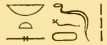
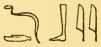
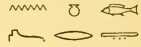
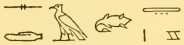
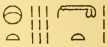
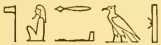
 , and twelve jackal-headed figures, who are walking on the Lake of Life,
 .
. , to a shrine in which the god Osiris, wearing the crown of the South, stands upon a serpent. Behind Osiris are the twelve gods, “who are behind the shrine,” and four gods, who preside over pits in the earth, and the “prince of destruction,” who holds a sceptre in his left
 in his right.
 .
.