Translate


Search This Blog

Featured Post

The Magic Book, c. 1100 BCE

Tales of Ancient Egypt:  Princess Ahura:  We were the two children of the King Merneptah, and he loved us very much, for he had ...

Showing posts with label History. Show all posts

Tuesday, January 30, 2018

Lecture: The history of wigs in Ancient Egypt


Ancient Egyptians are known by many as a historical symbol of ancient beauty, vanity, and hygiene. 


Appearance was very important in the country near the Nile River. The way people looked was a symbol of their wealth, status, and role in society. The desire for a beautiful body influenced fashion, but the climate and medical issues also formed a unique style.

Beauty in Ancient Egypt 

Ancient Egyptian hairstyles varied with social status, gender, and age. A slave could never have the same hairstyle as a free person, and the lower class could never have the same style of hair as the upper class. However, there were some similarities between them. Like nowadays, most people tried to follow the same fashion.

Generally, the hairstyle of children, be they boys or girls, was the same. Their hair was shaved off, with only a long lock of hair left on the side of the head. This style was related to the hieroglyphic symbol of a child or youth.

The princess Nsikhonsu, with long wavy brown hair


When the children grew older boys kept their shaved heads and girls wore their hair in plaits or something similar to a ponytail. Men usually wore their hair short, with their ears visible. But sometimes they preferred to have short curls covering their ears.

In the case of women, hairstyles were more advanced and unique. They often liked to have their hair smooth or with a natural wave. Women in ancient Egypt also liked to have long curls, but in the Old Kingdom period, they preferred short or chin length bobs.


A group of researchers based at the University of Manchester in the UK examined the hair from 18 mummies, most of them from during the early Ptolemaic Period. They took a close look at the hairs they found using microscopes. During analysis, the researchers discovered that the hair of nine mummies had an unknown substance on it. Chemical analysis revealed that it was made of fatty acids of animal and plant origin. The researchers were convinced that it was a sort of hair gel which was used by the Egyptians to hold their hair in a specific position. After death, the hair mummified naturally.

Wigs appeared for a few reasons. First of all, Egyptians didn't like to have gray or white hair. They used henna to avoid this problem, but in the dry Egyptian climate, wigs appeared as a better solution. Secondly, many saw this idea as more comfortable than having their own long hair. The examination of the aforementioned mummies suggests that the hair of ancient Egyptians, especially when they were older, was in bad condition.

The Popularity of Wigs

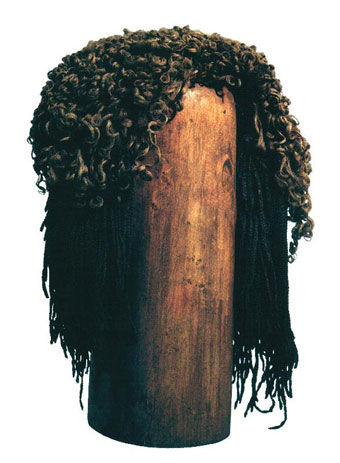
Wigs were very popular not only in Ancient Egypt, but also in Mesopotamia, Crete, Greece and Persia. Nonetheless, Egyptians improved the technique of making them to perfection. The most expensive royal wigs look like real hair. They were made of vegetable fiber such as linen, sheep’s wool, other types of animal hair, and human hair stiffened with beeswax. The cheapest ones were made of vegetable fiber, but royals only used the ones made of human hair. For both real hair and wigs, ancient Egyptians used fragrant oils like fir oil, almond oil, rosemary oil, and castor oil. They believed that the oils stimulated hair growth. Popular in ancient times, the seeds of fenugreek are still in use as a remedy for hair growth.

Wigs were used during daily life of the royals, but also at major festivals and events. Egyptian wigs usually were made in a structure similar to the helmet. Some of them were brightened blue, red or green, and decorated with precious stones and jewelry. People who belonged to the upper class liked to possess many wigs. The more wigs they owned, the higher their status was. Decorated with hair bands ending in tassels, with added braids and curls, over time the wigs gradually became bigger and bigger.

During the period of the Old and Middle Kingdom, two kinds of the wigs appeared as the most popular: the ones made of short and long hair. The hair was formed to make the forehead partly visible, with the ears and back of the neck fully covered.

The most classical style of wigs is a Nubian wig, a headdress worn in many periods in history, but especially popular during the 18th Dynasty and all the New Kingdom Period. In those times, wigs with luxurious decorations were a powerful symbol of fertility related to the one wore by the goddess Hathor. The wigs, known from tombs, reliefs and statues of Kiya, Nefertiti, Tiye and other women of this period, partly resemble the modern Afro hairstyle.

During the Third Intermediate Period, wigs were quite massive and heavy. Queen Isimkheb in 900 BC wore a wig which weighed so much that the queen needed help from her attendants to stand up. Nowadays, the wig is a part of the Cairo Museum collection. It was made of brown human hair held together by beeswax.

Wigs were mostly made by women. The human hair used by the wigmakers came from the clients of barbers or was brought by clients. Quite often the hair came from the client who ordered the wig. Sometimes it came from people who sold their hair or from slaves.

Wigs in the afterlife.

After death, people were often buried with their best wigs. They wanted to appear as wealthy and with beautiful hair in the afterlife. Because of this practice, many wigs have survived until now and they are parts of exhibitions around the world.

Women entertainers perform at a celebration in Ancient Egypt; the dancers are naked and the musician wears a typical pleated garment as well as the cone of perfumed fat on top of her wig that melts slowly to emit its precious odors; both groups wear extensive jewelry, wigs, and cosmetics; neither wear shoes - Thebes tomb c. 1400 BC. (Public Domain)

Legendary queens like Nefertiti, Cleopatra, and Nefertari were proud of their wigs and were regarded as great beauties. Many of them had shaved heads and their famous looks were partly made by the people who created the most impressive wigs of their kingdom.

Upper-class Egyptian men and women considered wigs an essential part of their wardrobe. Wearing a wig signaled a person's rank in Egyptian society. Although a shaved head was a sign of nobility during most of the Egyptian kingdoms, the majority of Egyptians kept their heads covered. Wigs were worn in place of headdresses or, for special occasions, with elaborate headdresses. Egyptian law prohibited slaves and servants from shaving their heads or wearing wigs.

The base of an Egyptian wig was a fiber-netting skullcap, with strands of human hair, wool, flax, palm fibers, felt, or other materials attached. The wig hair often stuck straight out from the skullcap, creating large, full wigs that offered wearers protection from the heat of the sun. Most often black, wigs were also other colors. Queen Nefertiti, who lived during the fourteenth century b.c.e., was known for wearing dark blue wigs, and festive wigs were sometimes gilded, or thinly coated in gold.

Wig hair was arranged in decorative styles throughout all the kingdoms of Egypt. During the earliest dynasties (which began around 3200 b.c.e.) and the Old Kingdom of Egypt (c. 2700–c. 2000 b.c.e.), both men and women wore closely cropped wigs with rows of short curls or slightly longer straight hair. In later kingdoms, some women began to grow their hair longer and wore wigs of greater length and bulk that showed their natural hair beneath. 


By the time of the Middle Kingdom (c. 2000–c. 1500 b.c.e.), bulky wigs with hair coils draping forward over each shoulder were favored. During the New Kingdom (c. 1500–c. 750 b.c.e.) men's wigs became much longer in the front than in the back and less bulky, but women's wigs became larger, completely covering the shoulders. For special occasions, wigs were decorated with gold, braided with colorful ribbons, or adorned with beads. Wigs were made even more elaborate with the addition of golden bands, caps, and fancy headbands.


The hot climate of Egypt made it uncomfortable for men to wear beards. However, Egyptians believed that the beard was manly, so they developed artificial beards, or beard wigs. Men of royal rank tied stubby beards on their chins for official or festive occasions. 


The king's beard was longer than that of other men and was usually worn straight and thick. Gods were depicted with thinner beards that curled up at the tip. Egyptians believed that kings were descended from the gods, and in some ceremonies kings would wear a curved beard to show that they represented gods.

Here are 10 facts about wigs worn in Ancient Egypt

1. What were Egyptian wigs made of?

The nicest wigs were made from human hair. These were also the most expensive. An accounts list from the town of Kahun put hair’s value in the same category as gold.

For the middle class, particularly those who couldn’t afford wigs made completely out of human hair, they would purchase a blended wig, which was constructed of part human hair, part vegetable fibers.

Wigs could also be made of sheep’s wool.

The absolute cheapest wigs were made out of 100% vegetable fibers.

2. Who could wear wigs, and who couldn’t?

Wigs were part of daily life in ancient Egypt. Both men and women could wear wigs. Men’s wigs were often shorter than women’s wigs.

Children did not wear wigs. Instead, girls either braided their hair or wore pigtails, and boys often sported shaved heads. Some kids wore what's called a side-lock, which was a braid on one side.

Priests, also, did not generally wear wigs and preferred to shave their heads instead.

Slaves and servants were prohibited by law from wearing wigs. They weren’t even allowed to shave their heads.

3. Why did Egyptians wear wigs?

In ancient Egypt, wigs served multiple purposes.
  • Decoration. People liked the way wigs looked.
  • Shade. Given that wigs could often be quite large and thick, the hairpieces could have acted as sun hats. They would have offered a degree of shade.
  • Special occasions and religious ceremonies. People would pull out their most expensive wigs for these occasions, rather than wear the simpler wigs they wore for everyday use.
  • To cover thinning hair. Even back then, people were concerned about hair loss. We know this because archaeologists have found instructions and recipes for hair growth remedies

4. What color were Egyptian wigs?

Most wigs were colored deep black. Less popular, but equally impressive, were blond wigs.

Queen Nefertiti, however, bucked both of these trends and had a fondness for dark blue wigs, which she made famous. What a fashion-forward rebel!

5. How were wigs decorated?

There were countless ways to adorn these valuable hairpieces. First, wigs could be curled and braided. Bangs extensions could be added. Men preferred simpler styles, while women loved adding lots of extra ‘bling.’ Here some examples of wig adornments:
  • golden tubes
  • jewelry chains
  • glittery pins and clips
  • ribbons woven through braids
  • tassels
  • flowers
  • tiaras
  • colored strands
  • caps
  • headbands

6. How were wigs made from human hair?

Hair first had to be collected. It was extremely valuable, and people probably bartered or sold their hair to wig-makers in exchange for goods. Once a wig maker had the required amount, they first cleaned the hair of any lice eggs. Combs have been found with traces of the eggs still in the teeth!

After cleaning the hair, it was separated into various lengths. A wigmaker would coat the hair with a mix of resin and beeswax to make it easier to work with.

Hairdressers would then weave the hair through a cap made of fine netting (which itself was often made of hair) and affix the strands using more wax.

After creating the basic wig, styles would be applied such as braids and curls. The wax and resin would help keep the styles in place through endless wearings, even in the Egyptian heat.

Fun fact: One particularly impressive wig artifact contains 120,000 individual hairs!

7. Who made wigs?

Ready made wigs were made in factories, archaeologists have uncovered the remains of wig factories. Wig boxes have been found in tombs, and may have come from the factories with the wigs inside.

Barbers also made wigs, and so did women. It was considered a very respectable profession.

8. How were wigs cared for?

Because they were so expensive, Egyptians spent effort caring for them.

Since they couldn’t be washed, wigs would be perfumed instead using scented petals, essential oils, and wood chips such as cinnamon bark.

Oils and emollients made from animal or vegetable fats could be applied to keep the wigs shiny and supple.

9. What the heck is a beard wig?


Beard wigs were false beards made of human hair or wool that were worn using hooks that fastened behind each ear.

Beard wigs were braided and knotted into a tight, solid rectangle or tube shape that hung straight down from the chin. They became so popular that even the gods were depicted wearing beard wigs.

Beard wigs became a symbol of pharaonic power, worn to show that they were living gods on earth. Even some of Egypt’s queens, such as Pharaoh Hatshepsut, wore beard wigs during certain ceremonies for this purpose.

10. How did wig styles change?

Just like modern fashion is always changing, so did wig fashions change and evolve in ancient Egypt.

Old Kingdom wigs
: These were short and either straight or with rows of short overlapping curls.


Middle Kingdom Wigs: Most people wore one of two styles: a short wig with bangs made of small curls that overlapped one another like shingles. The bangs were short enough to show some forehead, while the side and back covered the ears and neck. The alternative during this time was a long, bulky wig with bangs that framed the face, while the longer back section was formed into waves or spirals that were draped over each shoulder.

Wig rings of Sithathoryunet (Egypt, B. Sit-Hathor-yunet was a daughter of Senwosret II


New Kingdom Wigs: Many people wore wigs with groupings of long, tassel-ended tails. Women’s wigs became even larger and bulkier, and decorations became hugely popular, including beads and ribbons, and fancy caps. Men preferred less bulky wigs, and ones that were longer in the front than in the back.

An Ancient Egyptian wig worn in the New Kingdom,
this is known because of the gold detailing on the braids.


Amarna Period Wigs: During this time, styles became short and simple.


Final Note:

Like any fashion form any civilization you can see that through time styles changed from being very basic to very complex and decorative and like ours it will repeat in some form or another.

Thursday, November 16, 2017

TITLES WOMEN HAD IN ANCIENT EGYPT


All societies, ancient and modern, have sought to find ways to acknowledge the people who contribute more than most to their community. Medals are handed out to soldiers who perform particularly heroic deeds. Pictures and statues of leaders are displayed in public places. One very common method of honoring special people is to give them a title. Countess, duke and duchess would be examples used today in parts of Europe.

Ancient Egypt was a very hierarchical society, and as you might expect, titles were very important. There were three ways by which women could acquire a title: inheritance, marriage and merit. We know that all three of these ways were in operation, but at this point we do not have sufficient evidence to do more than guess which method was used for a specific title or which method a specific woman used to earn her titles.

The highest ranking women at any one time were the King's Mother and the King's Great Wife. Egyptian kings could and did have many wives. All bore the title King's Wife, but it was the Great Wife who took precedence at special ceremonies and it was her son who was first in line to inherit the throne. Occasionally a king, Amunhotep III, for example, is known to have had two Great Wives living at the same time. Whenever they were shown together in the same painting, however, only the senior was shown with the title; the other was then simply called King's Wife. As might be expected, there was considerable prestige attached to the titles of King's Sister and King's Daughter, whether the holder be related to the current king or his predecessor.

It will only take a few generations before the descendents of a King's Sister or a King's Brother will have to move out of the palace and live on their own. Such people could no longer consider themselves related to the current king, but they did form an aristocracy that could be called on to fill leadership roles in local governments. The most prominent men in this group bore the title Hereditary Nobleman (rpat). The female equivalent was Hereditary Noblewoman (rtpat). Older texts translated this word as "Hereditary Princess", but that expression has been abandoned as it called to mind the now discredited theory of an "Heiress Princess" whose husband became king. Also, not all the holders of this title were princesses in the sense that they were related to the reigning monarch. Since nobility implies heredity anyway, it might be simpler and more accurate to call her Noblewoman. The title corresponds to the British Duchess or the European Countess.

The titles Ornament of the King (Xkrt nsw) and Sole Ornament of the King (Xkrt nsw watt) were equivalent to the modern expression, Lady in Waiting. The word Sole did not mean unique but simply signified a higher rank. Further down the social ladder was the Servant of the Ruler. The women who held this title were married to rather junior officials so the "ruler" was likely a governor and not the king.

All of the above titles carried a large amount of prestige, but no responsibility or authority. A second category identifies a particular job and ranged from the lowly position of washerwoman all the way up to the one woman who held the rank of Vizier, the top bureaucrat in the country. The percentage of women in high office was relatively small but significant enough to suggest it was more than an aberration. Some scholars have argued that women could supervise other women but could not supervise men.

The most common titles in this category referred to a religious function. In the Old Kingdom the priesthood was a part time job filled by community minded members of the middle and upper classes, who devoted one or two months a year to the service of their god. Many women bore the title Priestess (Hmt nTr) of Hathor, Neith and occasionally some other deity. Musicians (xnr) danced and played musical instruments under the leadership of the Great Musician (wrt xnr). The usual title for women in the choir was Singer (Hsyt)


By the New Kingdom the priesthood gradually turned into a full time profession. Although two women held the very prominent office of Second Prophet of Amun and Mut respectively, women were largely confined to musical roles in the temple. A very common title at this time was Musician (Smayt) These women regularly served both gods and goddesses and were shown on temple and tomb walls carrying a sistrum or tambourine. 

Nephthys,
Sister of Isis, Mistress of the House

The title Mistress of the House (nbt pr) was available to any woman who owned or was married to someone who owned a house. Many women bore the title with pride, but others seem to have regarded it as a meaningless affectation. In legal documents women were often referred to as citizeness (anx niwt).

Thursday, October 26, 2017

Women in Ancient Egypt


In the ancient world, Egypt stood out as a land where women were treated differently.

...but the Egyptians themselves, in most of their manners and customs, exactly the reverse the common practices of mankind. For example, the women attend the markets and trade, while the men sit at home and weave at the loom... The women likewise carry burdens upon their shoulders while the men carry them upon their heads... Sons need not support their parents unless they chose, but daughters must, whether they chose to or not.


-- Herodotus

In Egypt, women were much more free than their counterparts in other lands. Though they were not equal with men, both men and women in Egypt accepted that everyone had their roles in ma'at (the natural order of the universe), and that the roles of men and women were different.


Women in Egyptian Art


From the formal paintings on tombs, the Egyptian stereotype of a woman was that of wife and mother, the husband being the head of the household. She worked indoors (mostly), out of the Egyptian sun, so her skin was lighter than that of her male counterparts. (When she died, she was painted green, as were the men, as this was the color of rebirth.) Women were seen to be slim and beautiful, even though a fat stomach in men equated with wealth and power (the rich could afford to eat more than the poor!) Noble women did not work in these paintings, but women are seen to be dancers, musicians, acrobats, prostitutes, maids, kitchen staff, field workers and much, much more.

Sculpture, unlike painting, usually only showed noble or influential people. When women were in a sculpture, she was usually part of a husband-and-wife or family group, with the wife physically supporting her husband with an arm around his shoulder. In the sculptures of a pharaoh and his wife, she was normally on a smaller scale, indicating the pharaoh's godly aspect, while the wife was only human. (Normal sculptures had the husband and wife in proportion to each other.) Women only sculptures are very rare.


Women in Writing


Ancient Egyptian letters, though, show the more human side of Egypt. There were love letters, poetry, private law cases and personal letters between friends and family members. Ostraca (pottery chips, and stone chips) were used as note pads by the Egyptians, showing their thoughts and messages to themselves. Not surprisingly, ancient Egyptian relationships were about the same as today. They loved and hated, they held hands to show affection and love, they had romantic moments and bitter fights, they gossiped and chatted, just as we do today. (Note, though, that the Egyptians were big on double entendres and were not prudish, as we westerners tend to be today. 'Unseemly' things have been left out or ignored, at times, in translation. For example, the sun god Ra masturbated, and his semen turned into his children, Shu and Tefnut!) But one must remember that the writings were written by men, as women were, on the whole, illiterate, so many topics that would have only been of interest to women are absent from Egyptian writings.

As an interesting side note, one ancient poem showed that, just as today, women had to put up with men harassing them:


She makes all men turn their necks
to look at her.
One looks at her passing by,
this one, the unique one.

Medical writings, though, show us what sort of problems the Egyptian woman faced. Ailments, symptoms and suggestions for cures for women were all recorded by the ancient Egyptian doctors. The modern study of the mummies also show these problems, and more general things about her. She was relatively short with dark hair and eyes, and light brown skin. She lived to approximately forty years, if she survived past childhood and pregnancy. Life was hard to both women and men, even with the Egyptian doctors. Most advice, though, was a mixture of ancient medicine and magic spells, scientific knowledge combined with superstition! They believed that every medical problem (not caused by an accident) was the result of demons or parasitic worms. The way they dealt with that was to alleviate the symptoms, and use spells to get rid of the cause. It's not surprising that the life expectancy of the ancient Egyptian was pretty low!

Prescription for safeguarding a woman whose vagina is sore during movement: You shall ask her "What do you smell?" If she tells you "I smell roasting," then you shall know that it is nemsu symptoms from her vagina. You should act for her by fumigating her with whatever she smells as roasting.


-- Kahun Medical Papyrus

Women suffered from deadly diseases such as smallpox, leprosy, spina bifida, polio and many, many more. Even smaller problems, such as diarrhea and cuts, could still prove fatal! Almost everyone suffered from rheumatism and abscessed teeth (the desert sands got into most Egyptian foods.) Doctors or scribes, other than giving advice for such conditions, occasionally even got into giving advice for such things as 'female troubles' and tips for the complexion! In ancient fiction, women tended to be secondary figures to the plot. She was the wife, daughter or mother, left behind while the man went off on his adventure. This points towards the fact that written tales were written by men, for men. It is not until the end of the Dynastic period that women started actually having characters in stories. Mostly they were the bad women of the plot. For example, in the Tale of the Two Brothers, as in the story of Joseph in Egypt, the woman was married (in this case, to one of the brothers), yet she made advances to the hero of the story. He rejected her, then in revenge, the told her husband that the hero had raped her. In this story, even the hero (who avoids this trap) married, and was betrayed by an unfaithful wife!

Love songs and romantic poems had a much more favorable image of women. Semi-erotic, they showed women who expressed their own sexuality, showing that women desired men just as much as men desired women. References to sexual intercourse were freely written, showing Egypt's relaxed attitude towards sexual relationships.


Women, Food and Drink


When it comes to food and drink, women could eat and drink as much as their male counterparts. Although Egyptians tend not to be depicted actually eating food, they were shown drinking. (The Egyptian for 'to pour' sti also meant 'to impregnate' (depending on the added determinative hieroglyph), so these scenes could well be visual puns!) Women were even depicted as getting drunk and throwing up, which was seen as a good Egyptian joke!


Women's Education and Career


Other than scribe god Thoth's wife Seshat, the goddess of writing, very few women were seen with a scribe's writing kit, let alone actually seen writing! These high ranking or royal women were often given a private tutor, who taught them reading and writing. The female pharaoh Hatshepsut's daughter, Neferura, had a private tutor, Senmut (one of Hatshepsut's favorite courtiers). Surprisingly, some ostraca suggest that some ordinary housewives were able to read and write. There were laundry lists, female fashion advice and other female concerns found! These women, though, would be the wives of educated men, so this was not common through the land of Egypt.

Despite this, due to the fundamental biology of a women, she only had a certain range of jobs available to her (though this can be disputed). She was married at the age when the males were starting their job training, and naturally became mother and housewife. Though a wife could become her husband's official representative from time to time. For example, if a husband was absent, she could take charge of his business for him. When a high-class woman found little to occupy her time, a religious position such as a priestess for a certain god or goddess, was encouraged. She was expected to make contributions to the temple - she was not just a "pretty face" for the particular temple she worked for.

Women with talent could enter jobs in the music (which has links to sexuality), weaving or mourning (the women hired to grieve at funerals) industries, while those well connected women could get professional positions such as domestic supervisors or domestic administrators. Women who took people into their service took women, the men took men into their service. Maids were for the mistress, man servants for the master of the house. (Sexual segregation seems to be wide spread, even in the temples - it was mostly women who served goddesses, and men who served gods.) Some of the job titles women could hold were "Supervisor of the Cloth", "Supervisor of the Wig Workshop", "Supervisor to the Dancers of the Pharaoh" and "Supervisor of the Harem of the Pharaoh". From this, it is known that these were female-linked occupations, because females were in the managerial-type role. One woman, Lady Nebet, even managed to get to the powerful position as Vizier, the right hand 'man' of the pharaoh, but it is known that her husband performed the duties of this role. Other women managed to become 'stewards' and 'treasurers'.


Women's Beauty, Hygiene and Fashion


In Egypt, cosmetics was not a luxury, it was a way of life! Men and women followed the latest fashions in both hairstyles and make-up. Cosmetics, more so, was life or death in Egypt - kohl to rim the eyes was (almost) equal to sunglasses today! Everyone, from the poor to the pharaohs, had make-up... the difference being the range and quality of the products used. As for hair, rich Egyptians shaved their heads and used wigs to keep up with the latest styles - these wigs were even made of human hair! Perfumed oils were used to rub into the scalp after shampooing (if they had their own hair), and perfumed fat was placed on top of the head (seen in many party scenes), to melt into the hair and give off a pleasing scent. Due to the climate, Egyptians were fixated on cleanliness - so much so that foreigners (thought to be dirty) and those who didn't have access to much personal hygiene were despised. Men and woman shaved and plucked off all of their body hair using tweezers, knives and razors, be them of flint or metal (they used oil as shaving lotion - moisturizing oils were also rubbed into the skin as protection against the harsh, hot climate). Not only was this for beauty, but it also rid the Egyptians of body lice. To clean themselves while bathing, the Egyptians used natron (which was also used when mummifying the dead, followed by linen towels for drying. The rich had facilities in their places of residence while the majority of Egyptians bathed in the Nile (which was also used for drinking, cooking water, laundry and sewerage - water-bourn diseases were common). The Egyptians even had deodorants! As for menstruation, there is very little written (men did not find this important enough to write about), but there is evidence that the Egyptian women used folded pieces of linen as sanitary towels that were laundered and reused.The term 'purification' and 'cleansing' were used to describe menstruation, and men tried to avoid contact with women at this time - it was seen as ritually unclean.

Nudity in ancient Egypt, when in its correct place, was not offensive or uncomfortable. Various jobs required that people went nude, such as fishermen and other manual laborers for instance, as did ones social status. The very poor tended to go nude. Female servant girls, dancers, acrobats and prostitutes went around totally or semi-nude for their jobs. The high class, though, seemed to love showing off their clothing and the latest fashions which changed much over time. However, there was always jewelry, including necklaces, rings, anklets, bracelets. Even the poor wore jewelry (though not of gold or precious gems), but this was not only decorative, but usually a good-luck symbol or protective amulet.


Women and Law


When it comes to law, legal correspondences show that (in theory) women stood as equals to the men of the same class. Egyptian women could inherit, she could purchase and own property and slaves, and she could sell her property and slaves as she wished. She could make legal contracts, start law proceedings (and hence, be tried for crimes) and borrow and lend goods. She was allowed to live life as a single woman, without male guardians. (In the rest of the ancient world, men dominated women, so this is very, very different from the norms of the rest of the world!) One of the reasons that this freedom might have occurred, is because decent could be passed through either the male or female lines, a pharaoh could only become pharaoh if he married a woman of royal blood, as women carried the royal line! (Editor's note: This view is now widely disputed among Egyptologists).

In marriage, assets acquired together by the couple were shared - a wife was entitled to a share of these communal assets. She could pass on her own assets, and her share of the marital assets, to her children as she saw fit.

I am a free woman of Egypt. I have raised eight children and have provided them with everything suitable to their station in life. But now I have grown old and behold, my children don't look after me any more. I will therefore give my goods to the ones who have taken care of me. I will not give anything to the ones who have neglected me.


-- Lady Naunakhte's Last Will and Testament

A husband could even pass the full amount of his assets on to his wife (rather than his siblings or children) in his will. He could even adopt his wife to make sure that his siblings could not inherit his assets - she was then entitled to both the wifely portion of his goods, as well as the potion given to his children!

My husband made a writing for me and made me his child, having no son or daughter apart from myself.


-- Nenufer, Wife of Nebnufer


Ancient Egyptian Women


Egyptian women had a free life, compared to her contemporaries in other lands. She wasn't a feminist, but she could have power and position if she was in the right class. She could hold down a job, or be a mother if she chose. She could live by herself or with her family. She could buy and sell to her hearts content. She could follow the latest fashions or learn to write if she had the chance. She loved and laughed and ate and drank. She partied and got sick. She helped her husband, she ran her household. She lived a similar life to that of her mother and grandmother in accordance with ma'at. She was an ancient Egyptian woman with hopes and dreams of her owe, which is not too much different from today's woman.

Tuesday, October 24, 2017

Ancient Egyptian religion


Ancient Egyptian religion was a complex system of polytheistic beliefs and rituals which were an integral part of ancient Egyptian society. It centered on the Egyptians' interaction with many deities who were believed to be present in, and in control of, the forces of nature. Rituals such as prayers and offerings were efforts to provide for the gods and gain their favor. Formal religious practice centered on the pharaoh, the king of Egypt, who was believed to possess a divine power by virtue of his position. He acted as the intermediary between his people and the gods and was obligated to sustain the gods through rituals and offerings so that they could maintain order in the universe. The state dedicated enormous resources to Egyptian rituals and to the construction of the temples.


The religion had its roots in Egypt's prehistory and lasted for more than 3,000 years. The details of religious belief changed over time as the importance of particular gods rose and declined, and their intricate relationships shifted. At various times, certain gods became preeminent over the others, including the sun god Ra, the creator god Amun, and the mother goddess Isis. For a brief period, in the theology promulgated by the Pharaoh Akhenaten, a single god, the Aten, replaced the traditional pantheon. Ancient Egyptian religion and mythology left behind many writings and monuments, along with significant influences on ancient and modern cultures.

Theology

The beliefs and rituals now referred to as "ancient Egyptian religion" were integral within every aspect of Egyptian culture. Their language possessed no single term corresponding to the modern European concept of religion. Ancient Egyptian religion was not a monolithic institution, but consisted of a vast and varying set of beliefs and practices, linked by their common focus on the interaction between the world of humans and the world of the divine. The characteristics of the gods who populated the divine realm were inextricably linked to the Egyptians understanding of the properties of the world in which they lived.[1]

Deities


The gods Osiris, Anubis, and Horus, in order from left to right
The Egyptians believed that the phenomena of nature were divine forces in and of themselves. These deified forces included the elements, animal characteristics, or abstract forces. The Egyptians believed in a pantheon of gods, which were involved in all aspects of nature and human society. Their religious practices were efforts to sustain and placate these phenomena and turn them to human advantage. This polytheistic system was very complex, as some deities were believed to exist in many different manifestations, and some had multiple mythological roles. Conversely, many natural forces, such as the sun, were associated with multiple deities. The diverse pantheon ranged from gods with vital roles in the universe to minor deities or "demons" with very limited or localized functions. It could include gods adopted from foreign cultures, and sometimes humans: deceased Pharaohs were believed to be divine, and occasionally, distinguished commoners such as Imhotep also became deified.
The depictions of the gods in art were not meant as literal representations of how the gods might appear if they were visible, as the gods' true natures were believed to be mysterious. Instead, these depictions gave recognizable forms to the abstract deities by using symbolic imagery to indicate each god's role in nature. Thus, for example, the funerary god Anubis was portrayed as a jackal, a creature whose scavenging habits threatened the preservation of the body, in an effort to counter this threat and employ it for protection. His black skin was symbolic of the color of mummified flesh and the fertile black soil that Egyptians saw as a symbol of resurrection. This iconography was not fixed, and many of the gods could be depicted in more than one form.
Many gods were associated with particular regions in Egypt where their cults were most important. However, these associations changed over time, and they did not mean that the god associated with a place had originated there. For instance, the god Monthu was the original patron of the city of Thebes. Over the course of the Middle Kingdom, however, he was displaced in that role by Amun, who may have arisen elsewhere. The national popularity and importance of individual gods fluctuated in a similar way.

Amun-Ra kamutef, wearing the plumed headdress of Amun and the sun disk representing Ra

Associations between deities

The Egyptian gods had complex interrelationships, which partly reflected the interaction of the forces they represented. The Egyptians often grouped gods together to reflect these relationships. Some groups of deities were of indeterminate size, and were linked by their similar functions. These often consisted of minor deities with little individual identity. Other combinations linked independent deities based on the symbolic meaning of numbers in Egyptian mythology; for instance, pairs of deities usually represent the duality of opposite phenomena. One of the more common combinations was a family triad consisting of a father, mother, and child, who were worshipped together. Some groups had wide-ranging importance. One such group, the Ennead, assembled nine deities into a theological system that was involved in the mythological areas of creation, kingship, and the afterlife.
The relationships between deities could also be expressed in the process of syncretism, in which two or more different gods were linked to form a composite deity. This process was a recognition of the presence of one god "in" another when the second god took on a role belonging to the first. These links between deities were fluid, and did not represent the permanent merging of two gods into one; therefore, some gods could develop multiple syncretic connections. Sometimes, syncretism combined deities with very similar characteristics. At other times it joined gods with very different natures, as when Amun, the god of hidden power, was linked with Ra, the god of the sun. The resulting god, Amun-Ra, thus united the power that lay behind all things with the greatest and most visible force in nature.

Unifying tendencies

Many deities could be given epithets that seem to indicate that they were greater than any other god, suggesting some kind of unity beyond the multitude of natural forces. In particular, this is true of a few gods who, at various times in history, rose to supreme importance in Egyptian religion. These included the royal patron Horus, the sun god Ra, and the mother goddess Isis. During the New Kingdom (c. 1550–1070 BC), Amun held this position. The theology of the period described in particular detail Amun's presence in and rule over all things, so that he, more than any other deity, embodied the all-encompassing power of the divine.
Because of theological statements like this, many past Egyptologists, such as Siegfried Morenz (de), believed that beneath the polytheistic traditions of Egyptian religion there was an increasing belief in a unity of the divine, moving toward monotheism. Instances in Egyptian literature where "god" is mentioned without reference to any specific deity would seem to give this view added weight. However, in 1971 Erik Hornung pointed out that the traits of an apparently supreme being could be attributed to many different gods, even in periods when other gods were preeminent, and further argued that references to an unspecified "god" are meant to refer flexibly to any deity. He therefore argued that, while some individuals may have henotheistically chosen one god to worship, Egyptian religion as a whole had no notion of a divine being beyond the immediate multitude of deities. Yet the debate did not end there; Jan Assmann and James P. Allen have since asserted that the Egyptians did to some degree recognize a single divine force. In Allen's view, the notion of an underlying unity of the divine coexisted inclusively with the polytheistic tradition. It is possible that only the Egyptian theologians fully recognized this underlying unity, but it is also possible that ordinary Egyptians identified the single divine force with a single god in particular situations.

Atenism

During the New Kingdom the pharaoh Akhenaten abolished the official worship of other gods in favor of the sun-disk Aten. This is often seen as the first instance of true monotheism in history, although the details of Atenist theology are still unclear and the suggestion that it was monotheistic is disputed. The exclusion of all but one god from worship was a radical departure from Egyptian tradition and some see Akhenaten as a practitioner of monolatry rather than monotheism, as he did not actively deny the existence of other gods; he simply refrained from worshipping any but the Aten. Under Akhenaten's successors Egypt reverted to its traditional religion, and Akhenaten himself came to be reviled as a heretic.

Other important concepts

Cosmology


The air god Shu, assisted by other gods, holds up Nut, the sky, as Geb, the earth, lies beneath.
The Egyptian conception of the universe centered on Ma'at, a word that encompasses several concepts in English, including "truth", "justice", and "order." It was the fixed, eternal order of the universe, both in the cosmos and in human society. It had existed since the creation of the world, and without it the world would lose its cohesion. In Egyptian belief, Ma'at was constantly under threat from the forces of disorder, so all of society was required to maintain it. On the human level this meant that all members of society should cooperate and coexist; on the cosmic level it meant that all of the forces of nature—the gods—should continue to function in balance. This latter goal was central to Egyptian religion. The Egyptians sought to maintain Ma'at in the cosmos by sustaining the gods through offerings and by performing rituals which staved off disorder and perpetuated the cycles of nature.
The most important part of the Egyptian view of the cosmos was the conception of time, which was greatly concerned with the maintenance of Ma'at. Throughout the linear passage of time, a cyclical pattern recurred, in which Ma'at was renewed by periodic events which echoed the original creation. Among these events were the annual Nile flood and the succession from one king to another, but the most important was the daily journey of the sun god Ra.
When thinking of the shape of the cosmos, the Egyptians saw the earth as a flat expanse of land, personified by the god Geb, over which arched the sky goddess Nut. The two were separated by Shu, the god of air. Beneath the earth lay a parallel underworld and undersky, and beyond the skies lay the infinite expanse of Nu, the chaos that had existed before creation. The Egyptians also believed in a place called the Duat, a mysterious region associated with death and rebirth, that may have lain in the underworld or in the sky. Each day, Ra traveled over the earth across the underside of the sky, and at night he passed through the Duat to be reborn at dawn.
In Egyptian belief, this cosmos was inhabited by three types of sentient beings. One was the gods; another was the spirits of deceased humans, who existed in the divine realm and possessed many of the gods' abilities. Living humans were the third category, and the most important among them was the pharaoh, who bridged the human and divine realms.

Colossal statue of the Pharaoh Ramesses II

Divine pharaoh

Egyptologists have long debated the degree to which the Pharaoh was considered a god. It seems most likely that the Egyptians viewed royal authority itself as a divine force. Therefore, although the Egyptians recognized that the Pharaoh was human and subject to human weakness, they simultaneously viewed him as a god, because the divine power of kingship was incarnated in him. He therefore acted as intermediary between Egypt's people and the gods. He was key to upholding Ma'at, both by maintaining justice and harmony in human society and by sustaining the gods with temples and offerings. For these reasons, he oversaw all state religious activity. However, the Pharaoh’s real-life influence and prestige could differ from that depicted in official writings and depictions, and beginning in the late New Kingdom his religious importance declined drastically.
The king was also associated with many specific deities. He was identified directly with Horus, who represented kingship itself, and he was seen as the son of Ra, who ruled and regulated nature as the Pharaoh ruled and regulated society. By the New Kingdom he was also associated with Amun, the supreme force in the cosmos. Upon his death, the king became fully deified. In this state, he was directly identified with Ra, and was also associated with Osiris, god of death and rebirth and the mythological father of Horus. Many mortuary temples were dedicated to the worship of deceased pharaohs as gods.

Afterlife

The Egyptians had elaborate beliefs about death and the afterlife. They believed that humans possessed a ka, or life-force, which left the body at the point of death. In life, the kareceived its sustenance from food and drink, so it was believed that, to endure after death, the ka must continue to receive offerings of food, whose spiritual essence it could still consume. Each person also had a ba, the set of spiritual characteristics unique to each individual. Unlike the ka, the ba remained attached to the body after death. Egyptian funeral rituals were intended to release the ba from the body so that it could move freely, and to rejoin it with the ka so that it could live on as an akh. However, it was also important that the body of the deceased be preserved, as the Egyptians believed that the ba returned to its body each night to receive new life, before emerging in the morning as an akh.
Originally, however, the Egyptians believed that only the pharaoh had a ba, and only he could become one with the gods; dead commoners passed into a dark, bleak realm that represented the opposite of life. The nobles received tombs and the resources for their upkeep as gifts from the king, and their ability to enter the afterlife was believed to be dependent on these royal favors. In early times the deceased pharaoh was believed to ascend to the sky and dwell among the stars. Over the course of the Old Kingdom (c. 2686–2181 BC), however, he came to be more closely associated with the daily rebirth of the sun god Ra and with the underworld ruler Osiris as those deities grew more important.

Judgment

During the late Old Kingdom (2686–2181 BC) and the First Intermediate Period (c. 2181–2055 BC), the Egyptians gradually came to believe that possession of a ba and the possibility of a paradisiacal afterlife extended to everyone. In the fully developed afterlife beliefs of the New Kingdom, the soul had to avoid a variety of supernatural dangers in the Duat, before undergoing a final judgment known as the "Weighing of the Heart". In this judgment, the gods compared the actions of the deceased while alive (symbolized by the heart) to Ma'at, to determine whether he or she had behaved in accordance with Ma'at. If the deceased was judged worthy, his or her ka and ba were united into an akh. Several beliefs coexisted about the akh's destination. Often the dead were said to dwell in the realm of Osiris, a lush and pleasant land in the underworld. The solar vision of the afterlife, in which the deceased soul traveled with Ra on his daily journey, was still primarily associated with royalty, but could extend to other people as well. Over the course of the Middle and New Kingdoms, the notion that the akh could also travel in the world of the living, and to some degree magically affect events there, became increasingly prevalent.

Writings

While the Egyptians had no unified religious scripture, they produced many religious writings of various types. Together the disparate texts provide a very extensive, but still incomplete, understanding of Egyptian religious practices and beliefs.

Mythology


Ra (at center) travels through the underworld in his barque, accompanied by other gods
Egyptian myths were metaphorical stories intended to illustrate and explain the gods' actions and roles in nature. The details of the events they recounted could change to convey different symbolic perspectives on the mysterious divine events they described, so many myths exist in different and conflicting versions. Mythical narratives were rarely written in full, and more often texts only contain episodes from or allusions to a larger myth. Knowledge of Egyptian mythology, therefore, is derived mostly from hymns that detail the roles of specific deities, from ritual and magical texts which describe actions related to mythic events, and from funerary texts which mention the roles of many deities in the afterlife. Some information is also provided by allusions in secular texts. Finally, Greeks and Romans such as Plutarch recorded some of the extant myths late in Egyptian history.
Among the significant Egyptian myths were the creation myths. According to these stories, the world emerged as a dry space in the primordial ocean of chaos. Because the sun is essential to life on earth, the first rising of Ra marked the moment of this emergence. Different forms of the myth describe the process of creation in various ways: a transformation of the primordial god Atum into the elements that form the world, as the creative speech of the intellectual god Ptah, and as an act of the hidden power of Amun. Regardless of these variations, the act of creation represented the initial establishment of maat and the pattern for the subsequent cycles of time.
The most important of all Egyptian myths was the myth of Osiris and Isis. It tells of the divine ruler Osiris, who was murdered by his jealous brother Set, a god often associated with chaos. Osiris' sister and wife Isis resurrected him so that he could conceive an heir, Horus. Osiris then entered the underworld and became the ruler of the dead. Once grown, Horus fought and defeated Set to become king himself. Set's association with chaos, and the identification of Osiris and Horus as the rightful rulers, provided a rationale for Pharaonic succession and portrayed the Pharaohs as the upholders of order. At the same time, Osiris' death and rebirth were related to the Egyptian agricultural cycle, in which crops grew in the wake of the Nile inundation, and provided a template for the resurrection of human souls after death.
Another important mythic motif was the journey of Ra through the Duat each night. In the course of this journey, Ra met with Osiris, who again acted as an agent of regeneration, so that his life was renewed. He also fought each night with Apep, a serpentine god representing chaos. The defeat of Apep and the meeting with Osiris ensured the rising of the sun the next morning, an event that represented rebirth and the victory of order over chaos.

Ritual and magical texts

The procedures for religious rituals were frequently written on papyri, which were used as instructions for those performing the ritual. These ritual texts were kept mainly in the temple libraries. Temples themselves are also inscribed with such texts, often accompanied by illustrations. Unlike the ritual papyri, these inscriptions were not intended as instructions, but were meant to symbolically perpetuate the rituals even if, in reality, people ceased to perform them. Magical texts likewise describe rituals, although these rituals were part of the spells used for specific goals in everyday life. Despite their mundane purpose, many of these texts also originated in temple libraries and later became disseminated among the general populace.

Hymns and prayers

The Egyptians produced numerous prayers and hymns, written in the form of poetry. Hymns and prayers follow a similar structure and are distinguished mainly by the purposes they serve. Hymns were written to praise particular deities. Like ritual texts, they were written on papyri and on temple walls, and they were probably recited as part of the rituals they accompany in temple inscriptions. Most are structured according to a set literary formula, designed to expound on the nature, aspects, and mythological functions of a given deity. They tend to speak more explicitly about fundamental theology than other Egyptian religious writings, and became particularly important in the New Kingdom, a period of particularly active theological discourse. Prayers follow the same general pattern as hymns, but address the relevant god in a more personal way, asking for blessings, help, or forgiveness for wrongdoing. Such prayers are rare before the New Kingdom, indicating that in earlier periods such direct personal interaction with a deity was not believed possible, or at least was less likely to be expressed in writing. They are known mainly from inscriptions on statues and stelae left in sacred sites as votive offerings.

Funerary texts


Section of the Book of the Dead for the scribe Hunefer, depicting the Weighing of the Heart.
Among the most significant and extensively preserved Egyptian writings are funerary texts designed to ensure that deceased souls reached a pleasant afterlife. The earliest of these are the Pyramid Texts. They are a loose collection of hundreds of spells inscribed on the walls of royal pyramids during the Old Kingdom, intended to magically provide pharaohs with the means to join the company of the gods in the afterlife. The spells appear in differing arrangements and combinations, and few of them appear in all of the pyramids.
At the end of the Old Kingdom a new body of funerary spells, which included material from the Pyramid Texts, began appearing in tombs, inscribed primarily on coffins. This collection of writings is known as the Coffin Texts, and was not reserved for royalty, but appeared in the tombs of non-royal officials. In the New Kingdom, several new funerary texts emerged, of which the best-known is the Book of the Dead. Unlike the earlier books, it often contains extensive illustrations, or vignettes. The book was copied on papyrus and sold to commoners to be placed in their tombs.
The Coffin Texts included sections with detailed descriptions of the underworld and instructions on how to overcome its hazards. In the New Kingdom, this material gave rise to several "books of the netherworld", including the Book of Gates, the Book of Caverns, and the Amduat. Unlike the loose collections of spells, these netherworld books are structured depictions of Ra's passage through the Duat, and by analogy, the journey of the deceased person's soul through the realm of the dead. They were originally restricted to pharaonic tombs, but in the Third Intermediate Period they came to be used more widely.
As Egypt became more modernized, its archaic practices were substituted with new and efficient scientific techniques. Some of these scientific advancements were related to the development of mummification. By enhancing their advanced practice of mummification, the Egyptians were able to reach a new level of excellency concerning afterlife.

Practices


First pylon and colonnade of the Temple of Isis at Philae.

Temples

Temples existed from the beginning of Egyptian history, and at the height of the civilization they were present in most of its towns. They included both mortuary temples to serve the spirits of deceased pharaohs and temples dedicated to patron gods, although the distinction was blurred because divinity and kingship were so closely intertwined. The temples were not primarily intended as places for worship by the general populace, and the common people had a complex set of religious practices of their own. Instead, the state-run temples served as houses for the gods, in which physical images which served as their intermediaries were cared for and provided with offerings. This service was believed to be necessary to sustain the gods, so that they could in turn maintain the universe itself. Thus, temples were central to Egyptian society, and vast resources were devoted to their upkeep, including both donations from the monarchy and large estates of their own. Pharaohs often expanded them as part of their obligation to honor the gods, so that many temples grew to enormous size. However, not all gods had temples dedicated to them, as many gods who were important in official theology received only minimal worship, and many household gods were the focus of popular veneration rather than temple ritual.
The earliest Egyptian temples were small, impermanent structures, but through the Old and Middle Kingdoms their designs grew more elaborate, and they were increasingly built out of stone. In the New Kingdom, a basic temple layout emerged, which had evolved from common elements in Old and Middle Kingdom temples. With variations, this plan was used for most of the temples built from then on, and most of those that survive today adhere to it. In this standard plan, the temple was built along a central processional way that led through a series of courts and halls to the sanctuary, which held a statue of the temple's god. Access to this most sacred part of the temple was restricted to the pharaoh and the highest-ranking priests. The journey from the temple entrance to the sanctuary was seen as a journey from the human world to the divine realm, a point emphasized by the complex mythological symbolism present in temple architecture. Well beyond the temple building proper was the outermost wall. In the space between the two lay many subsidiary buildings, including workshops and storage areas to supply the temple's needs, and the library where the temple's sacred writings and mundane records were kept, and which also served as a center of learning on a multitude of subjects.
Theoretically it was the duty of the pharaoh to carry out temple rituals, as he was Egypt's official representative to the gods. In reality, ritual duties were almost always carried out by priests. During the Old and Middle Kingdoms, there was no separate class of priests; instead, many government officials served in this capacity for several months out of the year before returning to their secular duties. Only in the New Kingdom did professional priesthood become widespread, although most lower-ranking priests were still part-time. All were still employed by the state, and the pharaoh had final say in their appointments. However, as the wealth of the temples grew, the influence of their priesthoods increased, until it rivaled that of the pharaoh. In the political fragmentation of the Third Intermediate Period (c. 1070–664 BC), the high priests of Amun at Karnak even became the effective rulers of Upper Egypt. The temple staff also included many people other than priests, such as musicians and chanters in temple ceremonies. Outside the temple were artisans and other laborers who helped supply the temple's needs, as well as farmers who worked on temple estates. All were paid with portions of the temple's income. Large temples were therefore very important centers of economic activity, sometimes employing thousands of people.

Official rituals and festivals

State religious practice included both temple rituals involved in the cult of a deity, and ceremonies related to divine kingship. Among the latter were coronation ceremonies and the sed festival, a ritual renewal of the pharaoh's strength that took place periodically during his reign. There were numerous temple rituals, including rites that took place across the country and rites limited to single temples or to the temples of a single god. Some were performed daily, while others took place annually or on rarer occasions. The most common temple ritual was the morning offering ceremony, performed daily in temples across Egypt. In it, a high-ranking priest, or occasionally the pharaoh, washed, anointed, and elaborately dressed the god's statue before presenting it with offerings. Afterward, when the god had consumed the spiritual essence of the offerings, the items themselves were taken to be distributed among the priests.
The less frequent temple rituals, or festivals, were still numerous, with dozens occurring every year. These festivals often entailed actions beyond simple offerings to the gods, such as reenactments of particular myths or the symbolic destruction of the forces of disorder. Most of these events were probably celebrated only by the priests and took place only inside the temple. However, the most important temple festivals, like the Opet Festival celebrated at Karnak, usually involved a procession carrying the god's image out of the sanctuary in a model barque to visit other significant sites, such as the temple of a related deity. Commoners gathered to watch the procession and sometimes received portions of the unusually large offerings given to the gods on these occasions.

Animal cults


The Apis bull
At many sacred sites, the Egyptians worshiped individual animals which they believed to be manifestations of particular deities. These animals were selected based on specific sacred markings which were believed to indicate their fitness for the role. Some of these cult animals retained their positions for the rest of their lives, as with the Apis bull worshiped in Memphis as a manifestation of Ptah. Other animals were selected for much shorter periods. These cults grew more popular in later times, and many temples began raising stocks of such animals from which to choose a new divine manifestation. A separate practice developed in the Twenty-sixth Dynasty, when people began mummifying any member of a particular animal species as an offering to the god whom the species represented. Millions of mummified cats, birds, and other creatures were buried at temples honoring Egyptian deities. Worshipers paid the priests of a particular deity to obtain and mummify an animal associated with that deity, and the mummy was placed in a cemetery near the god's cult center.

Oracles

The Egyptians used oracles to ask the gods for knowledge or guidance. Egyptian oracles are known mainly from the New Kingdom and afterward, though they probably appeared much earlier. People of all classes, including the king, asked questions of oracles, and, especially in the late New Kingdom their answers could be used to settle legal disputes or inform royal decisions. The most common means of consulting an oracle was to pose a question to the divine image while it was being carried in a festival procession, and interpret an answer from the barque's movements. Other methods included interpreting the behavior of cult animals, drawing lots, or consulting statues through which a priest apparently spoke. The means of discerning the god's will gave great influence to the priests who spoke and interpreted the god's message.

Popular religion

While the state cults were meant to preserve the stability of the Egyptian world, lay individuals had their own religious practices that related more directly to daily life. This popular religion left less evidence than the official cults, and because this evidence was mostly produced by the wealthiest portion of the Egyptian population, it is uncertain to what degree it reflects the practices of the populace as a whole.
Popular religious practice included ceremonies marking important transitions in life. These included birth, because of the danger involved in the process, and naming, because the name was held to be a crucial part of a person's identity. The most important of these ceremonies were those surrounding death (see "Funerary practices" below), because they ensured the soul's survival beyond it. Other religious practices sought to discern the gods' will or seek their knowledge. These included the interpretation of dreams, which could be seen as messages from the divine realm, and the consultation of oracles. People also sought to affect the gods' behavior to their own benefit through magical rituals (see "Magic" below).
Individual Egyptians also prayed to gods and gave them private offerings. Evidence of this type of personal piety is sparse before the New Kingdom. This is probably due to cultural restrictions on depiction of non-royal religious activity, which relaxed during the Middle and New Kingdoms. Personal piety became still more prominent in the late New Kingdom, when it was believed that the gods intervened directly in individual lives, punishing wrongdoers and saving the pious from disaster. Official temples were important venues for private prayer and offering, even though their central activities were closed to laypeople. Egyptians frequently donated goods to be offered to the temple deity and objects inscribed with prayers to be placed in temple courts. Often they prayed in person before temple statues or in shrines set aside for their use. Yet in addition to temples, the populace also used separate local chapels, smaller but more accessible than the formal temples. These chapels were very numerous, and probably staffed by members of the community. Households, too, often had their own small shrines for offering to gods or deceased relatives.
The deities invoked in these situations differed somewhat from those at the center of state cults. Many of the important popular deities, such as the fertility goddess Taweret and the household protector Bes, had no temples of their own. However, many other gods, including Amun and Osiris, were very important in both popular and official religion. Some individuals might be particularly devoted to a single god. Often they favored deities affiliated with their own region, or with their role in life. The god Ptah, for instance, was particularly important in his cult center of Memphis, but as the patron of craftsmen he received the nationwide veneration of many in that occupation.

Magic

The word "magic" is used to translate the Egyptian term heka, which meant, as James P. Allen puts it, "the ability to make things happen by indirect means". Heka was believed to be a natural phenomenon, the force which was used to create the universe and which the gods employed to work their will. Humans could also use it, however, and magical practices were closely intertwined with religion. In fact, even the regular rituals performed in temples were counted as magic. Individuals also frequently employed magical techniques for personal purposes. Although these ends could be harmful to other people, no form of magic was considered inimical in itself. Instead, magic was seen primarily as a way for humans to prevent or overcome negative events.

Amulet in the shape of the Eye of Horus, a common magical symbol
Magic was closely associated with the priesthood. Because temple libraries contained numerous magical texts, great magical knowledge was ascribed to the priests who studied these texts. These priests often worked outside their temples, hiring out their magical services to laymen. Other professions also commonly employed magic as part of their work, including doctors, scorpion-charmers, and makers of magical amulets. It is also likely that the peasantry used simple magic for their own purposes, but because this magical knowledge would have been passed down orally, there is limited evidence of it.
Language was closely linked with heka, to such a degree that Thoth, the god of writing, was sometimes said to be the inventor of heka. Therefore, magic frequently involved written or spoken incantations, although these were usually accompanied by ritual actions. Often these rituals invoked the power of an appropriate deity to perform the desired action, using the power of heka to compel it to act. Sometimes this entailed casting the practitioner or subject of a ritual in the role of a character in mythology, thus inducing the god to act toward that person as it had in the myth. Rituals also employed sympathetic magic, using objects believed to have a magically significant resemblance to the subject of the rite. The Egyptians also commonly used objects believed to be imbued with heka of their own, such as the magically protective amulets worn in great numbers by ordinary Egyptians.

Funerary practices

Because it was considered necessary for the survival of the soul, preservation of the body was a central part of Egyptian funerary practices. Originally the Egyptians buried their dead in the desert, where the arid conditions mummified the body naturally. In the Early Dynastic Period, however, they began using tombs for greater protection, and the body was insulated from the desiccating effect of the sand and was subject to natural decay. Thus the Egyptians developed their elaborate embalming practices, in which the corpse was artificially desiccated and wrapped to be placed in its coffin. The quality of the process varied according to cost, however, and those who could not afford it were still buried in desert graves.

The Opening of the Mouth ceremony being performed before the tomb
Once the mummification process was complete, the mummy was carried from the deceased person's house to the tomb in a funeral procession that included his or her friends and relatives, along with a variety of priests. Before the burial, these priests performed several rituals, including the Opening of the mouth ceremony intended to restore the dead person's senses and give him or her the ability to receive offerings. Then the mummy was buried and the tomb sealed. Afterward, relatives or hired priests gave food offerings to the deceased in a nearby mortuary chapel at regular intervals. Over time, families inevitably neglected offerings to long-dead relatives, so most mortuary cults only lasted one or two generations. However, while the cult lasted, the living sometimes wrote letters asking deceased relatives for help, in the belief that the dead could affect the world of the living as the gods did.
The first Egyptian tombs were mastabas, rectangular brick structures where kings and nobles were entombed. Each of them contained a subterranean burial chamber and a separate, above ground chapel for mortuary rituals. In the Old Kingdom the mastaba developed into the pyramid, which symbolized the primeval mound of Egyptian myth. Pyramids were reserved for royalty, and were accompanied by large mortuary temples sitting at their base. Middle Kingdom pharaohs continued to build pyramids, but the popularity of mastabas waned. Increasingly, commoners with sufficient means were buried in rock-cut tombs with separate mortuary chapels nearby, an approach which was less vulnerable to tomb robbery. By the beginning of the New Kingdom even the pharaohs were buried in such tombs, and they continued to be used until the decline of the religion itself.
Tombs could contain a great variety of other items, including statues of the deceased to serve as substitutes for the body in case it was damaged. Because it was believed that the deceased would have to do work in the afterlife, just as in life, burials often included small models of humans to do work in place of the deceased. The tombs of wealthier individuals could also contain furniture, clothing, and other everyday objects intended for use in the afterlife, along with amulets and other items intended to provide magical protection against the hazards of the spirit world. Further protection was provided by funerary texts included in the burial. The tomb walls also bore artwork, including images of the deceased eating food which were believed to allow him or her to magically receive sustenance even after the mortuary offerings had ceased.

History

Pre-dynastic and Early Dynastic periods


Narmer, a Predynastic ruler, accompanied by men carrying the standards of various local gods
The beginnings of Egyptian religion extend into prehistory, though evidence for them comes only from the sparse and ambiguous archaeological record. Careful burials during the Predynastic period imply that the people of this time believed in some form of an afterlife. At the same time, animals were ritually buried, a practice which may reflect the development of zoomorphic deities like those found in the later religion. The evidence is less clear for gods in human form, and this type of deity may have emerged more slowly than those in animal shape. Each region of Egypt originally had its own patron deity, but it is likely that as these small communities conquered or absorbed each other, the god of the defeated area was either incorporated into the other god's mythology or entirely subsumed by it. This resulted in a complex pantheon in which some deities remained only locally important while others developed more universal significance. As the time changed and the shifting of the empires changed like the middle kingdom, new kingdom, and old kingdom, usually the religion followed stayed within the border of that territory.
The Early Dynastic Period began with the unification of Egypt around 3000 BC. This event transformed Egyptian religion, as some deities rose to national importance and the cult of the divine pharaoh became the central focus of religious activity. Horus was identified with the king, and his cult center in the Upper Egyptian city of Nekhen was among the most important religious sites of the period. Another important center was Abydos, where the early rulers built large funerary complexes.

Old and Middle Kingdoms

During the Old Kingdom, the priesthoods of the major deities attempted to organize the complicated national pantheon into groups linked by their mythology and worshiped in a single cult center, such as the Ennead of Heliopolis which linked important deities such as Atum, Ra, Osiris, and Set in a single creation myth. Meanwhile, pyramids, accompanied by large mortuary temple complexes, replaced mastabas as the tombs of pharaohs. In contrast with the great size of the pyramid complexes, temples to gods remained comparatively small, suggesting that official religion in this period emphasized the cult of the divine king more than the direct worship of deities. The funerary rituals and architecture of this time greatly influenced the more elaborate temples and rituals used in worshiping the gods in later periods.

The pyramid complex of Djedkare Isesi
Early in the Old Kingdom, Ra grew in influence, and his cult center at Heliopolis became the nation's most important religious site. By the Fifth Dynasty, Ra was the most prominent god in Egypt, and had developed the close links with kingship and the afterlife that he retained for the rest of Egyptian history. Around the same time, Osiris became an important afterlife deity. The Pyramid Texts, first written at this time, reflect the prominence of the solar and Osirian concepts of the afterlife, although they also contain remnants of much older traditions. The texts are an extremely important source for understanding early Egyptian theology.
In the 22nd century BC, the Old Kingdom collapsed into the disorder of the First Intermediate Period, with important consequences for Egyptian religion. Old Kingdom officials had already begun to adopt the funerary rites originally reserved for royalty, but now, less rigid barriers between social classes meant that these practices and the accompanying beliefs gradually extended to all Egyptians, a process called the "democratization of the afterlife". The Osirian view of the afterlife had the greatest appeal to commoners, and thus Osiris became one of the most important gods.
Eventually rulers from Thebes reunified the Egyptian nation in the Middle Kingdom (c. 2055–1650 BC). These Theban pharaohs initially promoted their patron god Monthu to national importance, but during the Middle Kingdom, he was eclipsed by the rising popularity of Amun. In this new Egyptian state, personal piety grew more important and was expressed more freely in writing, a trend which continued in the New Kingdom.

New Kingdom

The Middle Kingdom crumbled in the Second Intermediate Period (c. 1650–1550 BC), but the country was again reunited by Theban rulers, who became the first pharaohs of the New Kingdom. Under the new regime, Amun became the supreme state god. He was syncretized with Ra, the long-established patron of kingship, and his temple at Karnak in Thebes became Egypt's most important religious center. Amun's elevation was partly due to the great importance of Thebes, but it was also due to the increasingly professional priesthood. Their sophisticated theological discussion produced detailed descriptions of Amun's universal power.
Increased contact with outside peoples in this period led to the adoption of many Near Eastern deities into the pantheon. At the same time, the subjugated Nubians absorbed Egyptian religious beliefs, and in particular, adopted Amun as their own.

Akhenaten and his family worshipping the Aten
The New Kingdom religious order was disrupted when Akhenaten acceded, and replaced Amun with the Aten as the state god. Eventually he eliminated the official worship of most other gods, and moved Egypt's capital to a new city at Amarna. This part of Egyptian history, the Amarna period, is named after this. In doing so, Akhenaten claimed unprecedented status: only he could worship the Aten, and the populace directed their worship toward him. The Atenist system lacked well-developed mythology and afterlife beliefs, and the Aten seemed distant and impersonal, so the new order did not appeal to ordinary Egyptians. Thus, many probably continued to worship the traditional gods in private. Nevertheless, the withdrawal of state support for the other deities severely disrupted Egyptian society. Akhenaten's successors restored the traditional religious system, and eventually they dismantled all Atenist monuments.
Before the Amarna period, popular religion had trended toward more personal relationships between worshippers and their gods. Akhenaten's changes had reversed this trend, but once the traditional religion was restored, there was a backlash. The populace began to believe that the gods were much more directly involved in daily life. Amun, the supreme god, was increasingly seen as the final arbiter of human destiny, the true ruler of Egypt. The pharaoh was correspondingly more human and less divine. The importance of oracles as a means of decision-making grew, as did the wealth and influence of the oracles' interpreters, the priesthood. These trends undermined the traditional structure of society and contributed to the breakdown of the New Kingdom.

Later periods

In the 1st millennium BC, Egypt was significantly weaker than in earlier times, and in several periods foreigners seized the country and assumed the position of pharaoh. The importance of the pharaoh continued to decline, and the emphasis on popular piety continued to increase. Animal cults, a characteristically Egyptian form of worship, became increasingly popular in this period, possibly as a response to the uncertainty and foreign influence of the time. Isis grew more popular as a goddess of protection, magic, and personal salvation, and became the most important goddess in Egypt.

Serapis
In the 4th century BC, Egypt became a Hellenistic kingdom under the Ptolemaic dynasty (305–30 BC), which assumed the pharaonic role, maintaining the traditional religion and building or rebuilding many temples. The kingdom's Greek ruling class identified the Egyptian deities with their own. From this cross-cultural syncretism emerged Serapis, a god who combined Osiris and Apis with characteristics of Greek deities, and who became very popular among the Greek population. Nevertheless, for the most part the two belief systems remained separate, and the Egyptian deities remained Egyptian.
Ptolemaic-era beliefs changed little after Egypt became a province of the Roman Empire in 30 BC, with the Ptolemaic kings replaced by distant emperors. The cult of Isis appealed even to Greeks and Romans outside Egypt, and in Hellenized form it spread across the empire. In Egypt itself, as the empire weakened, official temples fell into decay, and without their centralizing influence religious practice became fragmented and localized. Meanwhile, Christianity spread across Egypt, and in the third and fourth centuries AD, edicts by Christian emperors and iconoclasm by local Christians eroded traditional beliefs. While it persisted among the populace for some time, Egyptian religion slowly faded away.

Legacy


Altar to Thoth of a Kemetic follower.
Egyptian religion produced the temples and tombs which are ancient Egypt's most enduring monuments, but it also influenced other cultures. In pharaonic times many of its symbols, such as the sphinx and winged solar disk, were adopted by other cultures across the Mediterranean and Near East, as were some of its deities, such as Bes. Some of these connections are difficult to trace. The Greek concept of Elysium may have derived from the Egyptian vision of the afterlife. In late antiquity, the Christian conception of Hell was most likely influenced by some of the imagery of the Duat. Biblical accounts of Jesus and Mary may have been influenced by that of Isis and Osiris. Egyptian beliefs also influenced or gave rise to several esoteric belief systems developed by Greeks and Romans, who considered Egypt as a source of mystic wisdom. Hermeticism, for instance, derived from the tradition of secret magical knowledge associated with Thoth.