Translate


Search This Blog

Featured Post

The Magic Book, c. 1100 BCE

Tales of Ancient Egypt:  Princess Ahura:  We were the two children of the King Merneptah, and he loved us very much, for he had ...

Showing posts with label tombs. Show all posts

Tuesday, July 18, 2017

The Valley of the Kings


The Valley of the Kings was the royal cemetery for 62 Pharaohs and is located on the west bank at Luxor. The only entrance to this place was a long narrow winding path. This was a secret place, where sentries were placed at the entrance of the Valley, as well as along the top of the hills, in the hopes of discouraging tomb robbers, who had in the past plundered all royal tombs, including the treasures of the Pyramids! Some thefts were probably carefully planned, but others were spur of the moment, as when an earlier tomb was accidentally discovered while cutting a new one and workmen took advantage of the opportunity. This may have happened when KV 46 was found during the cutting of KV 4 or KV 3 nearby. The tombs in the Valley range from a simple pit (e.g. KV 54), to a tomb with over 121 chambers and corridors ( KV 5)


John Gardiner Wilkinson first established the present numbering system, in 1827, as part of his preparation of a map of Thebes. Wilkinson painted the numbers 1 through 21 at the entrances of the tombs that were then visible. The numbers were assigned geographically, from the entrance to the Valley southward. Since Wilkinson's day, tomb numbers have been assigned in chronological order of discovery, KV 62 (Tutankhamen) being the most recent. Wilkinson's is not the only system of tomb designation that has been used in the Valley though. Several explorers assigned numbers, letters or descriptive labels to the tombs, as the accompanying chart indicates, but Wilkinson's is the only system that is still in use. There are two main wings to the Valley of the Kings, west and east! You will find that eastern side has the majority of the tombs, the western part having very few, but including the tombs of Amenhotep III and Ay.

The earliest known tomb of the New Kingdom within the Valley of the Kings, is that of Tuthmoses I, who started to use the valley as a royal burial site. It is located in a desolate part of the valley, which is supposed to add greater protection as it was small enough to be closely guarded. The good quality of the stones gave the ancient Egyptians the chance to cut many tombs close to each other.

Most of the tombs were found already plundered! A few, like the tomb of Tutankhamen (KV 62) or that of Yuya and Thuyu (KV 46), contained thousands of precious artifacts. Some tombs have been accessible since antiquity, as Greek and Latin graffiti will attest. Some were used as dwellings, or as churches during the Greco-Roman and Byzantine Periods. Most of them have been discovered in the past two hundred years.


Some tombs, like KV 5, had been "lost," and their locations only recently rediscovered.

The very well known Egyptologist, Kent Weeks, who is still working in the valley, on many projects, among them the Theban mapping project, Mr. Kent weeks (Shown with the site author in the picture a bove) spent more than 6 years exploring and trying to uncoverthe secrets of this massive tomb. KV5 is the largest tomb ever found in the valley! Re-excavated in 1995, it contains at least 121 chambers andcorridors! Mr. Weeks believes that it was built for the children of Ramses II. On your way to the inner side of the valley,You can see KV5's entrance location (currently closed to the public)
Since 1922, and Howard Carter's discovery of the Tomb of Tutankhamen (KV 62), there had been no new tombs discovered in the valley until, on February 9, 2006, the Supreme Council of Antiquities of Egypt announced the discovery of a new tomb. Designated the number KV63, it was discovered by a joint effort between the University of Memphis (USA) and the Supreme Council of Antiquities of Egypt.This is one of the smaller tombs that have been found, consisting of a vertical shaft with an adjacent chamber at the bottom. Some artefacts have been found, but as this is an ongoing project, the details are still to be released

Presently, there are several archaeological projects currently at work in the Valley of the Kings.

Before the actual creation of the tombs is discussed, it is important that the tools, which the workers used, are examined, as well as the actual work crews. Though they are over three thousand years old, many of these tools have survived and in many cases are similar to tools used in construction today.

The first of these tools are the mallet and chisel, a pair of which were discovered and are now in the Royal Ontario Museum, Canada. The mallet is made from acacia wood and is well used, the chisel also being well used and constructed of bronze. Though they were not found in either Deir El-Medina or the Valley of the Kings, they have been dated to the 18th-20th Dynasties and so it can be safely assumed that they are the same type of tool that the tomb makers would have used. Many different types of chisel were used during tomb construction, from pointed tips to flat, broad tips, depending on the type of cut required.

Boning rods were an integral part of ensuring that horizontal surfaces were kept as straight as possible. A set of these were found with the two items above, and are also in the Royal Ontario Museum, Canada. Two workers would hold the boning rods with one of them also holding an identical piece of wood in his other hand. As he moves the piece of wood along the string, any protruding pieces of rock will be seen and can be cut away.

A vast assortment of other tools were used by the tomb makers; triangular level and plumb bobs, plumbs, squares, square levels, and drills, each with their very own specific piece of work to do. Measurement was made by cubits, though whether they were "small cubits" or "Royal cubits" is not always clear (A cubit was a forearm length divided into 6 palms or 24 fingers. The Royal cubit was divided into 7 palms or 28 fingers which corresponds with 20.9 inches per Royal cubit, 3 inches per palm, and ¾ inch per finger)

Pounders were usually made from dolerite, though gneiss or granodiorite could also be used, and tended to be shaped between round and oval, varying in size and weight. Often showing signs of battering and chipping, they were generally used for less precise work.

Polishers tended to be round, oval or flat with a smooth surface. They were produced from a variety of rock, including sandstone, flint, chert or basalt. Used for the final finishing of surfaces they often show signs of polish or abrasion from constant use.

The workers in the Valley of the Kings were all housed at Deir El-Medina, though they would often spend nights in the small enclave of huts built about halfway between the village and their workplace and some workers may even have spent their nights in one of the small huts which were scattered throughout the valley. Each workman had his own task to perform, whether they were stonemasons, draughtsmen, chisel-bearers, carpenters, artists or any one of the other trades which was represented within this community. From an ancient papyrus (Papyrus Salt 124) we know that work crews were separated into two different gangs, a right side and a left side, with a chief workman in charge of each "side".

During the Ramesside Period the workmen were known as the "Servants in the Place of Truth" and also the "Men of the Gang", a name which had come from the Egyptian military and navy referring to the Egyptian term "ist" which means gang or crew. The size of these gangs ranged from thirty to about one hundred and twenty, depending on the tomb being cut.

Work in the tombs depended on the length of time it took an oil filled lamp to burn and die, which was usually about four hours. This meant that the working day was divided into two shifts of four hours each, with a break for lunch and/or rest in between. The lamps were often in the shape of a bowl with a central jar made from one piece of clay. The central jar holds the twisted wick used in oil lamps, which was probably made out of linen coated with oil or animal fat to last longer and to provide light. Forget the illumination of tombs by reflected light off polished surfaces, as seen in the movie "The Mummy", as experiments have shown that this does not work. Also, the theory that says that the tombs would soon run out of air is a non-starter due to the tombs always being open; they were never closed until the Pharaoh was interred.

Scribes accounted for everything that went on in the valley, from the issuing of oil for the lamps to the visit of the vizier, as well as keeping an inventory of tools issued and returned, and these reports were periodically sent to the vizier so he would know what progress was being made. One particular scribe, Qenherkhepeshef, collected a library of reports and other important documents, and it is through him that many facts about life in Deir El-Medina, and the Valley of the Kings, is known. He, and his descendants, amassed a huge collection of papyri which included religious texts, official letters, poetry, stories, and magical and medical texts. They were discovered by French archaeologists at Deir El-Medina in 1928.

Once the King, vizier, architects and chief stonemasons had decided on a suitable site, work on cutting the tomb could commence. The workmen would be issued with the required tools, with this transaction being recorded by the scribe, who would also record its return. Large spike-like chisels would be hit with a mallet to break the rock, debris being removed by workers using leather or wicker baskets: limestone is a relatively soft stone and so work would have progressed at a reasonable pace, unless flint became an obstacle. The entrance doorway was shaped as soon as the workers had cut a space large enough for this operation to be conducted. Once sufficient depth into the mountain was achieved, a red line was painted on the ceiling to ensure that the stone cutters could follow a straight path, as well as it being used as a central point for measurements to be taken from, which could be used to make certain that all the walls were parallel to one another, angles of corners were correct and doorways were perpendicular. These red lines can still be seen inside some of the tombs today. The cutting of a tomb was a matter of great skill as the tombs had to run straight, unless a bend or corner was planned, and any aids which builders of external constructions could not be employed here.

Once work was progressing inside the passageway, smaller chisels were used to shape the corridors, leaving a rough surface for the pounders and polishers to finish. Because many tombs were finished at varying stages of completion, due to the death of the Pharaoh, it is easy to see how these workmen did their tasks. The rock was cut out in small blocks, leaving steps that would allow the stone cutters to work at a greater height without the need for scaffolding. Beyond the stepped portion the cutters continued to dig deeper into the mountain, shaping the ceiling as they dug deeper. Quite often niches were cut, and finished, at the same time as the corridor to save the following workers from having to use scaffolding.

In larger rooms pillars were created to support the ceiling. These were left rough at first, but axial lines were painted on them to assist in the final cutting and smoothing. These rooms also allowed for many workers to complete their tasks at the same time. The burial chamber of Hatshepsut-Meryet-Ra (KV42) revealed that plasters and painters were performing their tasks at the same time as the finishers and smoothers, due to the painted walls and yet the unfinished pillar and ceiling. This could be due to the sudden death of Hatshepsut-Meryet-Ra, and the seventy days in which they had to complete their work, but it does show that the workers would all work together if, and when, required.

When finishing the corridors one thing that had to be ensured was that the walls were not only parallel, but also perpendicular, and the tomb of Thutmose IV (KV43) has left the answer to how this was performed. Thutmose IV was an 18th Dynasty Pharaoh and the archaeological evidence shows that the work patterns, techniques and strategies that the work crews used, throughout the history of the Valley of the Kings and at Akhetaten, changed very little during this period. This tomb shows how plaster blobs were fixed to the walls to serve as plumb line pins.

Once the cutting crew had levelled the surfaces, getting the rock smoothed down to a smooth finish, the work of the cutting crew was complete. These finished surfaces could be extremely smooth allowing for careful studies to be made of the chisel marks left on the walls of tombs in order to determine the sizes and shapes of the implements.

As mentioned earlier, some tomb collisions did occur, which would have surely been avoided had some type of map been available to later workers. During the New Kingdom only three tombs accidentally encroached upon others, and it is surprising that this did not happen more often, especially when one considers how many tombs are in the valley.

The tomb of Siptah (KV47) broke into the tomb of Tia'a (KV32) and the design of the tomb was immediately altered, the intended burial chamber becoming another corridor. The ancient Egyptians simply repaired this accidental intrusion with large stone slabs.

Setnakhte's workers (KV11) broke into the tomb of Amenmeses (KV10) and abandoned work in this tomb. Ramesses III took over ( KV11), the workers changing its direction without further problems.

Whilst cutting (KV9) for Ramesses VI, the workers collided with (KV12)(an unknown occupant) and had to change their design to finish this tomb. This collision was repaired with a simple stone patch.

Monday, July 17, 2017

Funerary Compositions of ancient Egypt


From the end of Dynasty 5 onward, religious texts were inscribed in the burial chambers of royal tombs. The oldest surviving compositions, called Pyramid Texts because they were inscribed in pyramid burial chambers, were compilations of spells describing different aspects of the dead king's restoration and existence in the realm of the gods in the afterlife. For some unknown reason, Middle Kingdom rulers did not have any such texts inscribed in the burial chambers of their pyramids. Contemporary private burials, however, had a series of spells, called Coffin Texts because they were inscribed on coffins; many derived from or were influenced by the Pyramid Texts. The first descriptions of the netherworld appear as schematic "maps" on the inner floors on many of these coffins, and are called the Book of Two Ways.

New Kingdom Books of the Netherworld

New compositions appear for the first time in royal tombs of the New Kingdom. They consist of both figures and texts that describe the realm of the dead ruled by Osiris and the journey of the sun god Ra through this realm.


Book of Caverns

The modern name of this book was given because many of the figures are shown inside ovals that represent caves in the underworld. It is divided into only six sections, with the form of the sun god as a ram-headed man introducing the first four divisions. Bound enemies appear in the lowest register of the first five divisions, and two large figures of Nut and ithyphallic Osiris are found in the fifth division. In the sixth division, the concluding scene shows the dawning of the sun god as a scarab and a child emerging from the watery realm of creation.


Book of the Earth

The earliest appearance of scenes from this book is in the burial chamber of KV 8 (Merenptah), but the fullest version is in KV 9. Other tombs of Dynasties 19 and 20 have some scenes and texts derived from this composition in their burial chambers, such as KV 14, KV 11, KV 1, and KV 6. The composition does not follow an obvious narrative progression as other descriptions of the solar nightly journey do. (Egyptologists have divided the composition up in different ways: the system followed on this website is that of Piankoff, which distinguishes four parts, A-D.)

In the examples from KV 8, KV 9, KV 11 and KV 14, the same scenes recur on the side walls. Three registers on the left wall show the sun god Ra in his bark beneath a supine mummiform figure with overarching stars and sun disks. The bottom register shows an ithyphallic figure standing in a structure representing a water clock. The ba of Ra in the form of a large ram-headed bird dominates the right wall. It lies beneath a representation of a reborn sun emerging from the waters of chaos (taken from the closing scene of the Book of Caverns). Beneath the outspread wings of Ra's ba, the sun god's boat is shown resting on the image of the double-headed sphinx Aker, the embodiment of the earthly entry to the netherworld, with goddesses representing hours facing toward Ra. The Book of Aker was a name given in the past to this part of the composition that illustrates the sun god's boat resting on the back of Aker. Traces of other scenes can be found on the rear walls of the burial chambers of KV 8 and KV 11.


Book of Gates

The ancient name of this book is not known; the modern name derives from the depiction of gates and door leaves separating each of the twelve sections. The text has been studied in detail and translated by both Alexandre Piankoff and Erik Hornung, who have developed different numbering systems to designate the "divisions" as Piankoff calls them, or "hours" as designated by Hornung. Both systems are employed on this website, followed by a "P" in parentheses for Piankoff's system and an "H" for Hornung's.

The earliest example of this composition survives as excerpts consisting of the first to fifth divisions (P)/second to sixth hours (H) in the unfinished decoration in the burial chamber of the tomb of Horemheb. The first complete version occurs on the calcite sarcophagus of Seti I. (There are also excerpts on the walls of his tomb.) A second complete version is found on the west wall of the first corridor of the Osireion, the cenotaph Sety I constructed behind his temple at Abydos. Only one other complete version is known from the New Kingdom, on the south walls of the upper corridors and chambers (B-F) of the tomb of Rameses V and VI (KV 9). Certain chambers tended to be decorated with particular divisions of this composition. Thus, through the reign of Rameses III, pillared chamber F has the third and fourth divisions (P)/fourth and fifth hours (H).

Each section of this book except the last is also divided into three registers, with the sun god and his boat at the beginning of the middle register. The solar boat entering the western horizon is part of the prologue (P)/first hour (H). The enlarged fifth gate shows the Judgment Hall of Osiris, and the twelfth hour (P)/closing scene (H), shows the solar boat raised from the primeval waters by the god Nun at dawn.


Imydwat

This composition first appeared inscribed on limestone blocks in KV 20, the tomb of Hatshepsut. It is divided into twelve sections that correspond to the night hours. Each section after the first is divided into three horizontal registers. The sun god, shown as a ram-headed man, stands in a shrine on his boat, accompanied by other deities on his nightly journey through the netherworld (Imydwat meant "what is in the netherworld" in the ancient Egyptian language). Complete versions of the text are found in the tombs of Thutmes III (KV 34), Amenhetep II (KV 35), and Amenhetep III (KV 22). Subsequent occurrences of the composition are incomplete excerpts, although eleven of the twelve hours may be seen in corridors G and H of the tomb of Rameses VI (KV 9). In the Rameside period, some of these excerpts regularly appear at specific locations in the tombs. For example, from the reign of Sety I onwards, the fourth and fifth hours are associated with the walls of the third corridor that precedes well chamber E. These two hours deal with the descent of the sun god Ra into the realm of the Memphite necropolis god, Sokar. Their proximity to the well shaft has been interpreted to mean that the shaft was a symbolic tomb of Sokar and Osiris. The composition ends with Ra's boat been pulled through the body of a large snake and emerging on the eastern horizon in the morning as a scarab beetle.


Books of the Sky

In addition to compositions that describe the sun god's journey through the netherworld, several books are found on the ceilings of royal tombs that describe the journey of the solar bark across the sky, personified by the goddess Nut. This goddess is shown as an elongated woman covered in stars and apparently is associated with the Milky Way. The arms and legs of the goddess extend downwards to enclose the scenes and texts of the composition. Before the appearance of these compositions framed by the sky goddess, the ceilings of burial chambers in the Rameside period were decorated with images of personifications of stars and constellations.


Astronomical figures

Beginning with KV 17, the vaulted ceilings of burial chambers in several Rameside royal tombs were decorated with figures representing constellations of the northern and southern horizons. Other figures represented the decans, the stars used to herald the occurrence of the three ten-day-long intervals into which each month was divided.


Books of the Day and the Night

The arched figure of the sky goddess Nut frames texts describing the sun god's journey across the sky from sunrise to sunset and the nightly journey within the goddess's body (which begins by her "swallowing" him) until rebirth at dawn.


Book of the Heavenly Cow


This text describes how Ra's daughter Hathor averted destruction of mankind. The principal image is a large cow supported by the god Shu. The first occurrence of this composition is inside the outermost gilded shrine of Tutankhamen. The best-preserved version in the Valley of the Kings is in side chamber Je of KV 17 (Sety I).


Book of Nut


Other than in the Osireion at Abydos, this text is found only on the south half of the ceiling of the burial chamber J of Rameses IV (KV 2). The god of the air Shu is shown supporting the arched figure of the sky goddess Nut, separating her from the god of the earth, Geb.


Star Clocks

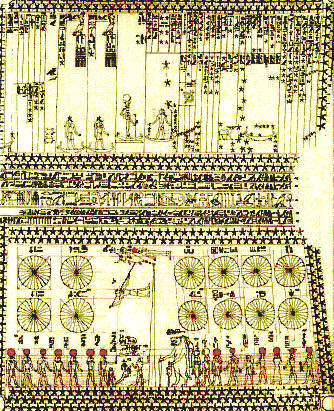
The measurement of time by means of celestial phenomena played an important role in funerary texts and decoration. One mechanism seen on the ceilings of royal tombs in the latter half of Dynasty 20 (KV 9, KV 1, KV 6) shows men kneeling beneath grids containing stars. Beside each figure is the name of the star that appears at a particular point on the human target at a given hour of the night. There is usually one image and name for each month of the year.

Other Funerary Texts

In addition to compositions dealing with the sun god's journeys, texts of a non-royal nature also are found in the royal tombs of the New Kingdom and in contemporary private tombs.


Book of the Dead

During the Second Intermediate Period, a collection of spells appears that is known as the Book of the Dead, or by its ancient title, the Spells for Going Forth by Day. These spells first appear in private New Kingdom tombs, on coffins, and on papyri. Often, the spells were illustrated with vignettes that illustrated their subject matter. Over 190 different spells have been recorded from New Kingdom sources, but individual private tombs contain only a selection of these, and the number is even more limited in royal tombs. The spells are concerned with the solar journey, the final judgment, the portals of the realm of Osiris, and descriptions of the netherworld. Book of the Dead spells are found on sarcophagi of the kings of Dynasty 18, but they do not appear in wall decoration until after the Amarna Period, in the tombs of Tutankhamen (KV 62) and Ay (KV 23). Many objects, such as shabtis and amulets, are connected with Book of the Dead spells.


Litany of Ra


The earliest version of this composition is found on two pillars in burial chamber J of Thutmes III (KV 34). It does not appear again until the tomb of Sety I (KV 17), where it decorates corridor B and stairwell C. It continues to be used as the decorative theme for this part of the royal tomb until the reign of Rameses IV (KV 2). An initial scene shows the sun disk with a serpent above and a crocodile below. A scarab (representing the god at sunrise) and a ram-headed man (representing the god at sunset) are contained inside the disk (representing the god at midday). Invocations to the sun in seventy-four forms are followed by representations of these forms. Another representation on the ceiling shows the soul of the sun god as a ram-headed bird flanked by Isis and Nephthys as kites.


Opening of the Mouth Ritual

This composition first appears as part of the Old Kingdom Pyramid Texts, but does not appear again until Dynasty 18 in private tombs. In Dynasty 18 royal tombs, only the opening scene occurs, and then only in KV 62 (Tutankhamen); fuller versions start to appear in the kings' tombs during the reign of Sety I. The text consists of a series of spells concerned with restoring the body to life and with animating a statue or image with spiritual force. The spells are accompanied by images of priests performing these rituals before the deceased or his statue. Well-preserved versions can be seen in the lower corridors (G, H) of the tombs of Sety I (KV 17) and Tausert/Setnakht (KV 14), and traces can also be found in similar positions in the tomb of Merenptah (KV 8) and Rameses III (KV 11). In later Dynasty 20 royal tombs (KV 7, KV 6), only the scene of the priest purifying the king is found.

Enigmatic Compositions

This rather loose category includes several different compositions that occur only once or twice, primarily in Dynasty 20 royal tombs such as KV 6 and KV 9. They are "enigmatic" because they either lack any accompanying text or because the text is written in unusual cryptographic hieroglyphs. The second gilded shrine that enclosed the sarcophagus of Tutankhamen had a composition of this type on its outer sides.

The right (southwest) wall of corridor D of the tomb of Rameses IX(KV 6) is decorated with two such scenes. The first represents the king offering to Ptah and Ma'at, followed by an ithyphallic figure of the god Osiris leaning against a sandy hill, protected by a giant serpent. Farther along the same wall is a composition in three registers. The top register consists of a series of sand-filled circles, each containing an inverted spread-eagled man. There is a solar bark bearing a scarab at the far end of the middle register and from it arrows fly to pierce serpents and goddesses standing on mounds adoring the sun. The bottom register features such unusual figures as a sun disk with scarabs emerging, a two-headed mummy, a leaning god holding a snake, four figures leaning backward, and four goddesses standing on serpents. The rear wall of the burial chamber in KV 6 has traces of a scene showing the resurrection of Osiris beneath a representation of the morning and evening solar barks. A nearly identical (and better-preserved) version decorated the ceiling of the chamber I of KV 9.

The ceilings of both KV 6 and KV 9 have other unique and enigmatic scenes. These include different views of the solar bark and its occupants, figures standing on beds, and the Mehen-serpent. In KV 9, the ceiling of chamber H is decorated with different aspects of the sun god Ra, as well as the lunar crescent and disk. There is a scene perhaps intended to repel hostile forces in the area of the accidental breakthrough into KV 12 above gate I.

Saturday, July 15, 2017

History of the Valley of the Kings (تاريخ وادي الملوك)


Third Intermediate Period

At the end of the New Kingdom, Egypt entered a period of political and economic decline. The priesthood of Amen at Thebes administered Upper Egypt, while kings ruling from Tanis controlled Lower Egypt. The Valley of the Kings suffered from plundering, which led the ruling high priests of Amen during Dynasty 21 to re-wrap and rebury the royal mummies in tombs such as KV 17, KV 35 and KV 57, in order to protect them. Later some of the mummies were moved to a cache south of Dayr al Bahri in TT 320.

Meanwhile, a number of tombs of the Valley of the Kings were reused either for non-royal burials (KV 19, KV 22, KV 24, KV 25, KV 34, KV 44, KV 45, and KV 47) or as a storage/work area (KV 4).

Graeco-Roman Era

For centuries, the Valley of the Kings remained almost deserted, until the arrival of the Greeks during the third century B.C., who expressed a new interest in the Valley, and monuments of Egypt in general. Two of the major tourist attractions in Thebes were the Colossi of Memnon, the pair of massive statues that preceded the pylon of the memorial temple of Amenhetep III [10179]. The northern one emitted a whistling sound at dawn, caused presumably by heated air escaping from cracks which appeared after an earthquake damaged the statue [15060]. Thus, it reminded the Greek visitors of the myth of Memnon who cried out to his mother, Eos, the goddess of the dawn, hence its name. A graffito carved on the foot of the colossus reads as follows: "From Trebulla. Hearing the holy voice of Memnon I missed you, O my Mother, and I prayed that you might hear him too."

The Valley of the Kings was another frequently visited site in Graeco-Roman times. Over two thousand Greek and Roman graffiti can be found in ten royal tombs (KV 1, KV 2, KV 4, KV 6, KV 7, KV 8, KV 9, KV 10, KV 11, KV 15) [16294]. KV 9 attracted the most visitors, probably because Rameses VI's cartouche strongly resembles the one of Amenhetep III and might have been a reminder of their hero Memnon. Around one thousand graffiti were noted in this tomb alone.

The graffiti are often limited to a name and sometimes a date, the visitor's profession, or comment about the tomb. The time period of touristic activities was set between the third century B.C. and sixth century A.D.

Diodorus Siculus and Strabo both visited Egypt between 60-56 B.C. and 25-24 B.C., respectively. According to Diodorus, priests claimed the Valley once contained forty-seven royal tombs, but that, during the reign of Ptolemy I, only seventeen remained. Strabo also mentioned the tombs in the Valley of the Kings. 

Byzantine Period

The next period of activity in the Valley of the Kings corresponds to the expansion of Christianity in Egypt. From the fifth century A.D. onwards, several tombs of the Valley (KV 1, KV 2, KV 4, KV 8, KV 9, KV 15) were used by hermit monks as refuges, while KV 3 was converted into a chapel. Numerous graffiti record hymns and prayers, representations of saints and crosses, and Christian names [10517, 10520, 10514, 13641].

Tomb Builders and Dayr al Madinah (مقبرة بناة ودير المدينة المنورة)


The village of Dayr al Madinah, home to the workmen who excavated and decorated the tombs in the Valley of the Kings, was probably founded during the reign of Thutmes I. His name was found stamped on the many bricks of the first enclosure wall of the village. But Amenhetep I and his mother Ahmes Nefertari were traditionally called its patrons, which may indicate that there was at least a small settlement here during their reign. The village remained in use throughout the New Kingdom (except during the Amarna Period).

Dayr al Madinah is located in a small valley southeast of the Valley of the Kings and northeast of the Valley of the Queens. The village, which was systematically enlarged during the New Kingdom, consisted of one main street along a north-south axis, and a few side alleys. The houses, there were about seventy of them-each had an entrance hall that also functioned as a private chapel, followed by a columned living area that gave access to a small cellar, used for storage. The main room led to smaller rooms, perhaps used as sleeping quarters, and sometimes a staircase led to the roof. At the back of the house an open space was used as a kitchen.


The workmen of the royal necropolis were called the "Servants in the Great Place" or "Servants in the Beautiful Place of the Mighty King" throughout Dynasty 18, and "Servants in the Place of Truth" during the Rameside Period. They were also called the "Men of the Gang," a reference to the Egyptian term ist, meaning "gang" or "crew," a term that came from the Egyptian military and navy. The number of workmen employed on a project varied between 30 and 120, according to the size of the tomb being cut. The men were divided into two groups, a right gang and a left gang. Two foremen and their deputies were appointed to supervise each gang. Scribes kept detailed records of each workman's attendance, accounts of salary payments, and records of any material removed from the royal storerooms.

The working day was divided into two shifts of about four hours each. The week was composed of eight working days followed by two days of rest. During these, the workmen returned to their homes to attend to personal affairs. They might also have spent the night in a settlement of huts located on the col of the mountain between the village and the Valley of the Kings.

If a tomb was completed prior to the death of its royal owner, the workmen were assigned to work on the tombs of queens and royal children in the Valley of the Queens and sometimes even on the tombs of noblemen. As time permitted, workmen could build their own tombs, adjacent to the village of Dayr al Madinah.

The daily life of the workmen and their family is well-known thanks to the vast number of documents found at Dayr al Madinah. Thousands of ostraca, numerous stelae, graffiti, and about two hundred documentary and literary papyri describing daily activity were recovered from the village and the Valley of the Kings.

In chamber 2 of KV 5, the Theban Mapping Project found an ostracon written by the scribe Qenherkhepeshef. According to Egyptologist Rob Demare, the ostracon is a receipt for oil lamps used to light the work in this tomb. Because of the ostracon's distinctive handwriting, Demare was able to identify its scribe as the well-known Qenherkhepeshef, who oversaw much of the building work of Rameses II. He was born during the reign of Rameses II, and lived until the first year of the reign of Siptah. Qenherkhepeshef's father was Panakht, but he also seems to have been adopted by Ramose, another scribe. According to ancient documents, Qenherkhepeshef was not especially popular. He was accused of corruption and of using royal workmen for personal projects.

Qenherkhepeshef and his descendants collected a large library of papyri that were recovered from the cemetery at Dayr al Madinah by French excavators in 1928. It included official letters, religious texts, tales, poetry, medical and magical texts.