Translate


Search This Blog

Featured Post

The Magic Book, c. 1100 BCE

Tales of Ancient Egypt:  Princess Ahura:  We were the two children of the King Merneptah, and he loved us very much, for he had ...

Showing posts with label Book of the Earth. Show all posts

Thursday, November 16, 2017

Book of the Earth

From Wikipedia, the free encyclopedia

The first vestiges we have of the Book of the Earth appear in the tombs of Merneptah (tomb), Tausert (tomb) and Ramesses III(tomb), where two scenes that wold later be including in the complete composition are depicted on the left wall of their sarcophagus chambers. They serve as a counterpart to the concluding representations of the Book of Caverns. We also find the solar barque atopAker as a double sphinx as an individual scene from Merneptah on, and in the Tomb of Ramesses IV, it concludes the representation in the decoration of his tomb.

In the tomb of Ramesses VI, all the decorated walls of the sarcophagus chamber have scenes from the Book of the Earth, though in the tomb of Ramesses VII, only one register depicts the scenes from parts D and C. Finally, Ramesses IX uses two scenes from part A in his tomb. All of the examples of this book appear within the sarcophagus chambers of the royal tombs, including one scene represented on the actual sarcophagus of Ramesses IV. Later, individual scenes also occur on several sarcophagi of the Late Period.

We also find individual scenes from the Book of the Earth in the cenotaph of Seti I at Abydos, as well as in the tomb of Osorkon II at Tanis. The section of the Book of the Earth that Painkoff called the Book of Aker occurs on Papyri of the 21st Dynasty, together with variations on the resurrection scene in A2, the tombs of Petamenophis and Padineith, TT197 of the 26th Dynasty at Thebes, and Lepsius 23 at Saqqara. We also see, from the Late Period, the depiction of Nut from part D in the tomb of Aba (TT36) and the scene of the birth of the stars on a cartonnage from the Ramesseum.


This funerary composition lacks an original ancient Egyptian title, and has actually been called by a number of names, depending on the scholar. Piankoff refers to it as La creation du disque solaire (The Creation of the Sun Disk). Hartwig Altenmuller calls it Buch des Aker (Book of Aker), while Erik Hornung names it Buch von der Erde (Book of the Earth) and Barta refers to it as Erdbunch (Earth-Book).

This was the last great composition concerning the netherworld, where the sun disk is raised up from the depths of the earth by numerous pairs of arms, and where the enemies of Egypt, those whose souls have not been blessed, are punished and destroyed in the Place of Annihilation.

Above all, it stresses the gods of the depths of the earth such as

The central figures in the story are Osiris, Ra and Ba, while the overarching plot is the journey the sun takes through the gods of earth, Aker, Geb and Tatenen.

Original sources

The scenes were found on all of the walls of the tombs of Ramesses VI and Ramesses VII. There were a few additional scenes found on the walls of other royal tombs extending from the New Kingdom to the Late Period, but since many scene from the Book were scattered around, the ordering of the illustrations is slightly convoluted.
Jean-François Champollion was the first one to publish the scenes and texts from the tomb of Ramesses VI in his Monuments de l'Egypte where he deciphered the hieroglyphs depicted in the tombs. Alexandre Piankoff was the first one to really study the composition of the images and hieroglyphics and looked for a meaning behind the illustrations. Bruno H. Stricker provided an explanation of the Book as a divine embryology in 1963.

Structure of the book


In the Book of the Earth, just as in the Book of Caverns, the hours of the night are not divided into sections, and the solar barque is largely missing as an aid to orientation. Though the original composition was probably divided into three registers, the registers in the surviving work are uncertain. Hence, the composition seems like a loose sequence of scenes. Because of the incomplete condition of his sarcophagus chamber which gives rise to various transpositions of materials, it is very uncertain whether the tomb of Ramesses VI provides a complete example of the Book of the Earth. Like the Book of Caverns, portions of it appear on the sides of several pillars. Scholars such as Abitz believe that the Book of the Earth, like the Book of Caverns, consists of two halves of which only one contains scenes of punishment. Like the Book of Caverns, the Book of the Earth uses the sun disk as a reoccurring theme, while the solar barque only makes rare appearances.

The directions of the scenes are mostly all oriented to the right and there is no visible morning goal, nor is there depicted the entry into the netherworlds. In the tomb of Ramesses VI, the divisions of the book run right to left, which is contrary to the usual arrangement. Piankoff recognized four parts, which were lettered A-D, while Abitz added further scenes on three pillar sides as parts E. He further theorizes that part D. with its praying king, represents the beginning of the composition, as at the beginning of the corridor of the Osireion. Further more, he believes part B belongs in part A, and part C to be a part of D. Barta instead designates the sequences of scenes from the sarcophagus chamber of Ramesses VII and Ramesses IX as part E, with the last scenes derived from a wide variety of books. Part A in the tomb of Ramesses VI portrays a clear central axis that has probably led to changes in the arrangements of the scenes in later versions. Unless the Aker scene is intended as such, there is also no concluding representations at the end of the composition.

Lake the Book of Caverns, Ramesses VI inserted many references to the king throughout the composition and uses subtitles to structure it.


Content


While the content of the book is similar in many ways to the Book of Caverns, there remain clear divergences also. Osiris is, of course, an central figure within the work, as is the transformation of Re, together with the ba of the blessed dead. A special theme is the journey of the sun through the earth god Aker. This actually represents and expansion of the eleventh scene in the Book of Gates, with its " barque of the earth".

Part E
In this part, there are six gods shown praying to a sun disc at burial mounds. This is smallest portion of the Book that is known, and Part E is most likely not the beginning of the Book of the Earth.

Part D

Part D is probably the beginning of the composition, where most of the setting is introduced. A majority of the content of the Book of the Earth is also located within this section. The realm of the dead is depicted with Osiris, as the primary figure, located within a tomb that is guarded by serpents. Beneath Osiris are the gods Anubis and another god who have their arms stretched out to provide protection over his corpse. This scene depicts renewal, while the scenes on both adjacent sides depict punishment. In the scenes of punishment, the gods of punishment are represented and are holding cauldrons.
Next, the mummy of the sun god stands upon a large sun disc that is enclosed by two pairs of arms rising from the depths of Nun. Surrounding this scene is a wreath of twelve stars and twelve small disks that indicate the course of the hours. The hands of two goddesses hold the ends of this illustration.
The final scene in this section shows Aker, who is representing the barque of the sun god, as a double sphinx. The barque is supported by two uraei, and inside the barque are Khepri and Thoth who are praying to the sun god. Underneath the barque are two royal figures with Isis and Nephthys who are holding a winged scarab beetle and a sun disc.
The middle register begins with Horus rising up out of a divine figure called the "Western One." Next, there are seven mounds that each contains a god. In the next scene, the propagation of Horus is repeated in which Horus is now falcon-headed, and rises from the body of Osiris which is being protected by the corpses of Isis and Nephthys.
In the next scene, Nun's arms are holding the solar disc, and other arms and two uraei hold another sun disc. A serpent is located on the top of this sun disc, which might signify the regeneration of the sun.
Like many Ancient Egyptian texts, the bottom register shows the punishment of enemies in the Place of Annihilation since it is below the gods. Since gods are more important figures, they are depicted above others. The sun god is shown above with several sarcophagi and four enemies below.
Finally, we find a corpse lying in a large sarcophagus located in the Place of Annihilation, which Re calls the "corpse of Shetit." This is the realm of the dead where gods and goddesses above the scene hold their hands out in prayer. In the last scene, we find the Apophis serpent being seized by ram headed gods.

Part C

Part C comprises three registers that might be connected to Part D, but the exact sequence is unclear. The upper and middle registers both start off with images of the sun god in his ram-headed form. Two ba-birds are praying to him while an unknown god is greeting him in the middle register. Behind the unknown god are two additional gods, one being ram-headed and the other being serpent-headed. These gods have their hands stretched out in front of them, towards the sun disc, in a protective gesture. Out of this gesture, the falcon shaped head of "Horus of the netherworld" is projected.

Part B

The registers of this section are less obvious, and many parts might be considered to belong to Part A. The first scenes in this section consist of four oval shapes with mummies inside, which are able to breathe from the rays of the sun god. There are also four burial mounds that have been turned over and are being protected by serpents. The main part of this section depicts a mummy, who is standing, called "corpse of the god," which is also the sun disc itself. In front of him, a serpent rises out of a pair of arms and holds a god and goddess in the act of praise. Behind the mummy is another par of arms, called the "arms of darkness," that is being supported by the crocodile, Penwenti.
Next, there are four more ovals containing mummies with four ba-birds, one ba-bird for each mummy. This, along with two additional hieroglyphs, represents shadows. Underneath this illustration are depictions of barques that contain the mummies of Osiris and the falcon-headed Horus.
At the end of this segment of the Book of the Earth, the upper portion shows a depiction of a large burial mound, containing the sun disc with an unknown god praying to it. Two heads and two goddesses that are located on both sides of the large burial mound also give praise. Directly below this, on the bottom register, are four gods and ba-birds that are also praying.

Part A

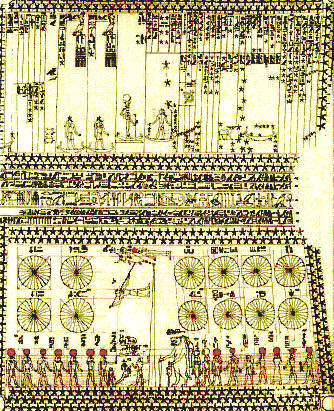
In the beginning of this section, the sun god is enclosed by mummies at a burial mound called the Mound of Darkness. Above this mound, a solar barque is shown. Following this scene, Aker is depicted as a double sphinx. the solar barque is located between the entrance and the exit of the realm of the dead, with its stern side facing the exit. Below shows the resurrection of the corpse of the sun, which is a scene that typically occurs in royal sarcophagus chambers. A falcon head emerges from a sun disc, and the light is shown falling on the "mysterious corpse" which is lying down. In the next scene, twelve goddess, each representing an hour of the night, are depicted. Each goddess has the hieroglyph of a star and a hieroglyph of a shadow with a beaming disk above her. At the beginning of the fourth scene, a few of the mummies are enclosed within four large circles. In the fifth scene, a central god, who is thought to be Osiris, is surrounded by the corpses of Shu (Egyptian deity)Tefnut, Khepri and Nun. The sixth scene, shows a pair of arms rising from the depths. A goddess called Annihilator stands up with her arms reaching to embrace a sun disc. The arms are supporting two praying goddesses named West and East in a reverse orientation. It is believed that the upper register of this part ends with a line containing a title of this work, though it is still unknown.
The middle register begins with the solar barque again. It is towed by fourteen ram-headed gods with all of their bas. Next, a god stands in his cave, surrounded by twelve star goddesses who are extending discs to him.
The following scene, which is scattered around the tomb of Ramesses VI, shows five burial mounds with a head and arms emerging from it. They are raised up in a gesture of praise. In the third scene, the birth of the sun is represented. This scene also occurs on the sarcophagus of Ramesses IV, but there is more detail and more story on that sarcophagus than in this scene.


Part A of the Book of the Earth

Part B and C from the Book of the Earth

Part D from the Book of the Earth


Sunday, July 30, 2017

Book of the Earth

This funerary composition lacks an original ancient Egyptian title, and has actually been called by a number of names, depending on the scholar. Piankoff refers to it as La creation du disque solaire (The Creation of the Sun Disk). Hartwig Altenmuller calls it Buch des Aker (Book of Aker), while Erik Hornung names it Buch von der Erde (Book of the Earth) and Barta refers to it as Erdbunch (Earth-Book).


This was the last great composition concerning the netherworld, where the sun disk is raised up from the depths of the earth by numerous pairs of arms, and where the enemies of Egypt, those whose souls have not been blessed, are punished and destroyed in the Place of Annihilation.

Above all, it stresses the gods of the depths of the earth such as Aker, Geb and Tatenen.

However, in reality it is not known if these scenes and texts from a part of a single composition or an amalgamation from different works, and the divisions of the book are confusing at the very least.

Original Sources


The first vestiges we have of the Book of the Earth appear in the tombs of Merneptah (tomb), Tausert (tomb) and Ramesses III (tomb), where two scenes that wold later be including in the complete composition are depicted on the left wall of their sarcophagus chambers. They serve as a counterpart to the concluding representations of the Book of Caverns. We also find the solar barque atop Aker as a double sphinx as an individual scene from Merneptah on, and in the Tomb of Ramesses IV, it concludes the representation in the decoration of his tomb.

In the tomb of Ramesses VI, all the decorated walls of the sarcophagus chamber have scenes from the Book of the Earth, though in the tomb of Ramesses VII, only one register depicts the scenes from parts D and C. Finally, Ramesses IX uses two scenes from part A in his tomb. All of the examples of this book appear within the sarcophagus chambers of the royal tombs, including one scene represented on the actual sarcophagus of Ramesses IV. Later, individual scenes also occur on several sarcophagi of the Late Period.

We also find individual scenes from the Book of the Earth in the cenotaph of Seti I at Abydos, as well as in the tomb of Osorkon II at Tanis. The section of the Book of the Earth that Painkoff called the Book of Aker occurs on Papyri of the 21st Dynasty, together with variations on the resurrection scene in A2, the tombs of Petamenophis and Padineith, TT197 of the 26th Dynasty at Thebes, and Lepsius 23 at Saqqara. We also see, from the Late Period, the depiction of Nut from part D in the tomb of Aba (TT36) and the scene of the birth of the stars on a cartonnage from the Ramesseum.

Research

Jean-Francois Champollion published the scenes and texts in the sarcophagus chamber of Ramesses VI in his Monuments de l'Egypte: Notices descriptives (Paris 1844, vol. 2, pp. 576-578), and later, a part of the composition was also published by Lefebure in his Notices des hypogees (Cairo, 1889). However, it was Alexandre Piankoff who actually provided the foundation for real study of the composition with his edition of it in 1953. Bruno H. Stricker provided an explanation of the book as a divine embryology in 1963, while Winfried Barta and Friedrich Abitz have been responsible for investigating the composition and meaning of the text.

The Structure of the Book of the Earth

In the Book of the Earth, just as in the Book of Caverns, the hours of the night are not divided into sections, and the solar barque is largely missing as an aid to orientation. Though the original composition was probably divided into three registers, the registers in the surviving work are uncertain. Hence, the composition seems like a loose sequence of scenes. Because of the incomplete condition of his sarcophagus chamber which gives rise to various transpositions of materials, it is very uncertain whether the tomb of Ramesses VI provides a complete example of the Book of the Earth. Like the Book of Caverns, portions of it appear on the sides of several pillars. Scholars such as Abitz believe that the Book of the Earth, like the Book of Caverns, consists of two halves of which only one contains scenes of punishment. Like the Book of Caverns, the Book of the Earth uses the sun disk as a reoccurring theme, while the solar barque only makes rare appearances.

The directions of the scenes are mostly all oriented to the right and there is no visible morning goal, nor is there depicted the entry into the netherworlds. In the tomb of Ramesses VI, the divisions of the book run right to left, which is contrary to the usual arrangement. Piankoff recognized four parts, which were lettered A-D, while Abitz added further scenes on three pillar sides as parts E. He further theorizes that part D. with its praying king, represents the beginning of the composition, as at the beginning of the corridor of the Osireion. Further more, he believes part B belongs in part A, and part C to be a part of D. Barta instead designates the sequences of scenes from the sarcophagus chamber of Ramesses VII and Ramesses IX as part E, with the last scenes derived from a wide variety of books. Part A in the tomb of Ramesses VI portrays a clear central axis that has probably led to changes in the arrangements of the scenes in later versions. Unless the Aker scene is intended as such, there is also no concluding representations at the end of the composition.

Like the Book of Caverns, Ramesses VI inserted many references to the king throughout the composition and uses subtitles to structure it.

The Composition

While the content of the book is similar in many ways to the Book of Caverns, there remain clear divergences also. Osiris is, of course, an central figure within the work, as is the transformation of Re, together with the ba of the blessed dead. A special theme is the journey of the sun through the earth god Aker. This actually represents and expansion of the eleventh scene in the Book of Gates, with its " barque of the earth".

Part D

In part D, probably the beginning of the composition, we find a schematic depiction of the entire realm of the dead with Osiris as the central figure. He resides within a tomb structure which serpents guard. Two mounds, surmounted by his ba and the "corpse of Geb", flank Osiris. Beneath hi are Anubis and a "Mysterious One" who protectively stretch their arms over a "mysterious coffer" that invisibly contains his corpse. This is a scene of renewal, and to either side are scenes depicting punishment. Here, we find punishing gods, whose names refer to the devouring of the bodies and the ba-souls of the enemies, hold cauldrons aloft. Above, a God holds the hieroglyphs for fire and blood from decapitated enemies flows down into the cauldrons below

the next scene we find the mummy of the sun god flanked between two fire spitting uraei. He stands upon a large sun disk that in turn is flanked by two pairs of arms rising from the depths of Nun. Surrounding this scene is a wreath of twelve stars and twelve small disks indicating the course of the hours, who's ends are held in the hands of two goddesses. A modification of this scene where the pairs of arms replaced by a double ouroboros (a serpent biting its own tail) and the name of the king is placed in the large disk occurs in the sarcophagus chamber of Ramesses III.

A modification of the depiction of Nut from the fifth section of the Book of Caverns occurs in the next scene. Here, looking backwards, she is called the Mysterious One. A ram-headed ba-bird and a disk, representing the sun god, rests upon the palms of her hands. Flanking her are two human headed serpents and a crocodile, together with another snake.

The final scene in this section is also a variation of a popular theme. Here, atop the back of Aker is represented the barque of the sun god as a double sphinx. The barque is supported by two uraei, and inside the barque are Khepri and the ape headed Thoth, who pray to the sun god. Underneath the barque, two royal figures together with Isis and Nephthys, hold high a winged scarab beetle and sun disk.

Protected by Atum, the middle register begins with Horus rising up out of the recumbent divine figure called the Western One. Next we find seven shrines or mounds, each containing gods, "those of mysterious forms". In the next scene, the miraculous, posthumous propagation of Horus is repeated. In this scene, the falcon-headed Horus rises from the curved corpse of Osiris which is in turn being protected by the corpses of Isis and Nephthys. In the next scene, two anonymous gods look upon the ba of Osiris, which is avian in form. They are flanked by burial mounds surmounted by ram-headed mummies.

The next two scenes have a similar theme. In the first, the arms only of Nun hold the solar disk, after which we find another huge sun disk flanked by four divine figures and two uraei. A Hathor head and a serpent emerge at the top of this solar disk, perhaps indicating the regeneration of the sun. In the next scene, two praying uraei and several burial mounts containing mummies, among them that of Osiris as Bull of the West, flank the birth of the sun, indicated by a winged scarab that emerges from the desk. The analogous scene with a sun disk and winged scarab flanked by mounds containing mummies probably also belongs in this register.

As is often the case with books of the netherworld, the lower register here is reserved for punishment of enemies in the Place of Annihilation. It starts out with a representation of the sun god together with several sarcophagi. There follows four enemies that are named the Burning Ones. Rather than heads, they have the hieroglyphs for fire surmounting their bodies, and they are watched over by four ram-headed gods.

In the next scene, four gods each carry an upside down, decapitated enemy. These enemies are painted red, perhaps to indicate that they are covered with blood. This scene is followed by one in which there are four kneeling enemies also with the hieroglyphs for fire, this time atop their heads. They are held by four goddesses who, we are told, "set the corpses of the enemies on fire". Afterwards, we find two goddesses hold their hands protectively over a large hart. They are flanked by two knife-welding gods facing pairs of arms that raise two cauldrons filled with the heads and pieces of flesh of enemies from the depths. Each cauldron is heated by a fire breathing head from below.

Next we find the "corpse" of the Place of Annihilation lying in a large sarcophagus, which Re calls the "corpse of Shetit". This is symbolically the realm of the dead, and above it three gods and three goddesses within burial mounds or shrines raise their hands in prayer. Finally, in the last scene, we find the familiar Apophis serpent being seized by ram headed gods. Beneath the snake, Osiris stands within a burial mound or shrine. Outside, the corpse of Geb and that of Tatenen flank the mound. All three of these figures are sunk to their knees in the depths.

Part C

There are three register in part C, that in some manner are connected with part D, but their precise sequence is unclear. Both the upper and middle registers each start out with a ram-headed sun god. In the upper register, two ba-birds pray to him. The first stands upon a perch-like structure and the second on a scarab above the Apophis snake, out of whose coils Khepri emerges according to the caption. Before the Apophis serpent stand Atum and Shu, though perhaps only their bas are intended here.

Below in the middle register, an unknown god greets the sun god in prayer, while behind are two more gods, one ram-headed and one serpent headed. They stretch out their hands in a protective gesture towards the sun disk, out of which the falcon shaped head of "Horus of the netherworld" is projected.

The lower register begins with a praying god and goddess, followed by four gods who grasp human headed posts. In the next scene, the corpse of Aker, who is represented in the form of a god holding a scepter, bends over his own ba in the form of a bird which is praying to him. He is flanked to either side by a burial mound containing a sun disk.

From these disks emerge a praying goddess. Afterwards, four Osirian figures follow, each with a sun disk behind him and a pair of arms stretched out towards him. At the end, there is a head, together with a pair of arms and a sun disk. The scene containing fettered and kneeling enemies with three gods must belong in a lower register, as perhaps also do the three ovals that follow (one of them now destroyed). On top of the ovals lie mummies that have turned themselves over, which with a goddess turned toward it.

Part A

Part A begins with the sun god, "who protects the corpses". He is flanked by mummies in a burial mound called the Mound of Darkness. Afterwards, we find a scene with the earth god Aker as a double sphinx. Above his mound is the solar barque. It sits between the personifications of the entrance and exit of the realm of the dead, with its direction reversed so that the stern faces the exit. Below is the resurrection of the corpse of the sun, a scene that occurs in the royal sarcophagus chambers beginning with Merneptah and often later on papyri of the 21st Dynasty. From a falcon's head that emerges from the bottom of the sun disk, we see light falling on the "mysterious corpse" which lies on the ground. It contains both Osiris and Re in a single form. This scene is surrounded by a wreath of twelve stars and twelve disks and by two Osiris figures on either side.

In the third scene, twelve goddess, each representing an hour of the night, are depicted, each with the hieroglyph of a star and a shadow along with a beaming disk above her. Then at the beginning of the fourth scene stands a "guardian of the corpses", flanked by representations of mummies. A few of the mummies are encased within four large disks. A central god, possibly Osiris but who's precise identity is not evident, is flanked by the corpses of Shu, Tefnut, Khepri and Nun in the fifth scene, and finally, in the sixth scene, a had and a pair of arms rise up from the depts. Upon the head, a goddess called Annihilator stand with her arms stretched out to embrace a solar disk. The arms, in turn, support two praying goddesses named West and east in a reverse orientation. Three mummies asymmetrically flank this scene. We believe the upper register of part A ends at this point with a line containing a title.

Below, the middle register begins, as in the Amduat and the Book of Gates, with the solar barque. It is towed by fourteen ram-headed gods, together with their bas. Below is represented an ithyphallic god who is called "he who hides the hours". He stands in his cave and is surrounded by twelve star goddesses who extend disks to him. There are also additional stars and disks, and there is the depiction of a child directly below the phallus of the god. All about this scene a giant snake is coiled.

The following scene, which is scattered about three places in the tomb of Ramesses VI, has five burial mounds, from which emerge a head and arms raised up in a gesture of praise. There are also two more mound without a head and arms. The birth of the sun is dealt with in the third scene. Here, there are two erect mummies. On the first, a sun disk replaces the head, and from the disk emerge the head and forelegs of a scarab. A praying goddess surmounts the second mummy. This is followed by a scene where a uraeus, a head with arms and an upright mummy are grouped on either side of a mummified god who is called "he who annihilates the hours". The arms each support a god holding a small sun disk in his hands. This scene also occurs on the sarcophagus of Ramesses IV, though there it is expanded. On this sarcophagus, the theme is the birth and annihilation of the hours in the abyss of the Place of Annihilation.

At the top, and also at the bottom of the fifth scene are ten heads. Those above are connected to hieroglyphs representing shadows, while below, arms extended from the heads are raised in prayer. A sun disk moves between the heads, which is adored by two extended goddesses from above and below.


Part of the summary scene in part A showing the barque entering and leaving the depths

The lower register of part A might be seen as a concluding summary depicting the entire course of the sun. On the far left is the solar barque containing a scarab and the ram-headed sun god. It is towed by seven ba-birds. Below, the arms of Geb embrace a mummy called the Mourned One atop a mound containing a weeping eye and four hieroglyphs designating flesh. To their left this "mourning" is continued by other figures. As at the end of the Amduat, the regeneration of Re is put in contract against the mourning of Osiris.


In the center we find the barque once more, but with a raft attached to the prow and a scarab adored by the bas of Atum and Khepri. It passes over one of the heads of the double sphinx of Aker and into the depths, where Tatenen, the god of the depths of the earth, receives it. There follows the arms of Nun raising the sun disk from the depths who is flanked by mummies. On the other side, the barque is then released by Nun, the god of the primeval waters, which is then hauled from the depths by fourteen uraei with human heads.

Part B

Part B is not clearly divided into registers and its scenes should probably be more correctly considered as belonging to part A. The first scene consists of four ovals that contain mummies, allowed to breath due to the rays of the sun god. There are also four burial mounds containing mummies that have turned themselves over. Each is under the protection of a serpent. Here, the caption alludes to their decay, from which even Re turns away.

The next scene takes up the entire height of part B. It is similar to the depictions of Nut and Osiris in the Book of Caverns found in the tombs of Siptah through Ramesses IV where a version of the scene was represented on the lids of the royal sarcophagi. The central part of the scene depicts a standing mummy called the "corpse of the god", in which is the sun disk. Before him, a pair of arms, from which serpents rise, holds a god and goddess in the act of praise. To the mummy's rear, another par of arms, called the "arms of darkness", support the crocodile Penwenti. They also hold a jackal-headed and a ram-headed scepter.

Afterwards, there are four ovals containing mummies that have an equal number of ba-birds, together with two hieroglyphs representing shadows. Underneath are depictions of barques that contain the recumbent mummies of Osiris and the falcon-headed "Horus of the netherworld". Each of these gods are attended to by the goddess Isis and Nephthys, respectively.

At the end of this part of the Book of the Earth, the upper portion starts with a depiction of a huge burial mound that contains the sun disk with a god praying to it. Adjacent to it are two godly figures above the hieroglyphic sign for flesh all within a large oval. Praise is given by two heads and two goddesses that flank the oval. Underneath this scene are four praying gods, with a ba-bird and the bend hieroglyph for shadow next to each.

Part E

. In part E, six gods in burial mounds are represented, and twice, gods pray beneath a sun disk.


Part A of the Book of the Earth


Part B and C from the Book of the Earth


Part D from the Book of the Earth

Monday, July 17, 2017

Funerary Compositions of ancient Egypt


From the end of Dynasty 5 onward, religious texts were inscribed in the burial chambers of royal tombs. The oldest surviving compositions, called Pyramid Texts because they were inscribed in pyramid burial chambers, were compilations of spells describing different aspects of the dead king's restoration and existence in the realm of the gods in the afterlife. For some unknown reason, Middle Kingdom rulers did not have any such texts inscribed in the burial chambers of their pyramids. Contemporary private burials, however, had a series of spells, called Coffin Texts because they were inscribed on coffins; many derived from or were influenced by the Pyramid Texts. The first descriptions of the netherworld appear as schematic "maps" on the inner floors on many of these coffins, and are called the Book of Two Ways.

New Kingdom Books of the Netherworld

New compositions appear for the first time in royal tombs of the New Kingdom. They consist of both figures and texts that describe the realm of the dead ruled by Osiris and the journey of the sun god Ra through this realm.


Book of Caverns

The modern name of this book was given because many of the figures are shown inside ovals that represent caves in the underworld. It is divided into only six sections, with the form of the sun god as a ram-headed man introducing the first four divisions. Bound enemies appear in the lowest register of the first five divisions, and two large figures of Nut and ithyphallic Osiris are found in the fifth division. In the sixth division, the concluding scene shows the dawning of the sun god as a scarab and a child emerging from the watery realm of creation.


Book of the Earth

The earliest appearance of scenes from this book is in the burial chamber of KV 8 (Merenptah), but the fullest version is in KV 9. Other tombs of Dynasties 19 and 20 have some scenes and texts derived from this composition in their burial chambers, such as KV 14, KV 11, KV 1, and KV 6. The composition does not follow an obvious narrative progression as other descriptions of the solar nightly journey do. (Egyptologists have divided the composition up in different ways: the system followed on this website is that of Piankoff, which distinguishes four parts, A-D.)

In the examples from KV 8, KV 9, KV 11 and KV 14, the same scenes recur on the side walls. Three registers on the left wall show the sun god Ra in his bark beneath a supine mummiform figure with overarching stars and sun disks. The bottom register shows an ithyphallic figure standing in a structure representing a water clock. The ba of Ra in the form of a large ram-headed bird dominates the right wall. It lies beneath a representation of a reborn sun emerging from the waters of chaos (taken from the closing scene of the Book of Caverns). Beneath the outspread wings of Ra's ba, the sun god's boat is shown resting on the image of the double-headed sphinx Aker, the embodiment of the earthly entry to the netherworld, with goddesses representing hours facing toward Ra. The Book of Aker was a name given in the past to this part of the composition that illustrates the sun god's boat resting on the back of Aker. Traces of other scenes can be found on the rear walls of the burial chambers of KV 8 and KV 11.


Book of Gates

The ancient name of this book is not known; the modern name derives from the depiction of gates and door leaves separating each of the twelve sections. The text has been studied in detail and translated by both Alexandre Piankoff and Erik Hornung, who have developed different numbering systems to designate the "divisions" as Piankoff calls them, or "hours" as designated by Hornung. Both systems are employed on this website, followed by a "P" in parentheses for Piankoff's system and an "H" for Hornung's.

The earliest example of this composition survives as excerpts consisting of the first to fifth divisions (P)/second to sixth hours (H) in the unfinished decoration in the burial chamber of the tomb of Horemheb. The first complete version occurs on the calcite sarcophagus of Seti I. (There are also excerpts on the walls of his tomb.) A second complete version is found on the west wall of the first corridor of the Osireion, the cenotaph Sety I constructed behind his temple at Abydos. Only one other complete version is known from the New Kingdom, on the south walls of the upper corridors and chambers (B-F) of the tomb of Rameses V and VI (KV 9). Certain chambers tended to be decorated with particular divisions of this composition. Thus, through the reign of Rameses III, pillared chamber F has the third and fourth divisions (P)/fourth and fifth hours (H).

Each section of this book except the last is also divided into three registers, with the sun god and his boat at the beginning of the middle register. The solar boat entering the western horizon is part of the prologue (P)/first hour (H). The enlarged fifth gate shows the Judgment Hall of Osiris, and the twelfth hour (P)/closing scene (H), shows the solar boat raised from the primeval waters by the god Nun at dawn.


Imydwat

This composition first appeared inscribed on limestone blocks in KV 20, the tomb of Hatshepsut. It is divided into twelve sections that correspond to the night hours. Each section after the first is divided into three horizontal registers. The sun god, shown as a ram-headed man, stands in a shrine on his boat, accompanied by other deities on his nightly journey through the netherworld (Imydwat meant "what is in the netherworld" in the ancient Egyptian language). Complete versions of the text are found in the tombs of Thutmes III (KV 34), Amenhetep II (KV 35), and Amenhetep III (KV 22). Subsequent occurrences of the composition are incomplete excerpts, although eleven of the twelve hours may be seen in corridors G and H of the tomb of Rameses VI (KV 9). In the Rameside period, some of these excerpts regularly appear at specific locations in the tombs. For example, from the reign of Sety I onwards, the fourth and fifth hours are associated with the walls of the third corridor that precedes well chamber E. These two hours deal with the descent of the sun god Ra into the realm of the Memphite necropolis god, Sokar. Their proximity to the well shaft has been interpreted to mean that the shaft was a symbolic tomb of Sokar and Osiris. The composition ends with Ra's boat been pulled through the body of a large snake and emerging on the eastern horizon in the morning as a scarab beetle.


Books of the Sky

In addition to compositions that describe the sun god's journey through the netherworld, several books are found on the ceilings of royal tombs that describe the journey of the solar bark across the sky, personified by the goddess Nut. This goddess is shown as an elongated woman covered in stars and apparently is associated with the Milky Way. The arms and legs of the goddess extend downwards to enclose the scenes and texts of the composition. Before the appearance of these compositions framed by the sky goddess, the ceilings of burial chambers in the Rameside period were decorated with images of personifications of stars and constellations.


Astronomical figures

Beginning with KV 17, the vaulted ceilings of burial chambers in several Rameside royal tombs were decorated with figures representing constellations of the northern and southern horizons. Other figures represented the decans, the stars used to herald the occurrence of the three ten-day-long intervals into which each month was divided.


Books of the Day and the Night

The arched figure of the sky goddess Nut frames texts describing the sun god's journey across the sky from sunrise to sunset and the nightly journey within the goddess's body (which begins by her "swallowing" him) until rebirth at dawn.


Book of the Heavenly Cow


This text describes how Ra's daughter Hathor averted destruction of mankind. The principal image is a large cow supported by the god Shu. The first occurrence of this composition is inside the outermost gilded shrine of Tutankhamen. The best-preserved version in the Valley of the Kings is in side chamber Je of KV 17 (Sety I).


Book of Nut


Other than in the Osireion at Abydos, this text is found only on the south half of the ceiling of the burial chamber J of Rameses IV (KV 2). The god of the air Shu is shown supporting the arched figure of the sky goddess Nut, separating her from the god of the earth, Geb.


Star Clocks

The measurement of time by means of celestial phenomena played an important role in funerary texts and decoration. One mechanism seen on the ceilings of royal tombs in the latter half of Dynasty 20 (KV 9, KV 1, KV 6) shows men kneeling beneath grids containing stars. Beside each figure is the name of the star that appears at a particular point on the human target at a given hour of the night. There is usually one image and name for each month of the year.

Other Funerary Texts

In addition to compositions dealing with the sun god's journeys, texts of a non-royal nature also are found in the royal tombs of the New Kingdom and in contemporary private tombs.


Book of the Dead

During the Second Intermediate Period, a collection of spells appears that is known as the Book of the Dead, or by its ancient title, the Spells for Going Forth by Day. These spells first appear in private New Kingdom tombs, on coffins, and on papyri. Often, the spells were illustrated with vignettes that illustrated their subject matter. Over 190 different spells have been recorded from New Kingdom sources, but individual private tombs contain only a selection of these, and the number is even more limited in royal tombs. The spells are concerned with the solar journey, the final judgment, the portals of the realm of Osiris, and descriptions of the netherworld. Book of the Dead spells are found on sarcophagi of the kings of Dynasty 18, but they do not appear in wall decoration until after the Amarna Period, in the tombs of Tutankhamen (KV 62) and Ay (KV 23). Many objects, such as shabtis and amulets, are connected with Book of the Dead spells.


Litany of Ra


The earliest version of this composition is found on two pillars in burial chamber J of Thutmes III (KV 34). It does not appear again until the tomb of Sety I (KV 17), where it decorates corridor B and stairwell C. It continues to be used as the decorative theme for this part of the royal tomb until the reign of Rameses IV (KV 2). An initial scene shows the sun disk with a serpent above and a crocodile below. A scarab (representing the god at sunrise) and a ram-headed man (representing the god at sunset) are contained inside the disk (representing the god at midday). Invocations to the sun in seventy-four forms are followed by representations of these forms. Another representation on the ceiling shows the soul of the sun god as a ram-headed bird flanked by Isis and Nephthys as kites.


Opening of the Mouth Ritual

This composition first appears as part of the Old Kingdom Pyramid Texts, but does not appear again until Dynasty 18 in private tombs. In Dynasty 18 royal tombs, only the opening scene occurs, and then only in KV 62 (Tutankhamen); fuller versions start to appear in the kings' tombs during the reign of Sety I. The text consists of a series of spells concerned with restoring the body to life and with animating a statue or image with spiritual force. The spells are accompanied by images of priests performing these rituals before the deceased or his statue. Well-preserved versions can be seen in the lower corridors (G, H) of the tombs of Sety I (KV 17) and Tausert/Setnakht (KV 14), and traces can also be found in similar positions in the tomb of Merenptah (KV 8) and Rameses III (KV 11). In later Dynasty 20 royal tombs (KV 7, KV 6), only the scene of the priest purifying the king is found.

Enigmatic Compositions

This rather loose category includes several different compositions that occur only once or twice, primarily in Dynasty 20 royal tombs such as KV 6 and KV 9. They are "enigmatic" because they either lack any accompanying text or because the text is written in unusual cryptographic hieroglyphs. The second gilded shrine that enclosed the sarcophagus of Tutankhamen had a composition of this type on its outer sides.

The right (southwest) wall of corridor D of the tomb of Rameses IX(KV 6) is decorated with two such scenes. The first represents the king offering to Ptah and Ma'at, followed by an ithyphallic figure of the god Osiris leaning against a sandy hill, protected by a giant serpent. Farther along the same wall is a composition in three registers. The top register consists of a series of sand-filled circles, each containing an inverted spread-eagled man. There is a solar bark bearing a scarab at the far end of the middle register and from it arrows fly to pierce serpents and goddesses standing on mounds adoring the sun. The bottom register features such unusual figures as a sun disk with scarabs emerging, a two-headed mummy, a leaning god holding a snake, four figures leaning backward, and four goddesses standing on serpents. The rear wall of the burial chamber in KV 6 has traces of a scene showing the resurrection of Osiris beneath a representation of the morning and evening solar barks. A nearly identical (and better-preserved) version decorated the ceiling of the chamber I of KV 9.

The ceilings of both KV 6 and KV 9 have other unique and enigmatic scenes. These include different views of the solar bark and its occupants, figures standing on beds, and the Mehen-serpent. In KV 9, the ceiling of chamber H is decorated with different aspects of the sun god Ra, as well as the lunar crescent and disk. There is a scene perhaps intended to repel hostile forces in the area of the accidental breakthrough into KV 12 above gate I.