Translate


Search This Blog

Featured Post

The Magic Book, c. 1100 BCE

Tales of Ancient Egypt:  Princess Ahura:  We were the two children of the King Merneptah, and he loved us very much, for he had ...

Showing posts with label Underworld. Show all posts

Wednesday, December 6, 2017

THE EARLIEST EGYPTIAN CONCEPTION OF THE OTHER WORLD.

Having briefly referred to the origin and development of the magical, religious, and purely funeral texts which, sometimes with and sometimes without illustrations, formed the "Guides" to the Ancient Egyptian Underworld, the form of the conceptions concerning the place of departed spirits as it appears in the Recessions of the XVIIIth and XIXth Dynasties must now be considered. 

To reconstruct the form which they took in the Pre-dynastic Period is impossible, for no materials exist, and the documents of the Early Empire are concerned chiefly with providing the deceased with an abundance of meat, drink, and other material comforts, and numbers of wives and concubines, and a place in Sekhet-Aaru, a division of Sekhet-hetepet, to which the name "Elysian Fields" has not inaptly been given. In later times Sekhet-Aaru, or Sekhet-Aanru, comprised all Sekhet-hetepet. 

Of Sekhet-hetepet as a whole the earliest known pictures are those which are painted on the coffins of Al-Barsha, and of no portion of this region have we any detailed illustrations of the occupations of its inhabitants older than the XVIIIth Dynasty. To the consideration of Sekhet-Aaru, which was the true heaven of every faithful worshiper of Osiris, from the time when he became the judge and benevolent god and friend of the dead down to the, Ptolemaïc Period, that is to say, for a period of four thousand years at least, the scribes and artists of the XVIIIth Dynasty devoted much attention, and the results of their views are set forth in the copies of PER-EM-HRU, or the Theban Book of the Dead, which have come down to us.

In one of the oldest copies of PER-EM-HRU, i.e., in the Papyrus of Nu, is a vignette of the Seven Arits, or divisions of Sekhet-Aaru; the portion shown of each Arit is the door, or gate, which is guarded by a gatekeeper, by a watcher, who reports the arrival of every comer, and by a herald, who receives and announces his name. All these beings save two have the head of an animal, or bird, on a human body, a fact which indicates the great antiquity of the ideas that underlie this vignette. Their names are:--

Arit I. Gatekeeper. SEKHET-HRA-ASHT-ARU.
Watcher. SEMETU.
Herald. HU-KHERU.

Arit II. Gatekeeper. TUN-HAT.
Watcher. SEQET-HRA.
Herald. SABES.

Arit III. Gatekeeper. AM-HUAT-ENT-PEHUI-FI.
Watcher. RES-HRA.
Herald. UAAU.

Arit IV. Gatekeeper. KHESEF-HRA-ASHT-KHERU.
Watcher. RES-AB.
Herald. NETEKA-HRA-KHESEF-ATU.

Arit V. Gatekeeper. ANKH-EM-FENTU.
Watcher. ASHEBU.
Herald. TEB-HER-KEHAAT.

Arit VI. Gatekeeper. AKEN-TAU-K-HA-KHERU.
Watcher. AN-HRA.
Herald. METES-HRA-ARI-SHE.

Arit VII. Gatekeeper. METES-SEN.
Watcher. AAA-KHERU.
Herald. KHESEF-HRA-KHEMIU.

From another place in the same papyrus, and from other papyri, we learn that the "Secret Gates of the House of Osiris in Sekhet-Aaru" were twenty-one in number; the Chapter (CXLVI.) gives the name of each Gate, and also that of each Gatekeeper up to No. X., 

thus:--

I. Gate. NEBT-SETAU-QAT-SEBT-HERT-NEBT-KHEBKHEBT-SERT-METU-KHESEFET-NESHENIU-NEHEMET-UAI-EN-I-UAU.
Gatekeeper. NERI.

II. Gate. NEBT-PET-HENT-TAUI-NESBIT-NEBT-TEMEMU-TENT-BU-NEBU.
Gatekeeper. MES-PEH. (or, MES-PTAH).


III. Gate. NEBT-KHAUT-AAT-AABET-SENETCHEMET-NETER-NEB-AM-S-HRU-KHENT-ER-ABTU.
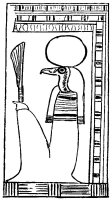
Gatekeeper. ERTAT-SEBANQA.

IV. Gate. SEKHEMET-TESU-HENT-TAUI-HETCHET-KHEFTI-NU-URT-AB-ARIT-SARU-SHUT-EM-AU.
Gatekeeper. NEKAU.

V. Gate. NEBT-REKHU-RESHT-TEBHET-TATU-AN-AQ-ERES-UN-TEP-F.
Gatekeeper. HENTI-REQU.

VI. Gate. NEBT-SENKET-AAT-HEMHEMET-AN-REKH-TU-QA-S-ER-USEKH-S-AN-QEMTU-QET-S-EM-SHAA-AU-HEFU-HER-S-AN-REKH-TENNU-MES-EN-THU-KHER-HAT-URTU-AB.
Gatekeeper. SMAMTI.

VII. Gate. AKKIT-HEBSET-BAK-AAKEBIT-MERT-SEHAP-KHAT.
Gatekeeper. AKENTI.

VIII. Gate. REKHET-BESU-AKHMET-TCHAFU-SEPT-PAU-KHAT-TET-SMAM-AN-NETCHNETCH-ATET-SESH-HER-S-EN-SENT-NAH-S.
Gatekeeper. KHU-TCHET-F.

IX. Gate. AMT-HAT-NEBT-USER-HERT-AB-MESTET-NEB-S-KHEMT-SHAA-. . . .-EM-SHEN-S-SATU-EM-UATCHET-QEMA-THESET-BES-HEBSET-BAK-FEQAT-NEB-S-RA-NEB.
Gatekeeper. TCHESEF.

X. Gate. QAT-KHERU-NEHESET-TENATU-SEBHET-ER-QA-EN-KHERU-S-NERT-NEBT-SHEFSHEFT-AN-TER-S-NETET-EM-KHENNU-S.
Gatekeeper. SEKHEN-UR.

XI. Gate. NEMT-TESU-UBTET-SEBAU-HENT-ENT-SEBKHET-NEBT-ARU-NES-AHEHI-HRU-EN-ANKHEKH.

XII. Gate. NAST-TAUI-SI-SEKSEKET-NEMMATU-EM-NEHEPU-QAHIT-NEBT-KHU-SETEMTH-KHERU-NEB-S.

XIII. Gate. STA-EN-ASAR-AAUI-F-HER-S-SEHETCHET-HAP-EM-AMENT-F.

XIV. Gate. NEBT-TENTEN-KHEBT-HER-TESHERU-ARU-NES-HAKER-HRU-EN-SETEMET-AU.

XV. Gate. BATI-TESHERU-QEMHUT-AARERT-PERT-EM-KERH-SENTCHERT-SEBA-HER-QABI-F-ERTAT-AAUI-S-EN-URTU-AB-EM-AT-F-ART-ITET-SHEM-S.

XVI. Gate. NERUTET-NEBT-AATET-KHAA-KHAU-EM-BA-EN-RETH-KHEBSU-MIT-EN-RETH-SERT-PER-QEMAMET-SHAT.

XVII. Gate. KHEBT-HER-SENF-AHBIT-NEBT-UAUIUAIT.

XVIII. Gate. MER-SETAU-AB-ABTU-MERER-S-SHAT-TEPU-AMKHIT-NEBT-AHA-UHSET-SEBAU-EM-MASHERU.

XIX. Gate. SERT-NEHEPU-EM-AHA-S-URSH-SHEMMET-NEBT-USERU-ANU-EN-TEHUTI-TCHESEF.

XX. Gate. AMT-KHEN-TEPEH-NEB-S-HEBS-REN-S-AMENT-QEMAMU-S-THETET-HATI-EN-AM-S.

XXI. Gate. TEM-SIA-ER-METUU-ARI-HEMEN-HAI-NEBAU-S.

From the above lists, and from copies of them which are found in the Papyrus of Ani, and other finely illustrated Books of the Dead, it is quite clear that, according to one view, Sekhet-Aaru, the land of the blessed, was divided into seven sections, each of which was entered through a Gate having three attendants, and that, according to other traditions, it had sections varying in number from ten to twenty-one, for each of the Gates mentioned above must have been intended to protect a division. It will be noted that the names of the Ten Gates are in reality long sentences, which make sense and can be translated, but there is little doubt that under the XVIIIth Dynasty these sentences were used as purely magical formula, or words of power, which, provided the deceased knew how to pronounce them, there was no great need to understand. In other words, it was not any goodness or virtue of his own which would enable him to pass through the Gates of Sekhet-Aaru, and disarm the opposition of their warders, but the knowledge of certain formula, or words of power, and magical names. We are thus taken back to a very remote period by these ideas, and to a time when the conceptions as to the abode of the blessed were of a purely magical character; the addition of pictures to the formula, or names, belongs to a later period, when it was thought right to strengthen them by illustrations. The deceased, who not only possessed the secret name of a god or demon, but also a picture of him whereby he could easily recognize him when he met him, was doubly armed against danger.

In addition to the Seven Arits, and the Ten, Fourteen, or Twenty-one Gates (according to the manuscript authority followed), the Sekhet-Hetepet possessed Fourteen or Fifteen Aats, or Regions, each of which was presided over by a god. 

Their names, as given in the Papyrus of Nu, are as follows:--

Aat I. AMENTET wherein a man lived on cakes and ale; its god was AMSU-QET, or MENU-QET.

Aat II. SEKHET-AARU. Its walls are of iron. The wheat here is five cubits high, the barley is seven cubits high, and the Spirits who reap them are nine cubits high. The god of this Aat is RA-HERUKHUTI.

Aat III. AATENKHU. Its god was OSIRIS or RA.

Aat IV. TUI-QAUI-AAUI. Its god was SATI-TEMUI.

Aat V. AATENKHU. The Spirits here live upon the inert and feeble. Its god was probably OSIRIS.


Aat VI. AMMEHET, which is presided over either by SEKHER-AT or SEKHER-REMUS. This was sacred to the gods, the Spirits could not find it out, and it was accursed for the dead.

Aat VII. ASES, a region of burning, fiery flame, wherein the serpent REREK lives.

Aat VIII. HA-HETEP, a region containing roaring torrents of water, and ruled over by a god called QA-HA-HETEP. A variant gives the name of this Aat as HA-SERT, and that of its god as FA-PET.


Aat IX. AKESI, a region which is unknown even to the gods; its god was MAA-THETEF, and its only inhabitant is the "god who dwelleth in his egg."
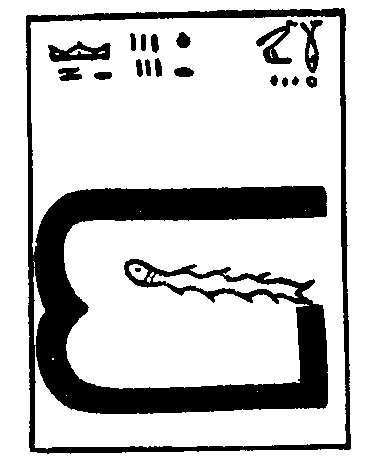
Aat X. NUT-ENT-QAHU, i.e., the city of Qahu. It was also known by the name APT-ENT-QAHU. The gods of this region appear to have been NAU, KAPET, and NEHEB-KAU.

Aat XI. ATU, the god of which was SEPT (Sothis).

Aat XII. UNT, the god of which was HETEMET-BAIU; also called ASTCHETET-EM-AMENT.

Aat XIII. UART-ENT-MU: its deity was the hippopotamus-god called HEBT-RE-F.

Aat XIV. The mountainous region of KHER-AHA, the god of which was HAP, the Nile.

A brief examination of this list of Aats, or Regions, suggests that the divisions of Sekhet-hetepet given in it are arranged in order from south to north, for it is well known that Amentet, the first Aat, was entered from the neighbourbood of Thebes, and that the last-mentioned Aat, i.e., Kher-aha, represents a region quite close to Heliopolis; if this be so, Sekhet-Aaru was probably situated at no great distance from Abydos, near which was the famous "Gap" in the mountains, whereby the spirits of the dead entered the abode set apart for them. We see from this list also that the heaven provided for the blessed was one such as an agricultural population would expect to have, and a nation of farmers would revel in the idea of living among fields of wheat and barley, the former being between seven and eight feet, and the latter between nine and ten feet high. The spirits who reaped this grain are said to have been nine cubits, i.e., over thirteen feet, in height, a statement which seems to indicate that a belief in the existence of men of exceptional height in very ancient days was extant in Egypt traditionally.

Other facts to be gleaned from the list of Aats concerning Sekhet-Aaru are that:--1. One section at least was filled with fire. 2. Another was filled with rushing, roaring waters, which swept everything away before them. 3. In another the serpent Rerek lived. 4. In another the Spirits lived upon the inert and the feeble. 5. In another lived the "Destroyer of Souls." 6. The great antiquity of the ideas about the Aats is proved by the appearance of the names of Hap, the Nile-god, Sept, or Sothis, and the Hippopotamus-goddess, Hebt-re-f, in connection with them.

The qualification for entering the Aats was not so much the living of a good life upon earth as a knowledge of the magical figures which represented them, and their names; these are given twice in the Papyrus of Nu, and as they are of great importance for the study of magical pictures they have been reproduced above.

Of the general form and the divisions of Sekhet-Aaru, or the "Field of Reeds," and Sekhet-hetepet, or the "Field of Peace," thanks to the funeral papyri of the XVIIIth Dynasty, much is known, and they may now be briefly described. From the Papyrus of Nebseni we learn that Sekhet-hetep was rectangular in shape, and that it was intersected by canals, supplied from the stream by which the whole region was enclosed. In one division were three pools of water, in another four pools, and in a third two pools; a place specially set apart was known as the "birthplace of the god of the region," and the "great company of the gods in Sekhet-hetep" occupied another section of it. At the end of a short canal was moored a boat, provided with eight oars or paddles, and each end of it terminated in a serpent's head; in it was a flight of steps. The deceased, as we see, also possessed a boat wherein he sailed about at will, but its form is different from that of the boat moored at the end of the canal. The operations of ploughing, and of seed-time and harvest, are all represented. As to the deceased himself, we see him in the act of offering incense to the "great company of the gods," and he addresses a bearded figure, which is intended probably to represent his father, or some near relation; we see him paddling in a boat, and also sitting on a chair of state smelling a flower, with a table of offerings before him. None of the inscriptions mentions Sekhet-Aaru, but it is distinctly said that the reaping of the grain by the deceased is taking place in Sekhet-hetep, or Sekhet-hetepet.

In chronological order the next picture of Sekhet-hetepet to be considered is that from the Papyrus of Ani, and it will be seen at a glance that in details it differs from that already described. Ani adores the gods in the first division, but he burns no incense; the boat in which he paddles is loaded with offerings, and he is seen dedicating an offering to the bearded figure. The legend reads, "Living in peace in Sekhet--winds for the nostrils." The second division contains scenes of' reaping and treading out of corn, but only three pools of water instead of four. In the third division we see An! ploughing the land by the side of a stream of untold length and breadth, which is said to contain neither fish nor worms. It is important to note that this division is described as SEKHET-AANRU. The eyot which represents the birthplace of the god of the city has no title, and the larger island, which is separated from it by a very narrow strip of ground, contains a flight of steps, but no gods. In the left-hand corner is a place which is described as "the seat of the Spirits, who are seven cubits in height"; the "grain is three cubits high, and it is the perfect Spirits who reap it." In the other portion of this section are two boats instead of one as in the Papyrus of Nebseni.

In connection with the two pictures of Sekhet-hetepet described above, it is important to consider the text which accompanies the older of them, i.e., that of the Papyrus of Nebseni. The deceased is made to say that he sails over the Lake of Hetep (i.e., Peace) in a boat which he brought from the house of Shu, and that he has come to the city of Hetep under the favour of the god of the region, who is also called Hetep. He says, "My mouth is strong, I am equipped [with words of power to use as weapons] against the Spirits let them not have dominion over me. Let me be rewarded with thy fields, O thou god Hetep. That which is thy wish do, O lord of the winds. May I become a spirit therein, may I eat therein, may I drink therein, may I plough therein, may I reap therein, may I fight therein, may I make love therein, may my words be powerful therein, may I never be in a state of servitude therein, and may I be in authority therein . . . . . . [Let me] live with the god Hetep, clothed, and not despoiled by the 'lords of the north,' and may the lords of divine things bring food unto me. May he make me to go forward and may I come forth; may he bring my power to me there, may I receive it, and may my equipment be from the god Hetep. May I gain dominion over the great and mighty word which is in my body in this my place, and by it I shall have memory and not forget." The pools and places in Sekhet-hetepet which the deceased mentions as having a desire to visit are UNEN-EM-HETEP, the first large division of the region; NEBT-TAUI, a pool in the second division; NUT-URT, a pool in the first division; UAKH, a pool in the second division, where the kau, or "doubles," dwell; TCHEFET, a portion of the third division, wherein the deceased arrays himself in the apparel of Ra; UNEN-EM-HETEP, the birthplace of the Great God; QENQENTET, a pool in the first division, where he sees his father, and looks upon his mother, and has intercourse with his wife, and where he catches worms and serpents and frees himself from them; the Lake of TCHESERT, wherein he plunges, and so cleanses himself from all impurities; HAST, where the god ARI-EN-AB-F binds on his head for him; USERT, a pool in the first division, and SMAM, a pool in the third division of Sekhet-hetepet. Having visited all these places, and recited all the words of power with which he was provided, and ascribed praises to the gods, the deceased brings his boat to anchor, and, presumably, takes up his abode in the Field of Peace for ever.

From the extract from the Chapter of Sekhet-Aaru and Sekhet-hetepet given above, it is quite clear that the followers of Osiris hoped and expected to do in the next world exactly what they had done in this, and that they believed they would obtain and continue to live their life in the world to come by means of a word of power; and that they prayed to the god Hetep for dominion over it, so that they might keep it firmly in their memories, and not forget it. This is another proof that in the earliest times men relied in their hope of a future life more on the learning and remembering of a potent name or formula than on the merits of their moral and religious excellences. From first to last throughout the chapter there is no mention of the god Osiris, unless he be the "Great God" whose birthplace is said to be in the region Unen-em-hetep, and nowhere in it is there any suggestion that the permission or favour of Osiris is necessary for those who would enter either Sekhet-Aaru or Sekhet-hetep. This seems to indicate that the conceptions about the Other World, at least so far as the "realms of the blest" were concerned, were evolved in the minds of Egyptian theologians before Osiris attained to the high position which he occupied in the Dynastic Period. On the other hand, the evidence on this point which is to be deduced from the Papyrus of Ani must be taken into account.

At the beginning of this Papyrus we have first of all Hymns to Ra and Osiris, and the famous Judgment Scene which is familiar to all. We see the heart of Ani being weighed in the Balance against the symbol of righteousness in the presence of the Great Company of the Gods, and the weighing takes place at one end of the house of Osiris, whilst Osiris sits in his shrine at the other. The "guardian of the Balance" is Anubis, and the registrar is Thoth, the scribe of the gods, who is seen noting the result of the weighing. In the picture the beam of the Balance is quite level, which shows that the heart of Ani exactly counterbalances the symbol of righteousness. 

This result Thoth announces to the gods in the following words, "In very truth the heart of Osiris hath been weighed, and his soul hath stood as a witness for him; its case is right (i.e., it hath been found true by trial) in the Great Balance. No wickedness hath been found in him, he hath not purloined the offerings in the temples, and he hath done no evil by deed or word whilst he was upon earth." The gods in their reply accept Thoth's report, and declare that, so far as they are concerned, Ani has committed neither sin nor evil. 

Further, they go on to say that he shall not be delivered over to the monster Amemet, and they order that he shall have offerings, that he shall have the power to go into the presence of Osiris, and that he shall have a homestead, or allotment, in Sekhet-hetepet for ever. We next see Ani being led into the presence of Osiris by Horus, the son of Isis, who reports that the heart of Ani hath sinned against no god or goddess; as it hath also been found just and righteous according to the written laws of the gods, he asks that Ani may have cakes and ale given to him, and the power to appear before Osiris, and that he may take his place among the "Followers of Horus," and be like them for ever.

Now from this evidence it is clear that Ani was considered to have merited his reward in Sekhet-hetepet by the righteousness and integrity of his life upon earth as regards his fellow-man, and by the reverence and worship which he paid to every god and every goddess; in other words, it is made to appear that he had earned his reward, or had justified himself by his works. Because his heart had emerged triumphantly from its trial the gods decreed for him the right to appear in the presence of the god Osiris, and ordered him to be provided with a homestead in Sekhet-hetep. There is no mention of any repentance on Ani's part for wrong done; indeed, he says definitely, "There is no sin in my body.

I have not uttered wittingly that which is untrue, and I have committed no act having a double motive [in my mind]." As he was troubled by no remembrance of sin, his conscience was clear, and he expected to receive his reward, not as an act of mercy on the part of the gods, but as an act of justice. Thus it would seem that repentance played no part in the religion of the primitive inhabitants of Egypt, and that a man atoned for his misdeeds by the giving of offerings, by sacrifice, and by worship. On the other hand, Nebseni is made to say to the god of Sekhet-hetep, 

"Let me be rewarded with thy fields, O Hetep; but do thou according to thy will, O lord of the winds." 

This petition reveals a frame of mind which recognizes submissively the omnipotence of the god's will, and the words "do thou according to thy will" are no doubt the equivalent of those which men of all nations and in every age have prayed--

"Thy will be done."

The descriptions of the pictures of Sekhet-hetep given above make it evident that the views expressed in the Papyrus of Nebseni differ in some important details from those which we find in the Papyrus of Ani, but whether this difference is due to some general development in religious thought, which took place in the interval between the periods when the papyri were written, cannot be said. There is abundant evidence in the Papyrus of Ani that Ani himself was a very religious man, and we are not assuming too much when we say that he was the type of a devout worshipper of Osiris, whose beliefs, though in some respects of a highly spiritual character, were influenced by the magic and gross material views which seem to have been inseparable from the religion of every Egyptian. 

Though intensely logical in some of their views about the Other World, the Egyptians were very illogical in others, and they appear to have seen neither difficulty nor absurdity in holding at the same time beliefs which were inconsistent and contradictory. It must, however, in fairness be said that this characteristic was due partly to their innate conservatism in religious matters, and their respect for the written word, and partly to their fear that they might prejudice their interests in the future life if they rejected any scripture or picture which antiquity, or religious custom, or tradition had sanctioned.

Certain examples, however, prove that the Egyptians of one period were not afraid to modify or develop ideas which had come down to them from another, as may be seen from the accompanying illustration.


This picture is intended to represent Sekhet-hetepet, and is taken from the inner coffin of Kua-Tep, which was found at Al-Barsha, and is now in the British Museum (No. 30,840); it dates front the period of the XIth Dynasty. From this we see that the country of the blessed was rectangular in shape, and surrounded by water, and intersected by streams, and that, in addition to large tracts of land, there were numbers of eyots belonging to it. In many pictures these eyots are confounded with lakes, but it is pretty clear that the "Islands of the Blessed" were either fertile eyots, or oases which appeared to be green islands in a sea of sand. Near the first section were three, near the second four, near the third four, three, being oval, and one triangular; the fourth section was divided into three parts by means of a canal with two arms, and contained the birthplace of the god, and near it were seven eyots; the fifth is the smallest division of all, and has only one eyot near it. Each eyot has a name which accorded with its chief characteristic; the dimensions of three of the streams or divisions are given, the region where ploughing takes place is indicated, and the positions of the staircase and the mystic boat are clearly shown. The name of the god Hetep occurs twice, and that of Osiris once.

If now we compare this picture with that front the Papyrus of Nebseni we shall find that the actual operations of ploughing, reaping, and treading out of the corn are depicted on the Papyrus, and that several figures of gods and the deceased have been added. The text speaks of offerings made by the deceased, and of his sailing in a boat, &c., therefore the artist added scenes in which he is depicted doing these things; and the lower part of the picture in the Papyrus has been modified considerably. In the second division it may be noted that Nebseni is seen laying both hands on the back of the Bennu bird; there is no authority for this in the older copy of the picture. 


In this illustration on which is reproduced from the coffin of Sen, in the British Museum (No. 30,841), a still simpler form of Sekhet-hetepet is seen; here we have only nine eyots, which are grouped together, and no inscription of any kind.

Still further modifications were introduced into the pictures of Sekhet-hetepet drawn in later times, and, in order that the reader may be enabled to trace some of the most striking of these, copies of Sekhet-hetepet from the Papyrus of Anhai (about B.C. 1040), and from that of Auf-ankh (Ptolemaïc Period)

Thursday, November 16, 2017

Book of the Earth

From Wikipedia, the free encyclopedia

The first vestiges we have of the Book of the Earth appear in the tombs of Merneptah (tomb), Tausert (tomb) and Ramesses III(tomb), where two scenes that wold later be including in the complete composition are depicted on the left wall of their sarcophagus chambers. They serve as a counterpart to the concluding representations of the Book of Caverns. We also find the solar barque atopAker as a double sphinx as an individual scene from Merneptah on, and in the Tomb of Ramesses IV, it concludes the representation in the decoration of his tomb.

In the tomb of Ramesses VI, all the decorated walls of the sarcophagus chamber have scenes from the Book of the Earth, though in the tomb of Ramesses VII, only one register depicts the scenes from parts D and C. Finally, Ramesses IX uses two scenes from part A in his tomb. All of the examples of this book appear within the sarcophagus chambers of the royal tombs, including one scene represented on the actual sarcophagus of Ramesses IV. Later, individual scenes also occur on several sarcophagi of the Late Period.

We also find individual scenes from the Book of the Earth in the cenotaph of Seti I at Abydos, as well as in the tomb of Osorkon II at Tanis. The section of the Book of the Earth that Painkoff called the Book of Aker occurs on Papyri of the 21st Dynasty, together with variations on the resurrection scene in A2, the tombs of Petamenophis and Padineith, TT197 of the 26th Dynasty at Thebes, and Lepsius 23 at Saqqara. We also see, from the Late Period, the depiction of Nut from part D in the tomb of Aba (TT36) and the scene of the birth of the stars on a cartonnage from the Ramesseum.


This funerary composition lacks an original ancient Egyptian title, and has actually been called by a number of names, depending on the scholar. Piankoff refers to it as La creation du disque solaire (The Creation of the Sun Disk). Hartwig Altenmuller calls it Buch des Aker (Book of Aker), while Erik Hornung names it Buch von der Erde (Book of the Earth) and Barta refers to it as Erdbunch (Earth-Book).

This was the last great composition concerning the netherworld, where the sun disk is raised up from the depths of the earth by numerous pairs of arms, and where the enemies of Egypt, those whose souls have not been blessed, are punished and destroyed in the Place of Annihilation.

Above all, it stresses the gods of the depths of the earth such as

The central figures in the story are Osiris, Ra and Ba, while the overarching plot is the journey the sun takes through the gods of earth, Aker, Geb and Tatenen.

Original sources

The scenes were found on all of the walls of the tombs of Ramesses VI and Ramesses VII. There were a few additional scenes found on the walls of other royal tombs extending from the New Kingdom to the Late Period, but since many scene from the Book were scattered around, the ordering of the illustrations is slightly convoluted.
Jean-François Champollion was the first one to publish the scenes and texts from the tomb of Ramesses VI in his Monuments de l'Egypte where he deciphered the hieroglyphs depicted in the tombs. Alexandre Piankoff was the first one to really study the composition of the images and hieroglyphics and looked for a meaning behind the illustrations. Bruno H. Stricker provided an explanation of the Book as a divine embryology in 1963.

Structure of the book


In the Book of the Earth, just as in the Book of Caverns, the hours of the night are not divided into sections, and the solar barque is largely missing as an aid to orientation. Though the original composition was probably divided into three registers, the registers in the surviving work are uncertain. Hence, the composition seems like a loose sequence of scenes. Because of the incomplete condition of his sarcophagus chamber which gives rise to various transpositions of materials, it is very uncertain whether the tomb of Ramesses VI provides a complete example of the Book of the Earth. Like the Book of Caverns, portions of it appear on the sides of several pillars. Scholars such as Abitz believe that the Book of the Earth, like the Book of Caverns, consists of two halves of which only one contains scenes of punishment. Like the Book of Caverns, the Book of the Earth uses the sun disk as a reoccurring theme, while the solar barque only makes rare appearances.

The directions of the scenes are mostly all oriented to the right and there is no visible morning goal, nor is there depicted the entry into the netherworlds. In the tomb of Ramesses VI, the divisions of the book run right to left, which is contrary to the usual arrangement. Piankoff recognized four parts, which were lettered A-D, while Abitz added further scenes on three pillar sides as parts E. He further theorizes that part D. with its praying king, represents the beginning of the composition, as at the beginning of the corridor of the Osireion. Further more, he believes part B belongs in part A, and part C to be a part of D. Barta instead designates the sequences of scenes from the sarcophagus chamber of Ramesses VII and Ramesses IX as part E, with the last scenes derived from a wide variety of books. Part A in the tomb of Ramesses VI portrays a clear central axis that has probably led to changes in the arrangements of the scenes in later versions. Unless the Aker scene is intended as such, there is also no concluding representations at the end of the composition.

Lake the Book of Caverns, Ramesses VI inserted many references to the king throughout the composition and uses subtitles to structure it.


Content


While the content of the book is similar in many ways to the Book of Caverns, there remain clear divergences also. Osiris is, of course, an central figure within the work, as is the transformation of Re, together with the ba of the blessed dead. A special theme is the journey of the sun through the earth god Aker. This actually represents and expansion of the eleventh scene in the Book of Gates, with its " barque of the earth".

Part E
In this part, there are six gods shown praying to a sun disc at burial mounds. This is smallest portion of the Book that is known, and Part E is most likely not the beginning of the Book of the Earth.

Part D

Part D is probably the beginning of the composition, where most of the setting is introduced. A majority of the content of the Book of the Earth is also located within this section. The realm of the dead is depicted with Osiris, as the primary figure, located within a tomb that is guarded by serpents. Beneath Osiris are the gods Anubis and another god who have their arms stretched out to provide protection over his corpse. This scene depicts renewal, while the scenes on both adjacent sides depict punishment. In the scenes of punishment, the gods of punishment are represented and are holding cauldrons.
Next, the mummy of the sun god stands upon a large sun disc that is enclosed by two pairs of arms rising from the depths of Nun. Surrounding this scene is a wreath of twelve stars and twelve small disks that indicate the course of the hours. The hands of two goddesses hold the ends of this illustration.
The final scene in this section shows Aker, who is representing the barque of the sun god, as a double sphinx. The barque is supported by two uraei, and inside the barque are Khepri and Thoth who are praying to the sun god. Underneath the barque are two royal figures with Isis and Nephthys who are holding a winged scarab beetle and a sun disc.
The middle register begins with Horus rising up out of a divine figure called the "Western One." Next, there are seven mounds that each contains a god. In the next scene, the propagation of Horus is repeated in which Horus is now falcon-headed, and rises from the body of Osiris which is being protected by the corpses of Isis and Nephthys.
In the next scene, Nun's arms are holding the solar disc, and other arms and two uraei hold another sun disc. A serpent is located on the top of this sun disc, which might signify the regeneration of the sun.
Like many Ancient Egyptian texts, the bottom register shows the punishment of enemies in the Place of Annihilation since it is below the gods. Since gods are more important figures, they are depicted above others. The sun god is shown above with several sarcophagi and four enemies below.
Finally, we find a corpse lying in a large sarcophagus located in the Place of Annihilation, which Re calls the "corpse of Shetit." This is the realm of the dead where gods and goddesses above the scene hold their hands out in prayer. In the last scene, we find the Apophis serpent being seized by ram headed gods.

Part C

Part C comprises three registers that might be connected to Part D, but the exact sequence is unclear. The upper and middle registers both start off with images of the sun god in his ram-headed form. Two ba-birds are praying to him while an unknown god is greeting him in the middle register. Behind the unknown god are two additional gods, one being ram-headed and the other being serpent-headed. These gods have their hands stretched out in front of them, towards the sun disc, in a protective gesture. Out of this gesture, the falcon shaped head of "Horus of the netherworld" is projected.

Part B

The registers of this section are less obvious, and many parts might be considered to belong to Part A. The first scenes in this section consist of four oval shapes with mummies inside, which are able to breathe from the rays of the sun god. There are also four burial mounds that have been turned over and are being protected by serpents. The main part of this section depicts a mummy, who is standing, called "corpse of the god," which is also the sun disc itself. In front of him, a serpent rises out of a pair of arms and holds a god and goddess in the act of praise. Behind the mummy is another par of arms, called the "arms of darkness," that is being supported by the crocodile, Penwenti.
Next, there are four more ovals containing mummies with four ba-birds, one ba-bird for each mummy. This, along with two additional hieroglyphs, represents shadows. Underneath this illustration are depictions of barques that contain the mummies of Osiris and the falcon-headed Horus.
At the end of this segment of the Book of the Earth, the upper portion shows a depiction of a large burial mound, containing the sun disc with an unknown god praying to it. Two heads and two goddesses that are located on both sides of the large burial mound also give praise. Directly below this, on the bottom register, are four gods and ba-birds that are also praying.

Part A

In the beginning of this section, the sun god is enclosed by mummies at a burial mound called the Mound of Darkness. Above this mound, a solar barque is shown. Following this scene, Aker is depicted as a double sphinx. the solar barque is located between the entrance and the exit of the realm of the dead, with its stern side facing the exit. Below shows the resurrection of the corpse of the sun, which is a scene that typically occurs in royal sarcophagus chambers. A falcon head emerges from a sun disc, and the light is shown falling on the "mysterious corpse" which is lying down. In the next scene, twelve goddess, each representing an hour of the night, are depicted. Each goddess has the hieroglyph of a star and a hieroglyph of a shadow with a beaming disk above her. At the beginning of the fourth scene, a few of the mummies are enclosed within four large circles. In the fifth scene, a central god, who is thought to be Osiris, is surrounded by the corpses of Shu (Egyptian deity)Tefnut, Khepri and Nun. The sixth scene, shows a pair of arms rising from the depths. A goddess called Annihilator stands up with her arms reaching to embrace a sun disc. The arms are supporting two praying goddesses named West and East in a reverse orientation. It is believed that the upper register of this part ends with a line containing a title of this work, though it is still unknown.
The middle register begins with the solar barque again. It is towed by fourteen ram-headed gods with all of their bas. Next, a god stands in his cave, surrounded by twelve star goddesses who are extending discs to him.
The following scene, which is scattered around the tomb of Ramesses VI, shows five burial mounds with a head and arms emerging from it. They are raised up in a gesture of praise. In the third scene, the birth of the sun is represented. This scene also occurs on the sarcophagus of Ramesses IV, but there is more detail and more story on that sarcophagus than in this scene.


Part A of the Book of the Earth

Part B and C from the Book of the Earth

Part D from the Book of the Earth


Monday, November 13, 2017

Lecture: the sandy island of Sokar aka Seker


Seker-Osiris
z
k
r
P3
Seker
in hieroglyphs
Seker (/ˈsɛkər/; also spelled Sokar) is a falcon god of the Memphite necropolis.

Name

Although the meaning of his name remains uncertain, the Egyptians in the Pyramid Texts linked his name to the anguished cry of Osiris to Isis 'Sy-k-ri' ('hurry to me'), or possibly skr, meaning "cleaning the mouth". In the underworld, Seker is strongly linked with two other gods, Ptah the Creator god and chief god of Memphis, and Osiris the god of the dead. In later periods this connection was expressed as the triple god Ptah-Seker-Osiris.

Appearance

Seker was usually depicted as a mummified hawk and sometimes as a mound from which the head of a hawk appears. Here he is called 'he who is on his sand'. Sometimes he is shown on his hennu barque which was an elaborate sledge for negotiating the sandy necropolis. One of his titles was 'He of Restau' which means the place of 'openings' or tomb entrances.
In the New Kingdom Book of the Underworld, the Amduat, he is shown standing on the back of a serpent between two spread wings; as an expression of freedom this suggests a connection with resurrection or perhaps a satisfactory transit of the underworld. Despite this the region of the underworld associated with Seker was seen as difficult, sandy terrain called the Imhet (also called AmhetAmmahet, or Ammehet; meaning 'filled up').

Roles and cults

Seker, possibly through his association with Ptah, also has a connection with craftsmen. In the Book of the Dead he is said to fashion silver bowls and a silver coffin of Sheshonq II has been discovered at Tanis decorated with the iconography of Seker. Seker's cult center was in Memphis where festivals in his honor were held on the 26th day of the fourth month of the akhet (spring) season. While these festivals took place, devotees would hoe and till the ground, along with driving cattle, which showed that Seker could have had agricultural aspects about him.
Also during the festivals in akhet, his followers had strings of onions around their necks, showing the Underworld part of him. Onions were used in embalming people - sometimes the skin, sometimes the entire onion. When just the skin was used, it would be placed on the eyes and inside the ears to mask the smell.
Also, the god was depicted as assisting in various tasks such as digging ditches and canals. From the New Kingdom a similar festival was held in Thebes, which rivaled the great Opet Festival
Other events during the festival including floating a statue of the god on a Henu barque, which was a boat with a high prow shaped like an oryx.

Tuesday, November 7, 2017

ORIGIN OF ILLUSTRATED GUIDES TO THE OTHER WORLD.


THE inhabitants of Egypt during the Dynastic Period of their history possessed, in common with other peoples of similar antiquity, very definite ideas about the abode of departed spirits, but few, if any, ancient nations caused their beliefs about the situation and form, and divisions, and inhabitants of their Heaven and Hell, or "Other World," to be described so fully in writing, and none have illustrated the written descriptions of their beliefs so copiously with pictorial representations of the gods and devils, and the good and evil spirits and other beings, who were supposed to exist in the kingdom of the dead. It is now generally admitted that Egyptian Dynastic History covers a period of nearly five thousand years, but it must not

be assumed for one moment that it is at present possible to describe in a connected or complete form all the views and opinions about their Other World which were held by the theologians and the uneducated classes of Egypt during this long space of time, and it must be said at once that the materials for such a work are not forthcoming. All that can be done is to collect from the copies that have come down to us of the books which relate to the state and condition of the dead, and to the abode of departed spirits, the beliefs which are enunciated or referred to therein, and, taking them so far as possible in chronological order, to piece them together and then make deductions and draw general conclusions from them. We must always remember that the texts of the various Books of the Dead are far older than the illustrations found in the later recessions of them which are now in our hands, and that such illustrations, in matters of detail at least, reflect the opinions of the priestly class that held religious supremacy at the time when they were drawn or painted. In cases where archetypes were available the artist was careful to follow in all general matters the ancient copies to which he had access, but when new beliefs and new religious conceptions had to be illustrated, he was free to treat them pictorially according to his own knowledge, and according to the wishes of those who employed him.

The oldest Books of the Dead known to us, that is to say, the religious compositions which are inscribed on the walls of the chambers and corridors of the pyramids of kings Unas, Teta, Pepi I., Mer-en-Ra, and Pepi II., are without illustrations of any sort or kind, and it is not easy to account for this fact. That the Egyptians possessed artistic skill sufficient to illustrate the religious and general works which their theologians wrote or revised, under their earliest dynasties of kings of all Egypt, is evident from the plain and colored bas-reliefs which adorn the walls of their mastabas, or bench-shaped tombs, and we can only point out and wonder at the fact that the royal pyramids contain neither painted nor sculptured vignettes, especially as pictures are much needed to break the monotony of the hundreds of lines of large hieroglyphics, painted in a bluish-green color, which must have dazzled the eyes even of an Egyptian. The reason, however, why such early texts are not illustrated is probably not far to seek. Professor Maspero has proved that the "pyramid texts" contain formulas and paragraphs which, judging from the grammatical forms that occur in them, it is easy to see must have been composed, if not actually written down, in the earliest times of Egyptian civilization. These formulas, &c., are interspersed with others of later periods, and it seems as if, at the time when the "pyramid texts" were cut into stone, these religious compositions were intended to contain expressions of pious thought about the hereafter which would satisfy both those who accepted the ancient indigenous beliefs, and those who were prepared to believe the doctrines which had been promulgated by the priests of the famous brotherhood of Ra, the Sun-god, who had made their head-quarters in Egypt at Annu, i.e., On, or Heliopolis. The old native beliefs of the country were of a more material character than the doctrines which the priests of Heliopolis taught, but it was found impossible to eradicate them from the minds of the people, and the priests therefore framed religious works in such a manner that they might be acceptable both to those who believed in the old animal-gods, tree-gods, plant-gods, &c., of Egypt, and those who preferred a purely solar cult, such as that of the worship of the Sun-god Ra. The oldest Books of the Dead, in fact, represent the compromise arrived at under the IVth, Vth, and VIth Dynasties, between the priests of the old and the new religions. This being so, the religious texts of the period represent too much a patch-work belief for purposes of systematic illustration, and in the result, and perhaps also through the funeral customs of the day, the growth in men's minds of the wish for illustrated guides to the Underworld was retarded.

When the glory of sovereignty departed from the kings who held court at Memphis after the end of the rule of the VIth Dynasty, the system of solar theology, which had been promulgated in Lower Egypt by the priests of Heliopolis, began to make its way into Upper Egypt, and wherever it came it assumed a leading position among the religious systems of the day. The kings of the VIIth and VIIIth Dynasties, like those of the IIIrd, IVth, and VIth, came from Memphis, but they had comparatively little power in the land, and, so far as we know, they did not build for themselves pyramids for tombs, and there is no evidence forthcoming to show that they filled the walls of their sepulchers with religious texts. They carried on neither wars nor building operations of any importance, and it seems that their tombs were neither large nor magnificent. Owing to their feeble rule the governors of Suten-henen, or Herakleopolis, and those who ruled in the provinces near that city, succeeded in gaining their independence, and the kings of the IXth and Xth Dynasties were Herakleopolitans; their rule gradually extended to the south, and the religious influence of their priests was so great that they succeeded in forcing many of their mythological legends and beliefs into the accepted religion of the country, and these subsequently became part and parcel of the great Recension of the Theban Book of the Dead. The dominion of the Herakleopolitans, however, was of comparatively short duration, and it collapsed under the attacks of the bold and vigorous governors of the Thebaïd, whose capital was at Thebes. Judging from the historical evidence concerning the period which lies between the VIth and the XIth Dynasties, neither the two last Memphitic nor the two Herakleopolitan Dynasties of kings did anything to improve the general condition of the country, and it seems as if they found it necessary to employ all their energies to maintain their position and the little real power in the country which they possessed.

As this was the case, we need not wonder that all magnificence disappeared from funeral rites and ceremonies, and that the tombs of the period were small and unimportant. The gods were worshiped and the dead were buried as matters of course, but it goes without saying that kings, whose authority was not consolidated, and whose power was ineffective except in the immediate neighborhood of the towns in which they lived, who were unable to wage wars in Syria and Sinai and to bring back much spoil, could neither establish Colleges of priests nor endow new temples; for in ancient Egypt, as elsewhere, the fortunes of the gods and the wealth of their sanctuaries increased or declined according as the inhabitants of the land were prosperous or otherwise. Similarly also, when the community was suffering from the evil effects of a long period of civil wars, and business was at a standstill, and farmers were unable to carry on the usual agricultural operations on which both the government and the priesthood ultimately depended for support, it was impossible for men to bury their dead with all the pomp and ceremony which were the characteristics of funerals in times of peace and prosperity. The innate conservatism of the Egyptians made them cling to their ancient beliefs during this period of stress, but no important pyramids were built, and very few private funeral chapels were maintained at expensive rates, and the souls of the dead were committed to such protection as could be obtained by the prayers of their relatives and friends, and by the utterance of religious formula, and by inexpensive amulets.

With the rise to power of the Princes of Thebes, things took a turn for the better so far as worship in the temples and the care for the dead were concerned. So soon as they had overcome their enemies the Princes of Herakleopolis, and their confederates the Princes of Asyut, and had firmly established themselves on the throne of Egypt, they sent men to reopen the quarries in the First Cataract and in the Wadi Hammamat near Coptos. This is a sure proof that the new line of kings, most of whom bear the name of Menthu-hetep, had need of large quantities of granite, and of sandstone of various kinds, and such materials can only have been required for the building of temples and palaces, and funeral altars and stelae, sarcophagi, &c. The fact that the work was begun again in the quarries also proves that the authority of the Menthu-heteps was well established. Menthu-hetep II., we are told by an inscription set up in the Wadi Hammamat by his officer Amen-em-hat, caused to be quarried a block of stone which measured eight cubits, by four cubits, by two cubits, i.e., about thirteen feet six inches long, six feet six inches wide, and three feet six inches thick, and it is probable that he required this for a sarcophagus. This king is also famous as the maker of a well in the desert, the mouth of which was about sixteen feet six inches square; and at one time he employed several thousands of men, including three thousand carriers or boatmen, in his stone-works. His successor, Menthu-hetep III., continued the work in the quarries, and built himself a pyramid, called Khu-ast, in the mountain of Tchesert at Thebes, which may now be identified with that portion of the great Theban cemetery to which the name Der al-Bahari was given by the Arabic-speaking Egyptians.

This building is mentioned in the great Abbott Papyrus preserved in the British Museum (No. 10,221), where it is declared to have been found unviolated by the members of the Commission which was appointed to inquire into the condition of the royal tombs, after the robberies which had taken place in them about the period of the rule of the priest-kings of Thebes, B.C. 1,000. The remains of the tomb of Menthu-hetep III. have been recently discovered, and though at the time of writing it has not been completely excavated, sufficient has been done to show that it is a very remarkable building. It is clear that the lower part of it is rectangular, and that it was surrounded by a colonnade; the outside is eased with limestone slabs, behind which is a "wall of rough and heavy nodules of flint, and the middle is filled with rubbish and loose stones." On this rectangular building, or base, a small pyramid probably stood, at least, this is what we should expect. The remains already excavated prove that this base was surrounded by a triple row of columns, which supported a ceiling and formed a hypostyle passage or colonnade, which "must have been quite dark, or nearly so (like the ambulatories surrounding the shrines in later temples), for the outside was closed by a thick wall." Between this wall and the edge of the platform on which the building stood was an outer colonnade of square pillars, but the pillars no longer exist. In the rock below the pavement of this colonnade a number of tombs were hewn; each consisted of a pit from twelve to fifteen feet deep, which led to a small rectangular chamber, wherein originally stood a limestone sarcophagus. In these tombs women who were both priestesses of Hathor and members of the royal harim were buried, and further excavations will no doubt reveal the fact that Menthu-hetep's high officers of state were buried in somewhat similar tombs in the immediate neighbourhood of the remarkable monument which the Egypt Exploration Fund has brought to light through the exertion of Prof. E. Naville and Mr. H. R. Hall.

The facts given above indicate that Menthu-hetep III. built a splendid tomb at Thebes, and it seems that in certain particulars he copied the royal pyramid tombs of the IVth, Vth, and VIth Dynasties. It is unlikely that the superstructure which he set upon the rectangular base, to which reference has been made above, and which is assumed to have been in the form of a pyramid, was as large as any of the important pyramids of Giza, and the base on which it rested is "a new and interesting fact in Egyptian architecture"; but when he set his funeral monument on the rocky platform in the mountain of Tchesert it is more than probable that either he or his architect had in mind the rocky platform on which the great Pyramids of Giza stand, and it seems as if he built it on a massive rectangular base, so that it might appear conspicuous and imposing from a distance. Like the earlier royal builders of pyramids, Menthu-hetep built a funeral temple in connexion with his pyramid, and established an order of priests, who were to perform the services and ceremonies connected with his worship, and he allowed the ladies of his court to be buried round about it, just as did the kings of old who reigned at Memphis. The great feature of Menthu-hetep's monument, which has no parallel in the older pyramids in the north of Egypt, is the ramp, with a double row of square columns on each side of it, which he built on the front or eastern face of the temple platform.

Now whilst Menthu-hetep III. was employed in building his pyramid and funeral temple, the hereditary governors and nobles of important provinces in Upper Egypt were not slow to avail themselves of the opportunity which peace and the renewed prosperity of the country gave them, and they began to make rock-hewn tombs for themselves and the members of their families in the hills, and to cause their bodies to be buried in elaborately inscribed or painted wooden coffins. Of coffins of this period, one of the oldest examples is that of AMAMU which was purchased by the Trustees of the British Museum so long ago as 1834. On the inside of this coffin is inscribed in black ink in the hieratic character a series of texts which are extracts from the Heliopolitan Recension of the Book of the Dead; these are enclosed within a coloured border, formed of rectangles, painted in blue, green, yellow, and red. Above the texts are carefully drawn, and painted as nearly as possible in their natural colours, representations of most of the objects which the deceased hoped he would use in the Underworld, and these pictures prove that the knowledge of the elaborate funeral rites and ceremonies, which were observed at Memphis under the IVth Dynasty, had descended in a complete state to the period when Amamu's coffin was made and ornamented.

In connection with Amamu's coffin reference must be made to a large group of coffins which was excavated a few years ago at Al-Barsha, a place situated on the north side of a rocky valley, just behind the modern Coptic village of Der An-Nakhla, near Shekh Abada (the ancient Antinoë), in Upper Egypt. All the coffins found here are rectangular in shape, and have so much in common with the coffin of Amamu, in respect of shape, and in the arrangement of their texts and pictures, including the representations of mastaba doors, that it seems impossible to assign to them a date much earlier or later than the period of the XIth Dynasty. For our present purpose, however, whatever be their exact date, they are of the greatest importance, for on the insides of the panels of some of them are painted the oldest known illustrations of certain sections of Books of the Dead. The texts inscribed on them contain extracts from the Heliopolitan Recension of the Book of the Dead, of which we know so much from the selections given in the Pyramids of Unas, Teta, and other kings, but side by side with these are copies of chapters belonging to Books of the Dead, which seem to have been originally composed at some anterior period, and which were intended to reflect the more popular and more materialistic religious views and beliefs. Among such books must be mentioned the "Book of Two Ways," or the "Two Ways of the Blessed Dead," of which a version inscribed on a coffin in the Berlin Museum has been recently published. The rubrical directions of this work show that it was compiled when implicit belief existed in the minds of the Egyptians as to the efficacy of certain "words of power" (hekau) and of pictures of the gods, and it is clear that many portions of it are purely magical, and were intended to produce very material results. Thus concerning one passage a rubric says, "Whosoever knoweth this Chapter may have union with women by night or by day, and the heart (or, desire) of the woman shall come to him whensoever he would enjoy her." This rubric follows a text in which the deceased is made to pray for power of generation similar to that possessed by the god Beba, and for the will and opportunity of overcoming women, and it was to be written on a bandlet which was to be attached to the right arm. Moreover, the soul which had knowledge of certain sections of the work would "live among the living ones," and would "see Osiris every day," and would have "air in his nostrils, and death would never draw nigh unto him." The illustrations which accompany the texts on the coffins from Al-Barsha make it evident that under the XIth Dynasty the Egyptian theologian had not only divided the Under-world in his mind into sections, with doors, &c., but that he was prepared to describe that portion of it which belonged to the blessed dead, and to supply a plan of it! Besides the sections from the "Pyramid Texts," to which reference has already been made, and the "Book of the Two Ways," the coffins of Al-Barsha contain a number of texts of various lengths, many of which have titles, and resemble in form the Chapters of the great Theban Recension of the Book of the Dead. Examples of these have been published in Prof. Maspero's Recueil de Travaux, tom. xxvi., p. 64 ff., by M. P. Lacau, e.g., "Chapter of the Seven Addresses of homage to the goddess Meh-urt"; [Chapter of] "the reassembling of the kinsfolk of a man in Neter-khert"; "Chapter of driving back Kebka"; "Chapter of setting out for Orion," &c.

From the considerations set forth above it is quite clear that the practice of illustrating certain sections of Books of the Dead existed under the XIth Dynasty, and there is no good reason for doubting that it continued to be observed during the prosperous rule of the kings of the XIIth Dynasty. Under the IVth, Vth, and VIth Dynasties the selections of extracts from Books of the Dead which were intended to benefit royal souls in the Underworld were cut upon the walls of the chambers and corridors of their pyramids, and in the case of private individuals texts intended to produce the same effect were usually cut into the walls of the chambers wherein their stone sarcophagi were placed. The pyramids of the kings of the XIth and XIIth Dynasties, whether in the north or south of Egypt, are not, so far as the information at present available goes, characterized by lengthy extracts from Books of the Dead, and officials and men of rank in general were content to dispense with the cutting of religious inscriptions into the sides of stone sarcophagi, and into the walls of the passages and chambers of their tombs in the mountains, and to transfer them to the sides of their brightly painted, rectangular wooden coffins. The practical advantages of this change are obvious. Wooden coffins were easier to obtain and cheaper than stone sarcophagi, longer and fuller selections from religious texts could be easily and quickly traced upon them in the hieratic character, which an expert scribe could, no doubt, write at a rapid rate, the expense of adding coloured drawings was small, and, above all, the deceased would have close to his mummy the sacred writings on which he so greatly relied for assistance in the Other World. The coffin which was fully inscribed could easily be made to hold copies of all the texts deemed to be of vital importance to the dead, and such a coffin when, as was frequently the case, it was placed in a massive, outer, wooden coffin, served the purpose of the large rolls of papyri inscribed with religious and funeral texts, and illustrated with elaborately painted vignettes, which were buried with the dead from the XVIIIth to the XXVIth Dynasty.

After the death of Amen-em-bat III., who was perhaps the greatest king of the XIIth Dynasty, the whole country fell into a state of confusion, and the kings of Thebes ceased to be masters of all Egypt. The kings of the XIIIth Dynasty were Theban and reigned at Thebes, and appear to have maintained their hold in a considerable degree upon Upper Egypt; but the kings of the XIVth Dynasty reigned at Xoïs, in the Delta, and many of them were contemporaries of the kings in Upper Egypt. The kings of the XVth and XVIth Dynasties were Hyksos, or "Shepherd Kings," and their rule was overthrown by Seqenen-Ra, III., a king of the XVIIth Dynasty, and a Theban, probably about B.C. 1800. In the interval between the XIIth and the XVIIIth Dynasties the ceremonies connected with the worship of the gods in their temples, and the funerals of kings and officials, lost the magnificence which had characterized them under the XIIth Dynasty, and the building of pyramids and the making of rock-hewn tombs ceased for a period of some hundreds of years. With the rise to power of the Theban kings, who formed the XVIIIth Dynasty, a marvellous development of temple and funeral ceremonies took place, and, thanks chiefly to the vast quantities of spoil which were poured into Thebes by the victorious armies of Egypt on their return from Western Asia, the cult of the gods and of the dead assumed proportions which it had never reached before in Egypt.

The chief deity of Thebes was Amen, the "Hidden," or perhaps "unknown," god, in whose honour a shrine was built to the north of the city, in a place called "Ap," or "Apt," by the Egyptians, and "Karnak" by the modern inhabitants of Luxor. It is impossible to say at present exactly when the first sanctuary of this god was built at Thebes, but the discovery of the large collection of 457 votive statues of kings and officials and other objects, made by M. Legrain in 1901-2, indicates that the foundation of the sanctuary of Amen dates from a very early period of Dynastic History. Be this as it may, the god Amen seems to have enjoyed no special importance or popularity in Egypt until the XIIth Dynasty, when his sanctuary appears to have been rebuilt and enlarged; but so long as his priests were dependent for maintenance upon the revenues of Upper Egypt alone neither they nor their god can have enjoyed any very great wealth. When Seqenen-Ra III. defeated the Hyksos, and made himself master of all Egypt, and when Aahmes I. (Amasis) drove the Hyksos out from their stronghold Avaris, in the Delta, thus completing the work of the deliverance of the country from a foreign yoke, which Seqenen-Ra III. had begun, they attributed the success of their arms to their god Amen, who was from this time forward regarded not only as the principal god of the Egyptians, but as the "king of the gods." Soon after Amen-hetep I., the successor of Aahmes I., came to the throne, he made war against the Nubians, and became master of the gold-producing districts of the Eastern Sudan. His next care was to rebuild, or perhaps to repair and add to, the sanctuary of Amen, and he founded the famous College of priests of Amen, whose counsels guided, both for good and for evil, the destinies of Egypt for several hundreds of years. He richly endowed these priests and their god and his temple, and on many of the coffins of this brotherhood are representations of members of the order in the act of worshipping his names, and of pouring out libations before his cartouches. The priests of Amen had, no doubt, good reason for worshipping Amen-hetep with such devotion.

It is unnecessary to describe in detail the growth of the cult of Amen under the XVIIIth Dynasty, and it will suffice to say that the history of his cult is, practically, the history of Egypt for nearly one thousand years. His priests made him possessor of the principal attributes and titles of all the ancient gods of Egypt, and their absolute power enabled them to modify the old systems of belief of the country. They introduced the primitive gods of the land into their own system of theology, but assigned to them subordinate positions and powers inferior to those of Amen, or Amen-Ra, as he was called, and the new editions of most of the old religious works which appeared at Thebes bore the traces of having been edited in accordance with their views and opinions. In many of its aspects the cult of Amen was less material than that of many of the old gods, and the religion of the priests themselves ruthlessly rejected many of the primitive beliefs which survived among the populace in general. They were obliged to tolerate and respect the universal belief in Osiris as the judge, king, and god of the dead, for they, of course, found it impossible to eliminate from the minds of the people the effect which the traditions of a material heaven, handed down for untold generations, had made upon. them. Among the servants of Amen and his temple, however, there were some who preferred to put their faith in the religious writings which had satisfied their ancestors many centuries before, and to these we owe the great collection of religious and funeral texts called PER EM HRU, "[The Book of] Coming forth by Day," which is now commonly known as the Theban Recension of the Book of the Dead.

It is true that the subject matter of many of the texts is older than the IVth Dynasty, and that the phraseology of some dates from the period of the Vth and VIth Dynasties, and that the forms in which most of them are cast are not more recent than the XIth or XIIth Dynasty, but it is equally true that the editing and arrangement of them by the Theban priests, to say nothing of the addition of supplementary hymns, Chapters, and coloured illustrations, produced a very decided change in the general teachings of the collection.

"The Book of Coming Forth by Day," in its Theban form, was an illustrated guide to the kingdom of Osiris, but its teachings did not satisfy the strict followers of Amen-Ra, and they brought into use a Recension of a work in which they were able to promulgate the particular ideas of their order as to the future state of the dead. The followers of Osiris believed that the righteous dead would find their everlasting abode in the kingdom of that god, and would enjoy in a fertile land, with running streams, a life very like that which the well-to-do Egyptian lived upon earth. The followers of Amen-Ra aimed at securing a place in the boat of the Sun-god, i.e., the "Boat of Millions of Years," so that they might sail over the sky with him each day, and enjoy the sight of the earth on which they had lived, and might, under his all-powerful protection, pass through the regions of darkness by night, and emerge in heaven, being reborn each day. In the kingdom of Osiris the beatified dead ate bread-cakes made from one wonderful kind of grain, and drank beer made from another kind, and enjoyed conjugal intercourse, and the company of their relations and friends; all their material comforts were supplied by the use of words of power, by which they even obtained entrance into that kingdom.

Entrance to the Boat of Millions of Years was likewise obtained by the knowledge of magical words and formulae, and of the secret names of the great gods, but the food on which lived the beatified souls who succeeded in securing a place in the Boat consisted of the emanations of the god Ra, or, according to the priests of Amen, Amen-Ra. In other words, the beatified souls in the Boat became beings formed of the light of Ra, on which they subsisted. The belief that the souls of the righteous flew into the Boat of Ra is a very old one, but the doctrine in the form in which it was developed by the priests of Amen can never have been universally accepted in Egypt, for it was not sufficiently material to satisfy any but the educated classes. The great kings of the XVIIIth and XIXth Dynasties, being convinced that their military successes were due to the influence and operation of Amen-Ra, dutifully accepted the instructions of the priests of the god in all matters relating to his worship, and they permitted them to prepare tombs for them in the Valley of Biban al-Muluk at Thebes, which were built and ornamented according to the views held by the followers of Amen-Ra concerning the Other World. The oldest tombs here, i.e., those of the XVIIIth Dynasty, are usually entered by means of long, sloping corridors that lead down into the chambers which held the sarcophagi, and into smaller halls which adjoin the large chambers; in the later tombs the corridors are often very long, and it is this characteristic which caused certain Greek writers to call them Σύριγγες, i.e., "shepherd's pipes." Of the forty-five tombs in this valley (Strabo mentions forty only), the oldest royal tomb appears to be that of Thothmes I., and the most recent that of Rameses XII., of the XXth Dynasty. These tombs vary greatly in details, just as they do in size and in the arrangement and number of their chambers, but it seems that each tomb was intended to represent the Underworld, and that the ceremonies, which were performed in it as. the mummy was taken from the entrance to the last chamber in which it was to rest, were highly symbolical, and that the progress of the body through the tomb was, so far as it was possible, made to resemble that of the Sun-god through the hours of the night in the Other World.

The religious texts with which the walls of the royal tombs are decorated do not consist of extracts from the funeral works of the Ancient and Middle Empires, but of sections from a work entitled AM-TUAT, i.e., [The Book of] "what is in the Tuat," or Underworld, and many of these are illustrated more or less fully with coloured pictures of the gods, mythological scenes, &c. The rubrics show that portions of this work belong to remote antiquity, and many of the beliefs which appear in it are the products of the period when the Egyptians were partly, if not wholly, savages. In the book itself numbers of gods and mythological beings are mentioned whose names are not found elsewhere in Egyptian literature. As we find it in the tombs of the royal followers of Amen, the Book "Am-Tuat" contains all the dogmas and doctrines which the priests of Amen held concerning the future life and the state. and condition of the dead, and it is quite easy to see that the great object of those who compiled it was to prove that Amen-Ra was not only the head of the gods in heaven, and the ruler of the world which he had created, but also the king of all the gods of the dead, and the master of all the beings who were in the Underworld. In other words, the priests of Amen asserted the absolute sovereignty of their god, and their own religious supremacy. It is, however, interesting to note that certain kings did not entirely shake off their belief in Osiris, and in the efficacy of the Chapters of the Book of Coming Forth by Day, for Thothmes III. was swathed in a linen sheet on which was written a copy of the CLIVth Chapter, and Amen-hetep III. was rolled up in sheets whereon extracts from several Chapters of that work were inscribed. Seti I. went a good deal further, for although fully illustrated copies of Divisions I.-XI. of the Book "Am-Tuat" were painted on the walls of his tomb, he took care to have a complete copy of the Book of Gates, with full illustrations, and copies of the LXXIInd and LXXXIXth Chapters of the Book of Coming Forth by Day cut on his alabaster sarcophagus.

The Chapter which Thothmes III. believed to be all-powerful is entitled "Chapter of not letting the body perish," and if its words really express his convictions, he must have been terrified at the idea of his material body falling into dust and decay, and must have hoped for its resurrection through Osiris. The Chapters which Seti I. had cut on his sarcophagus are entitled the "Chapter of Coming Forth by Day, and of making a way through Ammehet," and the "Chapter of causing the soul to be united to its body in the Underworld." In the former he declares that he knows the names of the gods who preside over the Other World, and also the proper words of power, and because he has this knowledge he demands admission into Sekhet-Aaru, a portion of Osiris's kingdom of Sekhet-hetepet, and a constant and abundant supply of wheat (for bread), barley (for beer), incense, unguents, &c., and the power to assume any form he pleases at will. In the latter he calls upon certain gods to make his soul rejoin its body, and, addressing the gods who tow the Boat of Millions of Years, he asks them to cause him to be born from the womb of the Sky-goddess Nut in the eastern horizon of heaven, [daily,] for ever.

It has already been said that a complete illustrated copy of the Book of Gates was also inscribed on the sarcophagus of Seti I., and it is not easy to explain this fact until we remember the important position which it makes Osiris to hold in the Other World. That the book is formed of very ancient materials is evident from the last sections, which certainly contain magical texts and pictures specially prepared with the object of making the sun to rise, and there is little doubt that the latter are representations of the ceremonies which the, primitive Egyptians actually, performed to produce that most desirable effect. The earlier sections of the Book are, full of magical ideas, but scattered among them are expressions of beliefs which, it seems, must belong to a later period of civilization, and passages which impress the reader with the idea that they were composed by men who believed that the righteous would be rewarded and the wicked punished in the world to come. Special prominence is given to the conception of the Judgment, wherein Osiris is the Judge of the dead. As the result of this Judgment the righteous have allotments of land meted out to them, which vary in size according to their deserts, and the wicked are slain, and their bodies cut in pieces, and their souls destroyed. In many particulars the views of the Book of Gates concerning the future state agree closely with those of the Book of Coming Forth by Day.

The net result of the facts stated in the last two paragraphs proves that Seti I. relied for salvation upon the protection, part magical and part religious, afforded by the sacred writings of two great schools of religious thought, the leaders of which in his day preached opposing and contradictory doctrines. It may be argued that by filling the walls of his tomb and sarcophagus with the texts of such books he was merely acting from the point of view of religious expediency, wishing to indicate his impartiality in respect of the followers of Amen and the followers of Osiris, and his respect for the ancient traditional beliefs, however material, crude, and impossible they may have appeared to him personally. This, however, is unlikely to have been the case, and it is far more probable that he believed every religious or funeral text to have its own special value as a means of salvation, and that he selected for inscribing on the walls of his tomb and sarcophagus those which he thought would bc the most likely to secure for him in the next world an existence which would be at once happy and everlasting. Therefore Seti I. provided himself with amulets, ushabtiu figures, magical formulae, pictures of gods and fiends to be used in working sympathetic magic, religious formulae and copies of hymns and funeral works, an inscribed tomb and sarcophagus, &c.; in fact, he was painfully anxious to omit nothing from the inscriptions in his tomb which would propitiate any god, or appease the wrath and turn aside the opposition of any of the fiends wherewith he had filled his Underworld.